
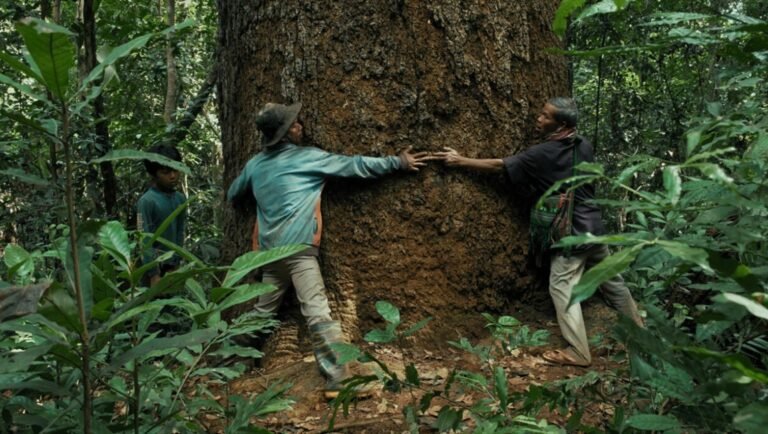
Rithy Panh, the relentless chronicler of the atrocities perpetrated by the Khmer Rouge, shifts his attention to another kind of destruction in his latest film, We are the Fruits of the Forest, one that is less dramatic but more dispersed across many years. Setting his film in the present that remains in constant awareness and conversation with the past, Panh refracts the urgently global theme of ecocide through the lens of the local erosion of the forest inhabitants’ culture. Beginning with an overhead shot of a verdant forest whose eventual destruction is already embedded in the frame through its gloomy palette, Panh pans toward the canopy, almost drawn in by the percussion accompanying the frame. The percussion forms a part of an acoustic canvas that, at least in the film’s universe, no longer exists, for Panh immediately shifts to a split-screen series of archival footages that show the ceremonies, and dances of the Bunong tribe, the arrival of their colonial overlords, their attempts at converting the locals, and, finally, the destruction of forest by the succession of wars, bombings, and Cambodian governments. The archival footage at last ends with forest fires, barren lands, private enclosures, and tree stumps as the credits roll.
This recapitulation, accelerated by the use of split-screens, condenses an entirety of history of culture and destruction through fragments available as footage, to the extent that it almost feels as if Panh has exhausted everything he wished to say in this 2-minute segment that serves as a warning because of its breakneck pace. However, the arrival of the title card is met with the arrival of a man, clad in a blue and orange jacket and cargo pants, posing alongside the ravaged landscape. A voiceover narration begins, accompanying the man and his tribe even if we never see him speak. The destruction is seen and summarized, but Panh recognizes the need to preserve and contextualize the archival footage, even as the jaws of destruction in the form of corporations are closing in. We are the Fruits of the Forest is this man’s, whose name we do not know, and by extension, his culture’s, lament, a lament for the loss of a forest whom they revere as gods (though they do hunt and cut trees down, but at nothing close to the catastrophic pace of colonizers and corporations ), and the loss of their existence, history, and independence as they are displaced to the margins of their ancestral land and governed by the dictates of bank documents.
The narrator’s family are among the few in his village who have resisted the pressures to convert to Christianity, and therefore function as an important source of “living” history. The narrator becomes our guide to remind us of a rapidly eroding past, detailing their rituals, ceremonies, and beliefs, while at the same time, bemoaning his actions that run contrary to his beliefs, such as his woodcutting, which helps him clear some of his debts. His dispirited tone infuses an aura of pessimism into the film, with Panh continually showing the despoiling in case we ever needed reminding. Panh, like his narrator, feels that these last acts of resistance are no more than sighs of a defeated community, and his duty, as a filmmaker, is to record them for posterity. The only sign of hope is the dedication of the narrator and his family, but when their children are already immersed in the world of phones and have no visual correlatives for their older generation’s recollections, what else remains but to record their lives?
Fortunately, Panh shows some dedication to the filming of their rituals, particularly in their acts of labor. He lights his film up with lively close-ups of faces and hands cooking, harvesting and praying, even as he devotes the same treatment to other labors forced upon them by their condition, such as hunting with guns and chopping trees. His split-screen gambit continually resurfaces, both as a means of juxtaposing the past and present and to lyrically link their traditions with the movements in nature — the rustling of grass in the wind, the shifting of the clouds, and the rising of the sun. But they are also employed in their strict, functional sense, chronicling a simultaneity of actions from different angles to further illuminate their traditions. Though overwhelmed by loss, the best scenes in We are The Fruits of the Forest let the cries of the Bunong tribe resonate, serving as a document for future generations to take up.
But sadly, this mood doesn’t sustain, as Panh singlehandedly matches the narrator’s pessimism with shots that puncture the slightest glimmers of hope. Panh doesn’t see a future for the Bunong tribe in this economic landscape, so he relentlessly underscores the destruction, seldom letting their culture linger. The only way out for him seems to be to reclaim the past, which, as he rather monotonously indicates through an archival video of a Bunong woman that repeatedly flickers on the screen, haunts the landscape of the present with its suppressed cries. However, the present, no matter how broken, still exists and converses with the past, and this writer, for one, wishes that Panh devoted a lot more time to their wearied defiance instead of insistently telling us how doomed the situation is, an aspect that was made amply clear in the first two minutes of the film.
Published as part of Cinéma du Réel 2026 — Dispatch 1.
Comments are closed.