
Chronovisor
Even when Jorge Luis Borges wrote screenplays, they weren’t necessarily “Borgesian” — not, that is, distilled into the particular pleasure of following one of Borges’ threads through maybe-real obscure texts to arrive at a sort of academic horror. His screenplay for Hugo Santiago’s Invasión (1969) is a masterful and surreal political thriller, and his work for the same director’s Les Autres (1974) certainly has tell-tale philosophical twists on an otherwise simple mystery story. But any fan of Borges will tell you there is nothing quite like the thrill of falling into his particularly literary labyrinths.
The tantalizing journey from one undiscovered bit of research to the next we now colloquially refer to as “rabbit holes” — a term which itself has a tinge of the fantastical, being named after the rabbit hole that shoots Alice into her Wonderland. But Borges is a macabre guide for his journeys, as his worlds promise forbidden knowledge; inaccessible knowledge; knowledge incompatible with reality as we know it; knowledge, usually by happenstance, safeguarded by curators and clerks who know not what they possess. But the distinct pleasure of a Borges story is not merely in the tale of academics lost in archives, but the text itself; the reader is invited on the same journey as the story’s protagonist, if there even is one. That’s what shoves the author’s works into that always uncomfortable, always inaccurate category of being “unadaptable” — a category filmmakers should always take as a challenge.
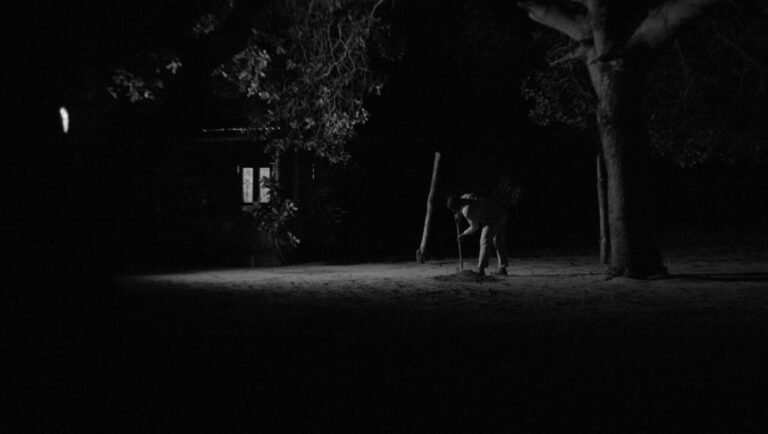
Chronovisor has taken up that challenge and has successfully earned the descriptor “Borgesian” by doing something so simple yet so daring: showing the text. The film itself is mostly just text, and the audience is simply expected to read along with the protagonist, no matter if the text is in Latin, Greek, Italian, French, or English. Consequently, it’s also one of the most formally inventive and genuinely thrilling new movies in years.
The story’s half the fun. A Columbia University philosophy professor (who possibly lies about her ever-increasing credentials throughout the film), Béatrice Courte (Anne-Laure Sellier), during one of her nights researching the neurological basis for memory, comes across a remarkable claim. A Benedictine musicologist named Pellegrino Ernetti had discovered, parallel to his research in musical decay, that memory itself still exists as waves in the ether, and we’d simply need a device, like a radio or television, to tune into these waves. He also claimed to have invented this very device, the Chronovisor, and has since pieced together a proto-Indo-European language and witnessed the crucifixion of Christ. It’s a scifi-noir setup straight out of Philip K. Dick, and Béatrice is hooked, though she provides no commentary; only the rare reverse-shots revealing her fluttering eyelids provide a window into her thinking. Well, that and her constant late-night visits to New York City’s vast libraries. Through her research we find out about Ernetti’s colleagues and detractors, the subsequent scandals and forged evidence of the Chronovisor, the secret truths behind those scandals and forgeries, and the many visits Ernetti made to the Vatican. Slowly, Courte runs out of these primary sources and can only go further by getting directly in contact with those who knew him, all of whom offer stern warnings about the authorities who silenced Ernetti and even sterner warnings about the Chronovisor itself. She ignores them and proceeds.
What’s even wilder is that it’s all true. Well, at the very least, Pellegrino Ernetti was a real Benedictine musicologist who really did claim to have invented the Chronovisor, exactly as the film states. From what I can tell, the primary sources — in French, Italian, English — are real as well. (I found the Ernetti-directed Gregorian chant album featured in the film for sale for under $10 on Discogs; the last seller being listed on March 3 of last year made me want to go through a Courtean dive of my own to see if it was sold to the production.) This is all to say that, while this would have still been a thrilling tale if invented from whole-cloth, it’s an even more fascinating recycling and remixing of archive materials, taking what the world once considered a simple hoax and shifting the details ever so slightly to create a plausible conspiracy.
But plenty of films about forbidden research tell a similar tale: The Name of the Rose, The Ninth Gate, even Eyes Wide Shut (which this film gives a nod through its slow hood-mounted driving sequences through Central Park). What makes Chronovisor special is its stubborn refusal to pry away from the research itself; we’re stuck in Courte’s brain as she reads through old academic journals and orders more. To help guide us through the paragraphs of text, only certain selections are highlighted with superimposed (and typeface-correct) glowing text, as if the good bits are adorned with a halo. This angelic force also translates those texts not in English and sometimes wipes away the dense paragraphs around it.
But this process is not done haphazardly; there’s a rhythm to how and how often the text is revealed. As Courte discovers more haunting passages, the score swells and the text is reduced to a single word in the frame, progressing quickly through one of Ernetti’s more startling admissions and repeating, remixing key words in a fashion similar to Hollis Frampton’s poetic structuralist work Zorns Lemma (1970). Phone calls are accompanied by found footage video of unsettling subjects: a séance, a funeral, and a trek through rural Portugal that should probably remind me of Jem Cohen or another classic work of the avant-garde, but instead kept bringing to mind that Mexican news broadcast in Signs (2002). Memory is a funny thing.
Even footage of Béatrice herself, footage that almost operates only as establishing shots here, are shot in low light and on the intimate grain of 16mm. Warm golden light illuminates her lone desk in a research library; a cold blue lights up only her face while using the library’s old VCRs in darkness. Even the endless shots of text on paper are carefully photographed to replicate reading under those signature library lamps. And then there’s a Chronovisor itself, with its otherworldly RGB phosphor dots approximating figures and voices indistinguishable from the more abstract works of Nam June Paik or other early video artists. The text, the images of Béatrice, the Chronovisor: all three elements are shot as if making three different experimental films, but the narrative along with the omnipresent and at times overwhelming Gustav Holst score lend coherence and a deceptively simple beauty to the whole project.
Chronovisor is many things: a nod to the excellent (and excellent-looking) libraries in New York City, an accurate portrayal of the exhilarating journeys that research into niche subjects can lead you through, and a structuralist film disguised as a scifi-noir — or vice versa. But, in the way that I’m always impressed with a successful hangout film, a genre that has no familiar structure or dramatic moments to grab the audience’s attention, the best part of watching Chronovisor is to witness it accomplish so much with so little. For, just as Michael Snow’s Wavelength can be facetiously referred to as “just a zoom,” or, a much more apt comparison, Chris Marker’s La Jetée can be deemed “just a few still pictures,” Chronovisor should be cheekily celebrated as masterwork of “just text.” — ZACH LEWIS
Pillion
Reflecting on the publication of his novel Box Hill: A Story of Low Self-Esteem, Adam Mars-Jones noted that he intended his darkly humorous narrative of a manipulative dom-sub relationship as a riposte against the “shallow mainstream tolerance” of readers who treat queer people a touch too delicately: “How about a level playing field? Gay people can be perfectly horrid.” Writer-director Harry Lighton recently adapted Mars-Jones’ novel as the film Pillion, and he landed somewhere rather different despite maintaining the core narrative. Lighton, instead of focusing on moral murkiness, emphasized the submissive protagonist’s “stubborn optimism” to actor Harry Melling, and described Joachim Trier’s winsome and crowd-pleasing The Worst Person in the World as a source of tonal inspiration. Lighton has transmuted Mars-Jones’ exploration of abjection, then, into a “dom-com” (as A24 has repeated in Pillion’s marketing materials). The relatively lighter tone has certainly aided Pillion’s success thus far, and while a bit of Box Hill’s transgressive edge has necessarily been sanded off, Lighton’s film engages as a narratively taut, emotionally grounded chronicle of personal growth through kink.
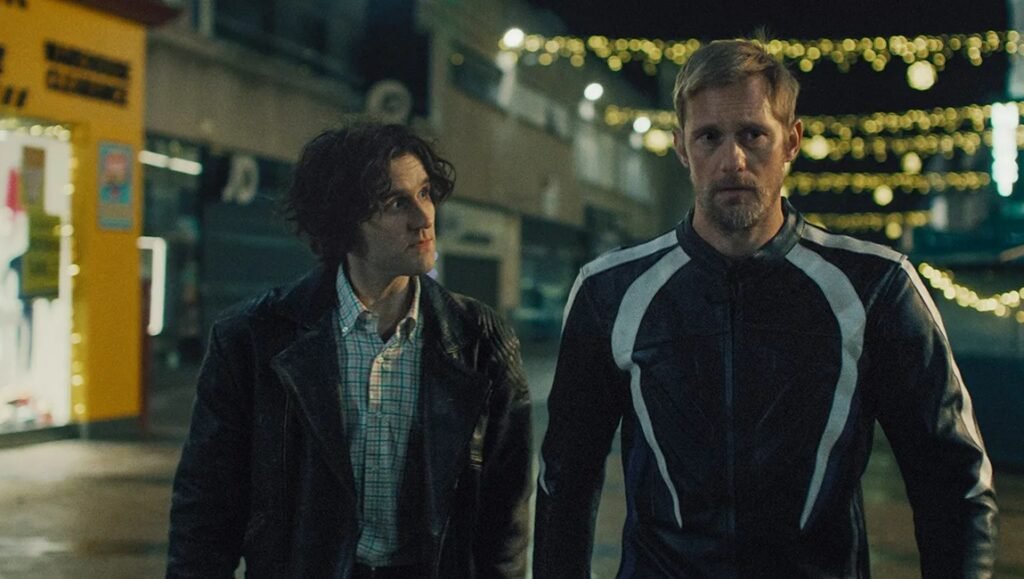
Melling plays Colin, a wallflower in his 30s who lives with his parents in the suburbs of London. He has no social life to speak of, and seemingly only goes out to clock in at a thankless job at a parking garage and to sing in a family barbershop quartet. A chance encounter with the devastatingly handsome Ray (Alexander Skarsgård) redirects Colin’s life. Ray, who belongs to a gay biker group, takes Colin under his wing as his submissive. Colin has no experience and Ray has no patience to explain. Rather, the taciturn Ray simply gives Colin commands — ranging from “cook dinner” to “buy yourself a butt plug” — and Colin, hungry for Ray’s attention, fulfills each of them with increasing fervor. Colin soon learns that he has a self-professed “capacity for devotion,” and Ray comes to rely on Colin’s presence. Colin takes pride in his role as a submissive, and by fulfilling Ray’s demands, he actually grows in confidence. Yet Colin eventually realizes he needs more from his relationship than just orders to obey, and he consequently begins to ask more of Ray emotionally than he is willing to give.
Lighton illustrates not only a psychologically intense relationship, but also the broader world of kink and fetish that Ray and Colin are enmeshed in. Ray and Colin’s roleplay — which, to be clear, goes far beyond just play — is the nexus, but Lighton also lingers on tight wrestling singlets, bespoke leather biking suits, and bulky chain necklaces. All of this is second nature to Ray, but revelatory to Colin, particularly as he becomes part of Ray’s social group of fellow kinky bikers. This group, consisting of actual members of the Gay Bikers Motorcycle Club and, in a featured role, Jake Shears of Scissor Sisters, represents a broader camaraderie, and a greater diversity of both physicality and kinks (take, for instance, a sub who sports a pup hood and a chastity cage, and a dom who uses a cane for mobility and wields it with casual authority).
The actual bikers sometimes threaten to upstage the professional actors at the film’s center, but Melling and Skarsgård both anchor the film with focused and energetic performances. Skarsgård plays his part at an imposing remove; his Ray lords his physique and stature over Colin and casually deploys his power with laconic utterances. Melling, in a precise contrast, perpetually gazes up wide-eyed at Skarsgård like a dog begging for a bone. Yet each actor becomes truly compelling when their roles take on unexpected complications: Skarsgård plays the secretive Ray’s rare moments of emotional vulnerability as if experiencing a glitch in his system, and, in a key moment, Melling unleashes his long-repressed need to assert his own agency in a blistering torrent.
Ray, ultimately, proves both impetus and obstacle for Colin’s self-discovery. Colin becomes a livelier, more fulfilled person after devoting himself to Ray, but Ray’s aversion to emotional intimacy spurs Colin to realize that he needs balance in his relationships — perhaps more like those enjoyed by the rest of the biker group, who seem to be happier than Ray allows himself to be. There is a touch of didacticism to Pillion’s ultimate thematic conclusions; for all intents and purposes, Lighton shapes Colin’s arc to illustrate both unhealthy and healthy models of kinky relationships. Yet Lighton takes such clear pleasure in lingering within the contradictions of Ray and Colin’s bond — imbalanced and fulfilling, raunchy and sweetly intimate — that the conclusion does not feel forced. If Mars-Jones composed a compelling literary work that dove into the darker corners of gay life, Lighton uses the same material to build a story of unconventional self-actualization. It’s to the director’s credit that, in uncovering an optimistic take on thorny narrative material, he manages to do so with both sexual frankness and genuine warmth. — ROBERT STINNER
ChaO
Chaos reigns in Yasuhiro Aoki’s anarchic, wildly imaginative feature directorial debut ChaO, a whirlwind exploration of the breadth of storytelling potential in animated film. Almost assaultively vibrant in its bright colors, fast pace, fantastical elements, and bold disregard for conventional narrative style and structure, it’s a somewhat disorienting experience to behold, and perhaps lacking some depth. But Aoki’s inventiveness extends to all aspects of his creation, and, while said invention may be of value in and of itself, its expert execution is where ChaO’s real value lies.
Even the movie’s ostensibly simple plot is rendered complex through the manner of its telling. ChaO opens with two fables, both told briefly, before revealing them to be the contents of a book, read by Juno (Shunsei Ôta), a journalist running late for a high-profile interview opportunity in a fantasy future where humans and merfolk live side by side. When he misses his gig, he happens upon a juicier scoop, spotting a ship worker he recognizes as Stephan (Ouji Suzuka), a man whose history was crucial to the societal integration of the people of both land and sea. Stowing away on his ship, he seizes the chance to speak to Stephan and get the inside track on his story.
From two introductory fables, ChaO passes through what we eventually understand to be the framing device of Juno’s tale, into Stephan’s tale. Now a humble man living an apparently modest life at sea, he was once an even humbler man working for Shanghai’s pre-eminent shipping company, when a freak accident saw him become inexplicably betrothed to ChaO (Anna Yamada), the princess of the sea. Despite his personal objections, political tensions force Stephan to endure this difficult romance and its complicated courtship — ChaO appears above sea level in fish form, comically unaccustomed to the landlubbers’ way of life, and her enthusiastic affection for the anxious, reluctant Stephan is scarcely returned. The particulars of this courtship occupy the majority of the movie’s action — in essence, a pretty ordinary rom-com premise, albeit one with quite an outlandish twist.
But ChaO isn’t a pretty ordinary movie. Aoki’s style is frantic, subversive, and resolutely chaotic. He lingers on quirky incidental details, sometimes crude, sometimes just outright bizarre, and minimizes tonal and narrative clarity and coherence. He cuts between stories and time periods with no warning, and the movie has a distinctly syncopated rhythm, accentuated by its dense visual style and its ambitious juxtapositions of different genre tropes and motifs. In individual shots, he combines tense stillness and furious action, heartfelt emotion and cheeky humor, pausing to hone in on one oddity or another. ChaO has a most singular timbre, and Aoki’s unique creative choices aren’t just entertainingly curious — some possess a peculiar sense of poetry, even if their intention isn’t always obvious, such as the pneumatic drilling that interrupts and completely drowns out a pivotal angry outburst from Stephan.
It’s thoughtful details like this that prevent ChaO from existing as merely an exhausting, if impressive, display of rabid imagination. Once it reaches its final act, and an element of mystery has finally contributed some tension, and thus purpose, to its otherwise meandering plot, its structure begins to make sense with an extended flashback — a journalist writing an article must operate like a detective, working backwards through their story/case to discover its truth, and ChaO’s reverse structural chronology functions similarly. Ultimately, the mystery isn’t quite as original as the stylistic verve with which Aoki has saturated his movie, though he uses it to imbue it with sentiment, and he’s moderately successful with this attempt. If it’s not exactly moving, it’s at least a little touching. But it’s rare to see a director, least of all one making their first feature, have so much success with so many new proposals, and rare to see them coalesce so seamlessly into a satisfying whole. This is a thrilling movie, burgeoning with vivid passion and uninhibited abandon, and a wondrous celebration of animation. — PADAÍ Ó MAOLCHALANN

The Prophet
Long takes involving medium-to-wide shots of landscapes have nearly cemented themselves as festival-cinema staples, so it’s not surprising to see an IFFR Tiger competition film, O Profeta, open with that. But Ique Langa, the film’s director, already hints at something aslant in his symmetrical shot of trees swaying in the wind as a funeral procession gradually enters the frame. The height of the trees naturally dwarves the people absorbed in their rituals, but Langa accentuates this feeling further through his narrow aspect ratio, almost imprisoning his actors between the tree trunks. Langa continues to build on this tension in his following scenes, introducing his protagonist, Pastor Hélder (Admiro De Laura Munguambe), as an awkwardly bobbing head at the bottom corner of the frame. Leisured long takes are suddenly splintered by shots of Hélder’s quivering fingers as he reads the Bible, or cuts to eyes and hands during conversations with his wife (Nora Matevel). Within 10 minutes, Langa has established Hélder’s spiritual crisis just through minor disruptions in his long takes and displacements of bodies, setting the tone for the rest of this film on the clash between the relatively new religion and the timeless landscape. The walls are closing in on Hélder, with even his mundane actions, which Langa films in tight, claustrophobic shots, being burdened by a primordial void that is gradually enveloping him.
The rest of the film, however, doesn’t sustain this invention, opting instead for a grand allegory that unfolds as a cautionary tale. An acquaintance suggests witchcraft as a solution, and Hélder takes his advice by following the common path of using the old to revitalize the new. A treacherous tangle of weeds, vines, leaves, and thorns foreshadows the perils of his path to renewal, and the encounter with the “witch” flips the film into a rather one-note allegorical drama, decorated with attractive shots that increasingly dazzle rather than introspect.
Langa’s stark black-and-white shots, which initially are very effective in grounding Hélder’s helplessness, soon devolve into an exoticizing, elemental portrayal of witchcraft and its alluring dangers. Langa mentioned that one of his themes was on the dangers of opening new doors in an interview, and the procession of images and events following Hélder’s encounter are deployed merely in service of this theme, in spite of his assured virtuosity. Initially buoyed by his witchcraft-aided success that enhances his reputation and church attendees, Hélder is naturally tormented by frightening visions of this witchcraft and its charged histories. But instead of reflecting on the commingling of the “old” and “new,” Langa merely employs the myths of the land for arty, but empty, surrealism that reduces the witchcraft to mere caricature. The wide-eyed witch even cackles and grins with cunning glee as she lords her triumph over Hélder. Langa’s controlled pacing and his sense of conflicting temporalities brought about by weighted cuts and exquisitely crafted extended dissolves become rather stale as his overdetermined theme suffuses his frames, leaving little room for questions and contradictions that initially arose. His final shot, though rather explicitly emphasized by a voiceover, tries to correct for the lack of reflection by reframing the exoticism into something more radical, but after the relentless straitjacketing of ideas raised in Langa’s excellent initial sequences into a grand, but hollow, allegory, this is merely a limp resuscitation. — ANAND SUDHA
Fuori
Fuori, the latest film by Italy’s Mario Martone (Nostalgia, The King of Laughter), is curiously inert, especially when you consider that most of the film features its two main characters wandering through Rome. This is a noncommunicative film, which may be a problem of cultural translation. It’s about the late Italian writer Goliarda Sapienza, played by Valeria Golino, and perhaps Fuori plays better if the viewer has read Sapienza’s work or even knows who she was. Born to a radical family (at one time she and her siblings were babysat by Gramsci!), Sapienza fell on hard times as her expansive modernist-feminist novel, The Art of Joy, was summarily rejected by the Italian literary establishment. Reduced to stealing and fencing jewelry from an old friend, Sapienza was arrested in 1980 and sent to Rebibbia Prison.
Goliara’s post-prison life is the primary focus of Fuori, although flashbacks to her time inside pop up throughout the film. They are brief, random, and unbidden, and Martone’s failure to integrate them speaks to the broader formlessness of the film. The title, Fuori, translates as “out,” and comes from a chant the inmates bellow when one of their number, Barbara (Elodie), fakes a suicide attempt. Conceptually, the title plays on Sapienza’s obsession with her incarceration and her emotional attempt to continue that life by remaining in contact with other former inmates on the outside. “With those women in Rebibbia,” she tells her husband (Corrado Fortuna), “I felt an unbelievable, unimaginable freedom.”
If that sounds like the upper-class writer is romanticizing her time in lockup, Fuori doesn’t seem to mind. The film takes Goliarda’s rather opaque, observational perspective as its dominant viewpoint, and so we never really understand who this woman is or what motivates her. Again, this could be a problem that is obviated for European viewers more familiar with Sapienza than this writer. Nevertheless, one gets the sense that Martone staked all his chips on Golino’s skill and charisma, assuming it would carry the day.
It almost works. Golino has always been a magnetic screen presence. She remains stunning at age 60, a fact that Fuori refuses to let the viewer forget. By the third nude scene, one almost gets the sense that Golino may have strong-armed the director into showcasing her physical attributes. Then again, it could be Fuori’s way of punctuating the strange subtext that is only spoken aloud in the final few minutes of the movie.
Golino’s co-star, Matilda De Angelis, plays Roberta, a young criminal who befriended Goliarda during her stretch in jail. In a couple of scenes, Fuori hints at the situational lesbianism typical of the women-behind-bars genre, but mostly the film ignores any gratuitous action. It’s treated matter-of-factly. However, as we observe Goliarda and Roberta’s post-prison adventures, one starts to sense that something more complicated is afoot. As it happens, Roberta is attracted to Goliarda, but also sees her as a surrogate mother. This confusion is in itself a turn-on for the younger woman, but although Goliarda rejects her more overt advances, we never really perceive how any of this affects her.
This lack of psychological shading makes the issue of forbidden sexuality seem to come out of nowhere, something Fuori is ill-equipped to really handle. Again, this points to the film’s broader deficits. If we needed to engage with Sapienza’s literary output to fully understand the character we’re seeing, Martone could’ve sent along a reading list. Then again, this would only point to the relative fruitlessness of Fuori as a cinematic endeavor. It has all the contours of a high-toned European biopic, but it unfortunately insists on keeping the viewer on the outside. — MICHAEL SICINSKI

Return to Silent Hill
Film adaptations of video games can be a dicey proposition. Part of the issue lies in the elements getting lost in translation: the inherently immersive factor of a game rarely makes a successful leap to the screen, and most video games are already so vividly realized that casting real actors against largely CGI backdrops for a movie version feels awfully redundant and pointless. Furthermore, the tenets of the respective media are commonly used as a cudgel against the other, as when Hideo Kojima presents a feature-length cutscene that occasionally makes one wonder if he really should be working in another industry altogether, or when James Cameron’s latest billion-dollar return to Pandora is casually dismissed by naysayers as looking and feeling too much like a video game. Many have tried, and yet the two formats never seem quite fit for marriage, with the most financially successful endeavors — your Sonic the Hedgehogs, your Minecrafts, your Detective Pikachus — are really just glorified cartoons, products for children that lean heavily on their sugar rush aesthetics while expanding a narrative lighter than balsa wood.
All of this is to say that 2006’s Silent Hill serves as the rare success in memorable video game adaptations. Based on the Konami franchise of the same name, the Roger Avary-penned, Christophe Gans-helmed film lacks much in the way of a cogent plot, but it more than makes up for it in terrific atmosphere, beautifully capturing the game’s creepily effective ambience, aided in no small part by the tremendous scoring efforts of Akira Yamaoka, whose iconic music was directly ported over from the games. Silent Hill’s contemporaneous assessment was unfavorable at best, but the 20 years since have allowed for a more enthusiastic response to flourish, with the film building a cult appreciation in the meantime and emerging as something of a spooky season viewing favorite. The franchise was resurrected with a semi-belated sequel that followed in 2012, Silent Hill: Revelation, which jettisoned Avary and Gans in order to cash in on the post-Avatar 3D craze, but the effort effectively killed off any further sequel interest outright.
It seems Gans ignored the memo, however, and seemingly isn’t ready to call it a day on the franchise just yet. Having only released one other film in the two-decade interim — 2014’s Léa Seydoux-starring Beauty and the Beast — the director makes his long-awaited return to Silent Hill with, well, Return to Silent Hill. But just when it seems like there may be hope for this series in the reunion of material and filmmaker, viewers are hit with an unfortunate reality: Return to Silent Hill is a crushing disappointment, offering little in the way of compelling performances, engrossing narrative, or even a reclamation of the original’s nightmarish mood. Gans may be back in the director’s chair, but a sinking feeling builds across the runtime that perhaps this particular film franchise was indeed better off dead.
James Sunderland (Jeremy Irvine) was a once-promising artist who has fallen into a pit of despair. Still reeling from the dissolution of his relationship with girlfriend Mary Crane (Hannah Emily Anderson), James frequently finds himself at the bottom of a bottle, often causing trouble during his nights out on the town. Therapist M (Nicola Alexis) offers an ear and a dash of genuine concern, but James remains haunted by his time with Mary, which is only exacerbated by the arrival of a letter from his former lover, beckoning him to return to Silent Hill, the town where they once met and lived together. Making the trek back, James discovers the town engulfed in ash and fog, with the majority of its denizens appearing to be monstrosities who mean him harm. As James subsequently wades through the gloom, memories of his time with Mary come flooding back, and the true nature of their relationship is gradually revealed.
Sharing screenwriting duties with Sandra Vo-Anh and Will Schneider, Gans comes armed with inspiration from video game entry Silent Hill 2, arguably the greatest Silent Hill of them all. The fractured relationship between James and Mary functions as an emotional throughline in Return to Silent Hill, examining James’ grief in a hopeless place as his time in the present is punctuated by flashbacks to happier times with Mary, before everything all went wrong. Gans and co. aren’t keen on remaining entirely faithful to Silent Hill 2, however, and they instead decide to re-introduce the cult from the 2006 film as a malevolent force that violated Mary’s life, sending her and James’ relationship spiraling out of control. It’s a change that will likely leave diehard fans of the games annoyed, and that frustration won’t be helped by the screen presence of Irvine and Anderson, who share very little chemistry and are largely DOA as an onscreen couple, sapping the film of much of its would-be stakes. Return to Silent Hill seems angled to be the most heartfelt film of the franchise, but its raison d’être is totally inert, squandering any semblance of an actually provocative and energizing take on the material.
James and Mary’s failed romantic relationship makes up one half of Return to Silent Hill, which leaves the expected horror to make up the other. Sadly, the film is also lacking in this regard, as Gans offers very little in terms of new frights here, content to lamely play the hits he’s covered before. There are a few encounters with the Armless ghoul who spits up acid, and another sequence devoted to the creepy Nurses in a darkened room, but they are largely missing any juice. Even Pyramid Head, making his requisite appearance as an implacable behemoth, is essentially reduced to a cameo here, popping in briefly to bust some heads before duly exiting the film. Return to Silent Hill‘s digital glaze also flattens its atmosphere and prevents any conjuring of the flavor that made the 2006 film pop; in that absence, as all else fails, Gans instead turns to an unfortunate ear-splitting sound design to jostle viewers in their seats. Perhaps most criminal, however, is the waste of Yamaoka’s score, which goes by almost completely unnoticed this time around, offering none of the maestro’s memorable orchestrations (save for one, belatedly arriving as the lead out into the end credits). Return to Silent Hill is left only to exist as a case study in diminishing returns and exsanguinated genre, sure to disappoint fans and newcomers to the series alike. — JAKE TROPILA
Lone Samurai
If you like Bone Tomahawk, Lucio Fulci’s Conquest, samurai poetry, and Yayan Ruhian being cool as hell, then there’s a new movie just screaming your name. Lone Samurai dropped unceremoniously on VOD in the U.S. last December, but it’s playing at the 2026 International Film Festival of Rotterdam, and with Well Go USA soon releasing the film on home video, maybe it will find the cult audience it’s destined for. Then again, the same could have been said about Marko Zaror’s similarly spiritual martial arts film Fist of the Condor, and that has seemingly yet to materialize. But we can always hope.
A prologue introduces us to an unnamed samurai who takes part in the second battle to stop the invading Mongol fleet in the 13th century, the one that, thanks to a timely storm that destroyed the Khan’s ships, gave rise to the concept of the kamikaze, or “divine wind.” A narrator asserts that, in addition to the wind, the Japanese also sent a select group of samurai onto the Mongol ships to kill everyone they found there. One of these samurai, played by Okinawan actor Shogen (star of Brillante Mendoza’s Gensan Punch), awakens on a deserted beach, with a piece of boat jammed in his thigh. The first third of the Lone Samurai follows him as he hobbles around the beach, gathers various materials, writes some poetry, and has visions of his wife and children, all on his way to find a good spot to commit seppuku.
But just before he’s able to complete his mission, he’s suddenly captured by a tribe of cannibals. The second third of the film, then, finds him trapped in a cave, drugged, and witness to the horrors of human sacrifice. Indonesian martial arts legend Yayan Ruhian appears as a kind of shaman, and Rama Ramadhan, a veteran stuntman from such films as The Night Comes for Us and The Raid: Redemption, plays the tribal leader. This middle section of the film plays as a horror movie, the spiritual opposite of the movie’s beautiful opening section. Proceedings here remain locked in a torchlit cave, in contrast to the first third that leaves viewers marveling at forests and waterfalls and sunsets. We see nature, and then we see what humanity has chosen instead.
Lone Samurai’s final third follows the samurai’s escape and his methodical cutting down of his enemies. This is where almost all of the film’s action lies, and it’s up to the standards set by previous Indonesian gems featuring Ruhian and Iko Uwais (whose company was one of Lone Samurai’s producers). The action here bears some resemblance to Crazy Samurai Musashi, in that it is basically just 30 minutes of one dude slicing up a near endless supply of other dudes, but American director Josh Waller — more successful lately as a producer (Mandy, A Girl Walks Home Alone at Night) his last feature as a director was the 2015 Zoe Bell vehicle Camino — and the stunt team give it more variety in weapons and settings (watch out when the samurai gets both his swords back!). It all builds quite nicely to the final two fights with Ruhian and Ramadhan, with the different styles employed by the key opponents requiring Shogen to adapt. Speaking of, Shogen himself is a magnetic presence, carrying the film’s almost completely non-verbal opening third as well as the relentless action of the finale. His samurai is a poet-warrior in the classic sense, a fully-realized version of an idealized character. In the end, Lone Samurai uses the right recipe to deliver everything one wants in a low-budget genre film: it’s short, nasty, pretentious, and exhilarating. — SEAN GILMAN
Comments are closed.