
Reflecting on the publication of his novel Box Hill: A Story of Low Self-Esteem, Adam Mars-Jones noted that he intended his darkly humorous narrative of a manipulative dom-sub relationship as a riposte against the “shallow mainstream tolerance” of readers who treat queer people a touch too delicately: “How about a level playing field? Gay people can be perfectly horrid.” Writer-director Harry Lighton recently adapted Mars-Jones’ novel as the film Pillion, and he landed somewhere rather different despite maintaining the core narrative. Lighton, instead of focusing on moral murkiness, emphasized the submissive protagonist’s “stubborn optimism” to actor Harry Melling, and described Joachim Trier’s winsome and crowd-pleasing The Worst Person in the World as a source of tonal inspiration. Lighton has transmuted Mars-Jones’ exploration of abjection, then, into a “dom-com” (as A24 has repeated in Pillion’s marketing materials). The relatively lighter tone has certainly aided Pillion’s success thus far, and while a bit of Box Hill’s transgressive edge has necessarily been sanded off, Lighton’s film engages as a narratively taut, emotionally grounded chronicle of personal growth through kink.
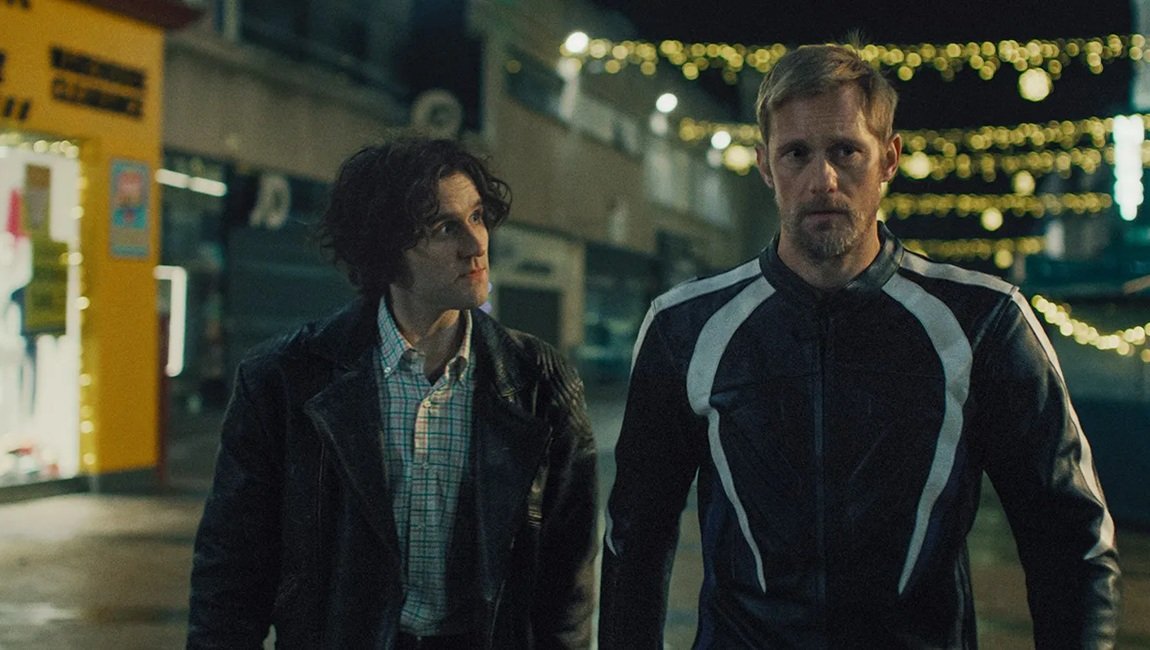
Melling plays Colin, a wallflower in his 30s who lives with his parents in the suburbs of London. He has no social life to speak of, and seemingly only goes out to clock in at a thankless job at a parking garage and to sing in a family barbershop quartet. A chance encounter with the devastatingly handsome Ray (Alexander Skarsgård) redirects Colin’s life. Ray, who belongs to a gay biker group, takes Colin under his wing as his submissive. Colin has no experience and Ray has no patience to explain. Rather, the taciturn Ray simply gives Colin commands — ranging from “cook dinner” to “buy yourself a butt plug” — and Colin, hungry for Ray’s attention, fulfills each of them with increasing fervor. Colin soon learns that he has a self-professed “capacity for devotion,” and Ray comes to rely on Colin’s presence. Colin takes pride in his role as a submissive, and by fulfilling Ray’s demands, he actually grows in confidence. Yet Colin eventually realizes he needs more from his relationship than just orders to obey, and he consequently begins to ask more of Ray emotionally than he is willing to give.
Lighton illustrates not only a psychologically intense relationship, but also the broader world of kink and fetish that Ray and Colin are enmeshed in. Ray and Colin’s roleplay — which, to be clear, goes far beyond just play — is the nexus, but Lighton also lingers on tight wrestling singlets, bespoke leather biking suits, and bulky chain necklaces. All of this is second nature to Ray, but revelatory to Colin, particularly as he becomes part of Ray’s social group of fellow kinky bikers. This group, consisting of actual members of the Gay Bikers Motorcycle Club and, in a featured role, Jake Shears of Scissor Sisters, represents a broader camaraderie, and a greater diversity of both physicality and kinks (take, for instance, a sub who sports a pup hood and a chastity cage, and a dom who uses a cane for mobility and wields it with casual authority).
The actual bikers sometimes threaten to upstage the professional actors at the film’s center, but Melling and Skarsgård both anchor the film with focused and energetic performances. Skarsgård plays his part at an imposing remove; his Ray lords his physique and stature over Colin and casually deploys his power with laconic utterances. Melling, in a precise contrast, perpetually gazes up wide-eyed at Skarsgård like a dog begging for a bone. Yet each actor becomes truly compelling when their roles take on unexpected complications: Skarsgård plays the secretive Ray’s rare moments of emotional vulnerability as if experiencing a glitch in his system, and, in a key moment, Melling unleashes his long-repressed need to assert his own agency in a blistering torrent.
Ray, ultimately, proves both impetus and obstacle for Colin’s self-discovery. Colin becomes a livelier, more fulfilled person after devoting himself to Ray, but Ray’s aversion to emotional intimacy spurs Colin to realize that he needs balance in his relationships — perhaps more like those enjoyed by the rest of the biker group, who seem to be happier than Ray allows himself to be. There is a touch of didacticism to Pillion’s ultimate thematic conclusions; for all intents and purposes, Lighton shapes Colin’s arc to illustrate both unhealthy and healthy models of kinky relationships. Yet Lighton takes such clear pleasure in lingering within the contradictions of Ray and Colin’s bond — imbalanced and fulfilling, raunchy and sweetly intimate — that the conclusion does not feel forced. If Mars-Jones composed a compelling literary work that dove into the darker corners of gay life, Lighton uses the same material to build a story of unconventional self-actualization. It’s to the director’s credit that, in uncovering an optimistic take on thorny narrative material, he manages to do so with both sexual frankness and genuine warmth.
DIRECTOR: Harry Lighton; CAST: Alexander Skarsgård, Harry Melling, Douglas Hodge, Lesley Sharp; DISTRIBUTOR: A24; IN THEATERS: February 6; RUNTIME: 1 hr. 46 min.
Originally published as part of IFFR 2026 — Dispatch 1.
Comments are closed.