
If you’re looking for a supposed “fresh set of eyes” in your criticism, I am the ideal audience for Mortal Kombat II. I haven’t seen its predecessor from 2021, or any of the other adaptations that exist out there, nor have I played the games beyond its couple of characters that are featured in Injustice 2. In other words, I went into this film with absolutely zero expectations — that is, until I got to the theater for a press screening. Always punctual, I’m outside enjoying the sun in Union Square 30 minutes ahead of showtime. I check my email, pretending I’m on my phone for something important so nobody will come up to bother me as I kill time. Suddenly, a new message from Warner Brothers: the screening location has changed to Times Square. That’s another swipe at the turnstiles for a whopping 3 dollars. Also, Times Square might as well be the ninth circle of hell — not unlike Scorpion’s version of it in this film, although I’d argue that’s more desirable to the tourist-scarred sprawl of Midtown Manhattan.
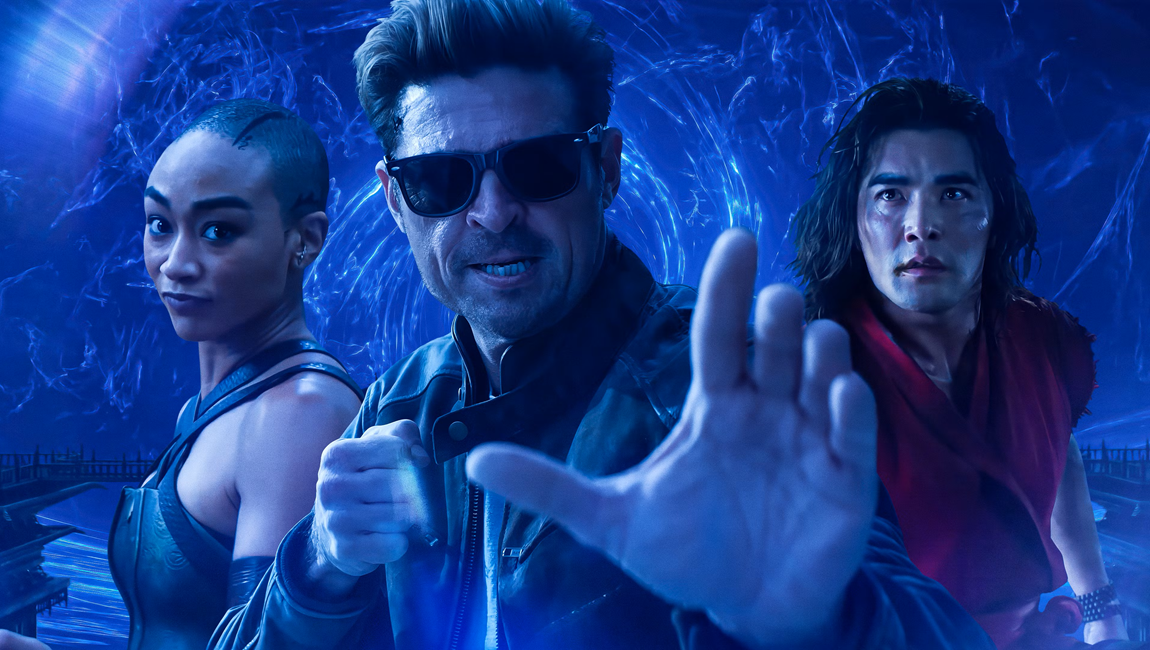
I was feeling pissed, petty, poised to draw blood in my critique of Simon McQuoid’s sequel, but what ensued over the next 116 minutes was something altogether worse: Mortal Kombat II is, well, somewhat enjoyable. The film delivers on the expectedly kinetic fight choreography, the fantastical arenas for (mostly) one-on-one skirmishes, and a soup of unintelligible mythology that serves only as a device to help motivate one character to obliterate another. Why is this so bad, then? Well, because it merely… delivers. Nothing more. It provokes an observation of “ah, that’s pretty cool” here or an “oof, that must hurt” there, and it elicits a few chuckles targeted at the film’s overshadowing star, Karl Urban, playing the gifted martial-artist-turned-Hollywood-actor Johnny Cage. His smug humor here immediately resembles Chris Evans in Scott Pilgrim vs the World, and provides some welcome relief from the patience-testing exposition that fills the downtime between fight sequences.
Bjarke Liboriussen recalls, specifically in reference to McQuoid’s 2021 film, that such sequences “might function as a prop that reactivates remembered gameplay experiences, either because the viewer makes a conscious effort to retrieve long-term memory or because the memory is triggered automatically during viewing.” But what happens when a film adaptation forgets to do anything besides deliver on those props, when all we get on screen is essentially detritus of a video game that some of us have played more than others (if at all). And yes, that punctuation is intentionally a period rather than a question mark.
Everything in Mortal Kombat II revolves around a Tesseract-adjacent amulet, and characters spew background stuff about it that could easily have been pulled from any recent Marvel or DC installment. And the visual texture of this film slides in comfortably alongside the anonymous aesthetics of our present day: Disney-era Star Wars, the Avengers standing heroically before a non-specific cityscape that’s supposed to resemble New York, late-stage Game of Thrones when it scaled up and quality’ed down. Mortal Kombat II could have been filmed in a data center somewhere in the Mojave, but without the cast or crew ever knowing such a landscape existed outside the windowless warehouse in which they worked. And that’s precidely the feeling evoked by McQuoid’s sequel: an un-lived-in netherspace. A world that leaves no strong feelings. In fact, this review was penned quickly after the screening ended, not because of the impending embargo lift, but because everything about it is sure to rapidly dissipate from one’s thoughts.
A film adaptation should always strive to push beyond, against, or attempt to deepen or innovate or offer something new within its source material. To the best of my knowledge, the games contain a wealth of lore, but that lore seems to have been fully lobotimized here. The extradimensional locations are static, as if embalmed within their “fight arena” trappings from the games, leaving the camera unable to explore what lies on the periphery. The masses of people who populate Shao Kahn’s captive city and Baraka’s arid village are given the faceless, dis-identification treatment that so many recent blockbusters lean into. But Mortal Kombat II‘s greatest crime is that even the easiest, most basic carryover — the defining, controversial violence of the games — is notched down via CGI. In the end, brutality is present, but never visceral.
DIRECTOR: Soon McQuoid; CAST: Karl Urban, Adeline Rudolph, Jessica McNamee, Josh Lawson, Ludi Lin; DISTRIBUTOR: Warner Bros. Pictures; IN THEATERS: May 8; RUNTIME: 1 hr. 56 min.
Comments are closed.