
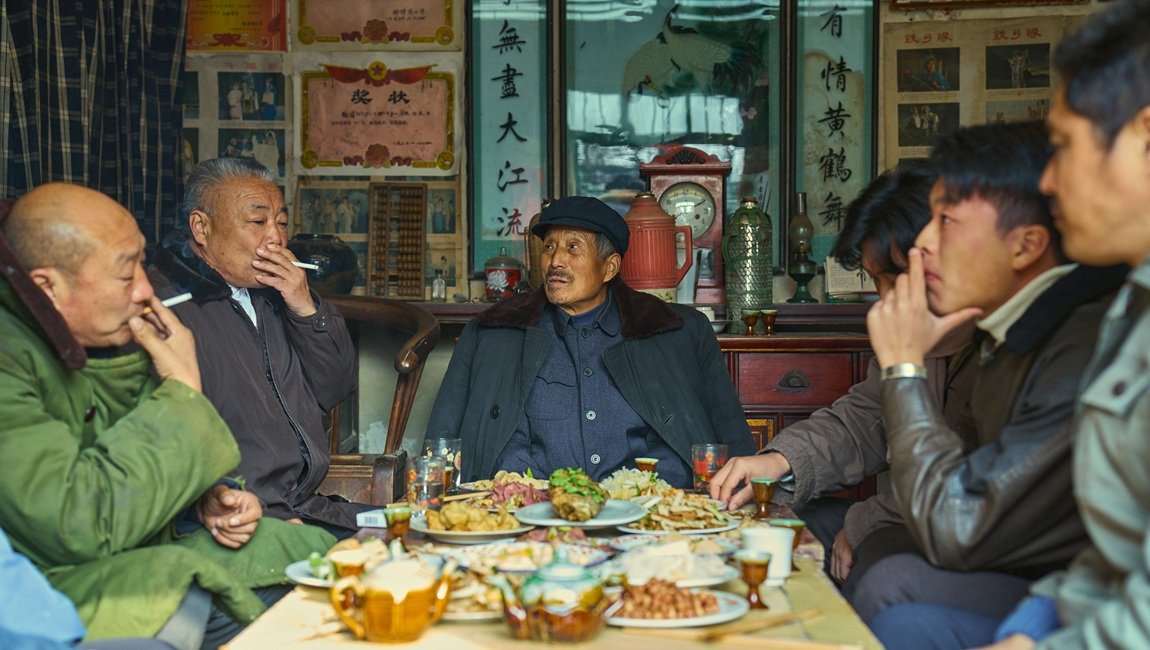
No civilization without land was the starting point of Carl Schmitt’s definition of the nomos — the measure by which land “in a particular order was divided and situated” — and, for most of human history, the organizing principle of law and labor. Amid the rapid currents of modernity, Huo Meng’s sprawling and bucolic third feature imparts a fresh if unsentimental appreciation of the earth on which societies exist and endure. Set in 1991 and taking place over the course of the year, Living the Land charts the cyclical passages of time in the rural Chinese countryside. Untouched by industrialization for the most part, the village of Bawangtai in Hunan province plays host to an agrarian economy of grain and cotton farming, with nary a paved road or a tractor in sight. Instead, oxen plough the vast green fields, and laborers of all ages and sizes help to cultivate the land, reap their dues, and inhabit their preordained roles in the life of their community.
Into this primitive landscape roams the camera, taking as its stand-in 10-year-old Xu Chuang (Wang Shang), the third son of parents who have left him in the care of relatives while they head south to the rising economic conurbation of Shenzhen. Murmurs of city life slowly but steadily creep into daily conversation, as do the village loudspeakers that signpost the wider procession of history (the Gulf War, for instance). For all its stark disconnect from the world beyond, life for Chuang is tightly regulated by both tradition and the state. Remnants of the Cultural Revolution are hinted at in the dead forefathers waiting to be exhumed and reburied in their family graves; more pressingly, the reverberations of the One-Child Policy make themselves keenly felt not least in Chuang’s presence within the village. “This is not your place,” his grandfather states, without harshness. A perennial outsider despite partaking in the rhythms of daily life just like anybody else, the boy doubles as an observer gently acclimatizing to the way of this eternal if subtly dynamic microcosm.
Huo’s observational brushstrokes neither exoticize nor valorize their subjects, and although Living the Land brims with a quiet curiosity about the many inner lives as they intersect and are interwoven, the film also gestures at the invisible and often repressive social forces tugging away at them. Chuang’s young aunt, Xiuying (Zhang Chuwen), is submitted to a state-mandated pregnancy exam and betrothed by her family to a man she does not love; even as her eyes flicker with disgust and muted resignation, no protests emanate, not least from Chuang’s great-grandmother (Zhang Yanrong), a woman who was herself sold as a child bride and did not even possess a name. There is a backwardness and insularity here, matched by a certain solidity, not quite of faith, but of duty and fate. Through our eyes, the village’s customs — both nuptial and funerary rites — may be punctured with delectable irony, tethered as they are to strictures of obligation; through a child’s eyes, they write the world anew. The myriad textures of Huo’s elegiac canvas, tracking wheat and human warmth alike under cinematographer Guo Daming’s spontaneous and leisurely compositions, come alive as elemental parts under an organic whole. Through yearly seasonal affairs, and through faces old and new, comes the realization that those who live off the land are bound, at least for a while, to survive it.
DIRECTOR: Huo Meng; CAST: Wang Shang, Zhang Chuwen, Zhang Yanrong, Zhang Caixia, Cao Lingzhi; DISTRIBUTOR: Film Movement; IN THEATERS: April 3; RUNTIME: 2 hr. 12 min.
Comments are closed.