
When a documentary’s primary source material and subject of inquiry is revealed to be vlog content, YouTube channels, and other ephemera of pre- and early-aughts Internet culture, that’s either a serious omen or a cause for relief. This writer is happy to report that Joshua Bailey’s Stolen Kingdom — which digs into a sordid tale of Disney World thievery — doesn’t fall into the former category; unfortunately, that doesn’t mean it falls into the latter either. In a recent cultural history of Disney theme parks, Sabrina Mittermeier recalls Walt Disney’s claim that the initial park would “never be completed,” elaborating that “it would continue to grow, as long as there was ‘imagination left in the world.’ Imagination, yes, but there are other factors that are more important… It will continue to exist and grow, as long as there is demand for it.” This quote places Bailey’s film and its strengths into full perspective. Stolen Kingdom’s first half boasts verve in its editing, an insatiable curiosity in pacing, and moment-to-moment focus, so much so that it mirrors the eccentric vloggers — theme park explorers, ruin pornographers, excavators of the abandoned – with whom it engages.
For a while, then, the film is fun, buoyant, and somewhat unsettling in the mined footage of fearless Backrooms-esque exploration of commercial detritus. A particular interviewee discusses his inspiration for breaking into discarded Disney attractions: he once explored a dead mall, and a sense of eerie excitement set in when he found himself surrounded by dozens of clothing-store mannequins that had been piled up at the foot of a defunct escalator. In the dark, no less. Little moments like these, punctuated with low-key, toothy music by Brendan Canty of Fugazi and played off of surrounding vignettes by other vloggers, are where this documentary shines. In this stretch, it’s pleasantly unserious in tone, its subjects are awkward and impulsive in highly watchable ways, and Bailey manages to construct an interesting portrait of a subculture out of the vloggers themselves and their viral output.
Going into Stolen Kingdom, one might expect the guerilla notoriety (if poor execution) of something like Escape from Tomorrow, but such viewers will be pleased to find, for a time, a thoughtful and playful examination of outsider/underground culture predicated on the desire to scour and document these strange spaces: the chasmic rafters; the hallways to nothing; the phantom Discovery Island speakers that still play audio on a timed loop despite habitats being shuttered; and other negative spaces that exist in the tears of an ultra-consumerist fabric. No hallucinations, sex trafficking, sinister businessmen, or violent secretions are to be found here — besides one YouTuber who’s convinced that Discovery Island is a secret torture lab. Instead, Stolen Kingdom just exudes the ever-present feeling that the Disney Corporation is surveilling your every move.
Rather, the closest companion to this film is another documentary of late: Secret Mall Apartment. Bailey’s debut suffers from the same pivot as Jeremy Workman’s latest. In that previous film’s case, this turn comes when the focus on a communal art project, one that similarly critiques and plays with the notion of transactional and all-consum(er)ing spaces, devolves into more of a vanity project for its main subject’s artistic practice. Which isn’t to say that there’s much vanity in the artist’s work itself — it serves therapeutic and community-building purposes — but the shift there seemed disingenuous and energy-deflating in its movement from collective effort to individual “genius.” And one feels very much the same when Stolen Kingdom shifts gears to what its marketing had promised from the get-go.
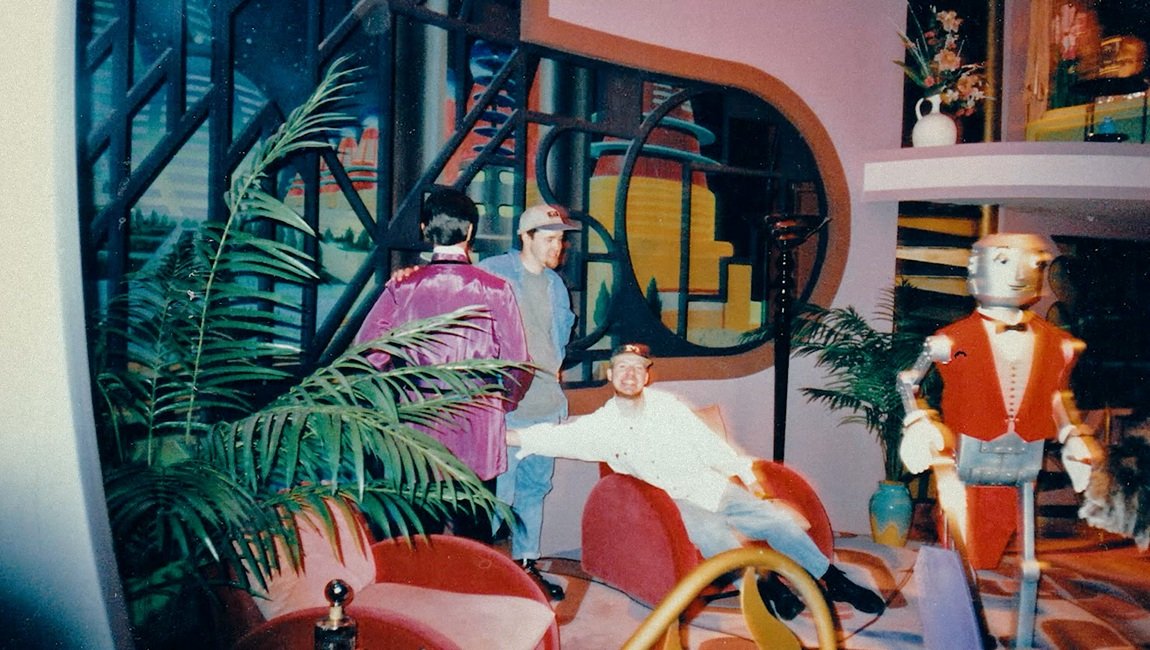
In fairness, this writer did sign up for a whodunnit about which vlogger stole the high-value Buzzy animatronic from the Cranium Command attraction, but it’s telling that a hook of that flavor is so easy to forget during the film’s far more compelling first half. Suffice to say, a compelling study of surprising weight soon dissipates into brand placement, but even that observation invokes a fear that too many mentions of D***ey have graced this review. As anything else of substance to discuss with regard to Bailey’s documentary quickly evaporates in the film’s back half, this writer is left only with the suspicion that a sleeper agent may arrive with blowdart in tow at any moment now.
DIRECTOR: Tyler Thier; DISTRIBUTOR: Antenna Releasing; IN THEATERS: May 22; RUNTIME: 1 hr. 14 min.
Comments are closed.