
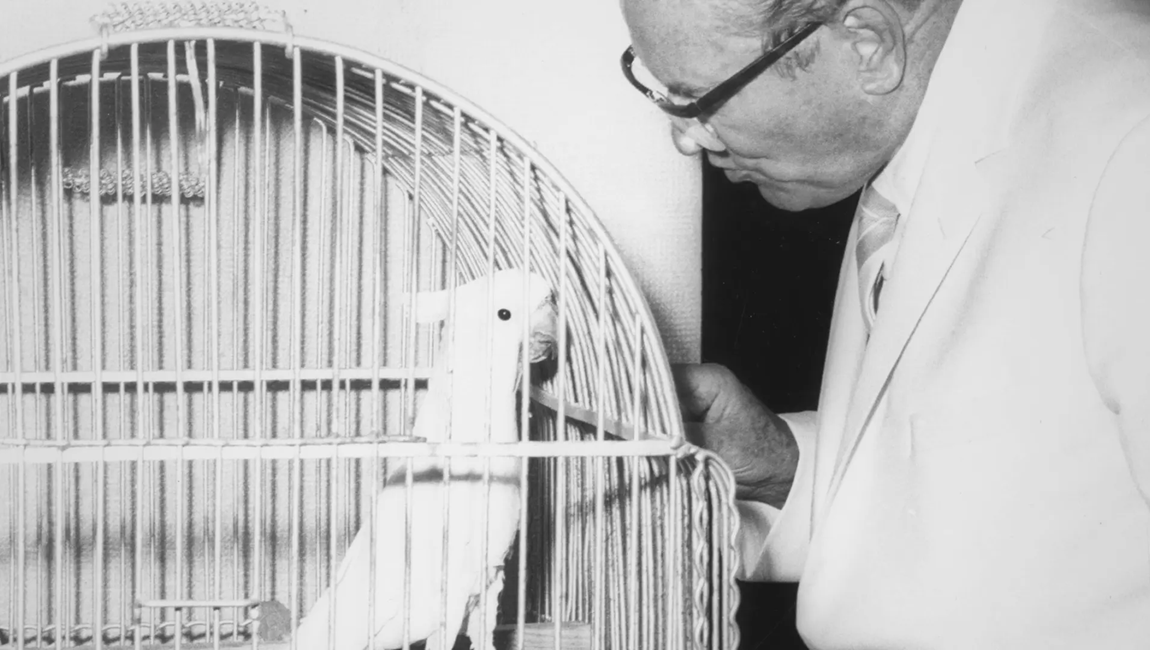
Koki, Ciao, the award-winning Dutch experimental short film, is dictated by an unusual protagonist with a storied life, known for charming the likes of Sophia Loren with his gift of the gab and animal magnetism. He is Koki, a 67-year-old yellow-crested cockatoo and former pet of the Yugoslavian President Josip Broz Tito. Credited as the film’s narrator and co-author, the titular bird turns his swivelling, blue-ringed eye on the archive, provoking the question of who bears witness to history.
Condensed into a flighty runtime of 11 minutes, Koki, Ciao splices together state archival footage and images — which number in the thousands, typical of the worldly political figure and cult of personality — with Koki’s own verbalizations in Croatian. In a conversation held after the film’s screening at this year’s Images Festival, director Quenton Miller discussed how he engaged Koki during filming. Over years, Miller brought the cockatoo a number of previously unseen archival sound recordings, photos, and videos, which he shuttled from the state archive in Belgrade to Brijuni National Park, where Koki resides as a public attraction. (“I was giving Koki memories,” Miller said.)
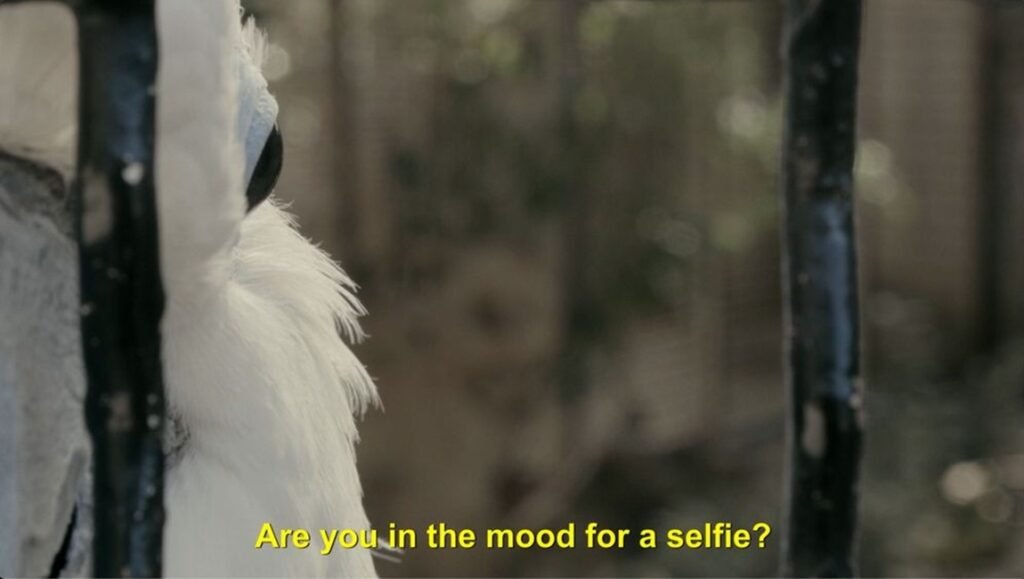
The bird, who is accustomed to being presented with images and footage from tourists, would chirp his witty observations in response, which Miller fashioned into both narration and narrative. One shot has the director flipping through glossy images in front of the cockatoo’s cage, Koki’s scaly feet extended to grip each photograph — or memory — with his talons.
“I’ll talk everything,” Koki says, a generous conversationalist who also doesn’t mince words. Of course, he knows “cage,” “human,” and “Comrade Tito,” yet he is precise with the decades of vocabulary he has amassed. He doesn’t like dogs, referring to them as “devils” and “rats.” He name-checks figures like Ho Chi Minh, Nicolae Ceaușescu, and Sukarno — evoking a parlor trick to entertain a visiting delegation. But Koki’s profanity is the most enthralling; his use of phrases like “you’re shitting me” and “your mother’s pussy,” or heavily loaded words like “coercion” and “achievement,” are an unnerving reminder of the rooms he was in, the conversations and secrets overheard.
Koki was one of Tito’s many beloved diplomatic animals, which filled the leader’s summer residence on the Croatian islands of Brijuni. While Tito was known to love animals, his menagerie of nearly 400 creatures served as a jewel of his presidency; many were gifted as diplomatic exchanges between world leaders of the Non-Aligned Movement, including five elephants from Indira Gandhi. Koki, with all his loquaciousness and charm, was introduced to Fidel Castro, Elizabeth Taylor and Richard Burton, and Sophia Loren, to name a few (he’s known to cry “I love you, Sophia!”).
Crotchety in his old age yet practiced as an entertainer, Koki has been known to beckon visitors forward, ask their name, and reply with a scathing remark like “stupid,” or just exit with a simple “bye.” Parrot speech is rooted in associative learning, replication, and mimicry for the sake of bonding — an intelligence in its own right — yet this kind of lucidity in language doesn’t seem to register with human counterparts. Miller considered this while observing tourists, even noting how the public’s interactions with Koki revealed a sense of political positioning and cultural memory. Visitors were disdainful, reverent, or even desiring of the bird — seemingly a feathered avatar of his former owner — with the director wryly observing how children, too, “parroted” their parents’ views of the communist leader.
In turn, Miller employs mimicry of his own in the film, following an interior monologue to cohere Koki’s storytelling with an approach familiar to humans. Named an autobiography, Koki, Ciao occasionally pulls away from the archive to observe the bird’s caged existence as a tourist attraction in Brijuni’s National Park, which also houses other animals of the era. First exchanged as an exotic gift and now a living remnant of a past national identity, the film depicts an affecting sense of melancholy, capturing Koki’s boredom, tantrums, and lonely verbalizations in the nighttime: “Where’s Tito?” Only adding to Koki’s enigmatic mystique, Miller also includes an email from Tito’s granddaughter, which suggests the cockatoo’s identity is dubious. Is this Tito’s real pet, or an imposter? Will the real Koki please stand up?
Less concerned with geopolitics and human foibles, Koki, Ciao is more preoccupied with the specter of history as exerted upon its most unexpected witnesses, and how language, whether mimicked or not, complicates ideas of personhood and recollection. While the film’s structure could fall into a trap of anthropomorphism, Miller, who mentioned being fascinated by animal narration in literature and film, stressed that he wanted to “avoid the element of ventriloquism.” Creatures like Koki are presented not as invisible ghosts in the archives, but rather are acknowledged as sentient, observing presences in our lives — whether those lives are mundane or outsized and politically significant. Koki, Ciao poses thorny, profound questions of animal intelligence, witness, and memory, leaving us to consider who is left behind when regimes topple, and what those who linger have to say.
Comments are closed.