
In an age of rapid acceleration and environmental decay, the act of preservation remains a preeminent concern — not only for the ecologist, but also for the writer and filmmaker. Icelandic novelist Andri Snær Magnason knows this all too well, as in 2019 he was tasked to write a four-line eulogy to honor the death of Okjökull, his nation’s first glacier lost to climate change. When facing the impossible task of composing an epitaph for a glacier, there is a difficult line to tread between remembering its past and preparing for the future: how can one commemorate the life and acknowledge the death of a natural object previously thought to be invulnerable? What words, which are certain to last centuries, if not millennia, should be immortalized on its headstone for future generations to remember? Must this be a sorrowful farewell or a grave warning?
In her fifth documentary feature, Time and Water (2026), director Sara Dosa examines this tension between retrospection and foresight by turning to Magnason’s own family archive. Accordingly, Time and Water, a follow-up to Dosa’s previously acclaimed Fire of Love (2022), is particularly concerned with memory and preservation. Her film visually interprets Magnason’s struggle with memorializing Okjökull by sifting through his collection of images, videos, and letters that attempt to preserve his lineage. The result is a film that serves as a handshake of generations and a farewell to their fading homeland.
Glaciers aptly serve as a poignant milestone in both regards. Mediated by Magnason’s lyrical narration, Time and Water eulogizes his nation’s topography. And this act of memorialization becomes even more resonant in the wake of his grandparents, Hulda and Arni Kjartansson, who worked as explorers at the Icelandic Glacial Research Society. Coming to terms with their passing, Time and Water is Magnason’s cathartic tribute to his grandparents’ legacy and the disappearing landscapes fundamental to their, and many Icelanders’, lives.
By interpreting the current state of climate activism through this singular anecdote, Dosa applies a personal and archival dimension to a documentary genre often predicated on fear and desperation. Unlike many contemporary environmental documentaries, Time and Water does not diagnose or sermonize its message. The film delves into the processes of climate change and loss without the cynicism that scares its viewers into paralysis. Instead, Dosa’s call to action is far quieter and more nostalgic, as her film offers a thorough consideration of the past and what it means to remember and preserve it.
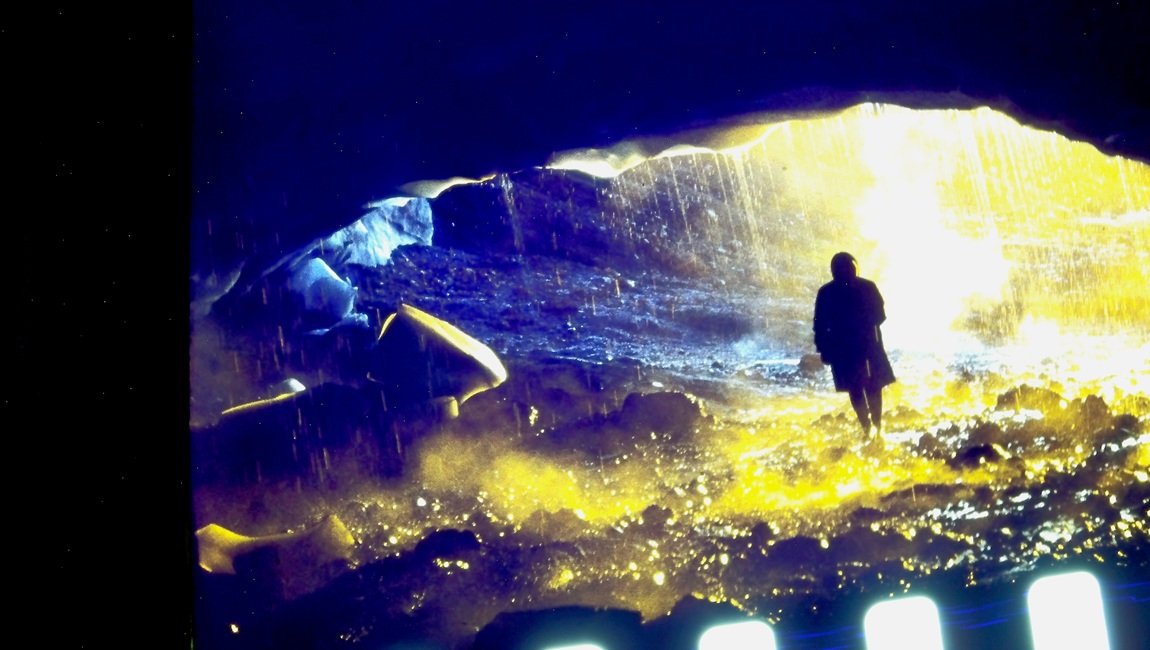
Dosa appropriately keeps this concern in mind by oscillating between chronologies in her film’s structure. Many shots are presented in the same digital format stereotypical of any 21st-century National Geographic production, yet Time and Water finds its footing by contrasting these images with the analog. Much of the film draws from the Icelandic National Archive, while Magnason’s grandfather’s own photography plays a vital role in revealing the extent of glacial erosion. Ranging from 8mm to 16mm film stock, from VHS to camcorder, and even from animation and iPhone footage, the outcome is a multi-media agglomeration. Although Magnason continually memorializes the past with these archival sources, he simultaneously addresses his daughter and his future successors through digital imagery. The film’s components, therefore, seem particularly appropriate to Dosa and Magnason’s stated intent: to make a film that bridges time.
Time and Water is unique in this incorporation of the archive, particularly when viewed as a literary adaptation. In 2019, Magnason also documented his experience with Okjökull by publishing a book, On Time and Water, which attempts to capture the reception of climate change within the contemporary zeitgeist through both scientific writing and personal musing. His text is a travelogue, folktale, and historical account. Dosa’s filmic successor serves as a sister to this original writing by introducing documentary elements that elaborate on the book’s initial premise.
Within this cinematic translation, there are three distinct traditions of environmental, landscape, and personal documentaries at play. Dosa impressively finds a balance in each, but not without allowing Maganson’s linguistic background to somewhat eclipse her filmmaking prowess. While the film generally excels in its multi-modal production, its greatest weakness lies in its lack of grammar. Though its thematic premise is ever relevant, and its footage of the Icelandic countryside is radiant to virtually any spectator’s eyes, the sum of these parts fails to fully deliver the grand poignancy that Time and Water attempts.
There are significant differences between film and literature that consistently define the quality of an adaptation. The cinema, as a medium, is unique in its ability to communicate meaning without language. The arrangement of images, through juxtaposition and parallel, is essential to any film’s structure, and Time and Water exemplifies that reliance on narration can be a detriment to this visual appeal and expression. Magnason’s often saccharine voiceover can be heard throughout the film’s entire duration. At times, this commentary is necessary for contextualization. Still, Time and Water depends on his narration to the point that its constellation of images alone communicates almost nothing: their content is vivid and stunning, and their arrangement is loose and contingently meaningless. As a result, the overuse of narration eliminates the need for this communicative function almost wholly. His words inform spectators of a narrative that drives the film forward, while its accompanying images steadily remain taciturn in the process.
Perhaps this film is an aiding sister to Maganson’s original text. Perhaps it is a subordinate adaptation. But while it can be interpreted through this unfortunate dependence, Dosa’s film is far too multi-faceted in form to shrug off in technique. Though steadily tired in its verbal delivery, Time and Water is remarkably effective in its moments of multi-generational imagery. Its archival approach to activism remains an outlier among other documentaries that profit from perpetual alarmism and futility. Yes, this film, at times, falls well in line with an abundance of other heavy-handed environmental documentaries, but Dosa’s interest in the analog and the historic may just set it apart.
By the film’s conclusion, Okjökull’s inscribed words are unveiled. Engraved in a copper plaque on the former icecap’s now-stony deathbed, Magnason’s “letter to the future” looks forward: “Ok is the first Icelandic glacier to lose its status as a glacier. In the next 200 years, all our glaciers are expected to follow the same path. This monument is to acknowledge that we know what is happening and what needs to be done. Only you know if we did it.” His words do not overtly mourn the glacier. They immortalize a period in need of decisive action. Dosa only further suspends this struggle in film by enshrining the present and commemorating the past in a collection of moving images that span a century of climate change.
DIRECTOR: Sara Dosa; DISTRIBUTOR: 1-2 Special; IN THEATERS: May 29; RUNTIME: 1 hr. 33 min.
Comments are closed.