
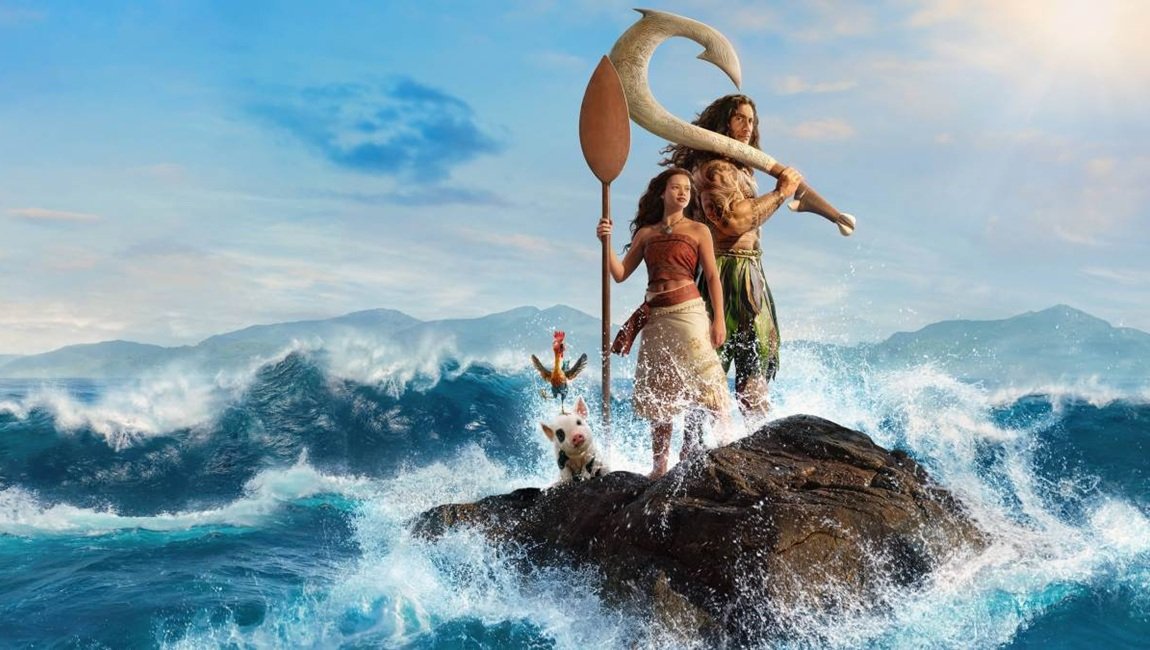
Thomas Kail’s live-action Moana retains the 2016 animated film’s narrative and musical architecture so faithfully that the change of medium amounts largely to a substitution of surfaces. Catherine Lagaʻaia assumes the title role, while Dwayne Johnson reprises his role of Maui in physical form, after providing his voice in the animated features. In this latest bit of Disney IP rehash, one would think that featuring human performers bedecked in spirited costumes and filming partly on Pacific locations should alter the scale and rhythm of the story, but instead Kail asks them to hit positions already determined by animation, with eyelines, creatures, transformations, and much of the surrounding geography completed digitally. The earlier film could change a body’s shape within a unified graphic field. Here, the actors must accommodate images that will be constructed around them. Disney might call the result live action, but the live bodies are usually the film’s most restricted elements.
The fictional island of Motunui comes closest to demonstrating what the new format might offer. Costume fibers remain visible, and scenes of the group dancing give the village sequences a communal energy that cannot be produced by digital crowds alone, with the Pacific Islander cast bringing its own cultural investment to the songs and movement. But Óscar Faura’s cinematography seldom functions to develop that physical advantage: dialogue is frequently broken into medium close-ups with softened backgrounds, and while wider views work to establish the village, the blocking introduced in those shots is rarely carried through the coverage. The camera instead regularly returns to isolated faces, and the landscape loses its scale, while subdued grade further reduces the visual separation between vegetation and sky.
Lagaʻaia, in her first starring role, performs her musical numbers with greater assurance than the dialogue scenes permit. The jokes preserve pauses designed around an animated face, forcing her either to hold a reaction or reproduce an expression whose timing feels as if it belongs to another performance. Kail and editor Melanie Oliver impose rhythm through cuts during the musical numbers instead of allowing gesture and vocal performance to develop together; “How Far I’ll Go,” for instance, is assembled from images of Lagaʻaia singing and views of the shore, with few sustained shots connecting her body to the space she intends to leave. The scenery does its duty in illustrating the lyrics, but this aesthetic approach leaves the actress to remain pinned to their familiar cadence.
At sea, the uncertainty surrounding the term “live action” becomes more concrete. Moana and Maui spend long passages as the only photographed figures on a canoe surrounded by digital water. Repeated close-ups place their faces against an indistinct horizon; reverse angles introduce whatever effect or creature has attracted their attention. Because the ocean’s gesture and the actors’ responses are often divided across cuts, their exchanges lack shared timing. Wide shots provide scale for a moment, but the coverage always returns to the canoe in cramped context, and its movement through the water has little continuity from one angle to the next. In the animated film, Moana and the ocean could deform within the same image; Kail stages their relationship as a succession of eyelines.
Johnson’s return in its more material sense here exposes the cost of reproducing Maui’s design literally. Animation rendered the demigod as impossibly broad, turning his vanity into a comic silhouette before he spoke, but the prosthetic torso and enormous wig here enlarge Johnson’s outline while limiting the quickness of his gestures. Medium framing favors his face, so the proportions seldom control the composition as they did in animation. And where his original vocal performance carried jokes through acceleration and sudden changes in pitch, musical numbers here often ask Johnson to wait between the sung line and a tattoo movement or transformation supplied by the effects team. The actor’s existing star persona already informed Maui; placing him inside an imitation of the drawing leaves little space for another interpretation.
Among the franchise’s hit songs, “You’re Welcome” comes nearest to finding workable movement here because the sequence permits animation to dominate. Mini Maui travels across Johnson’s tattoos, and the transformations can interrupt the dimensions of his body without respecting the prosthetic costume. Elsewhere, Kail and Oliver frequently cut according to changes in visual effects rather than changes in physical action. The Kakamora attack jumps rapidly between shot scales, while its muted palette makes screen direction difficult to follow. Tamatoa’s “Shiny” gives most of the frame to digital reflections and moving surfaces, reducing the photographed performers to scale markers. These composition choices are all the more disappointing given Kail’s theatrical background, making the absence of sustained spatial choreography particularly noticeable — the numbers are assembled from attractions rather than being organized around bodies moving through a continuous space.
In keeping with the sum mishandling in the 2026 Moana, the size of the effects does little for the encounter with Te Kā. Moana’s recognition of Te Fiti repeats the earlier film’s emotional structure, but the live performer and the digital figure seldom occupy the frame with equal weight. Cutting isolates Moana’s response before returning to the effects work, while Mark Mancina’s score does the work of supplying the continuity between them. Where animation in the original Moana could transform the color and graphic balance of the entire image as Te Kā changed, Kail’s version preserves the event while dispersing it across separate visual layers.
And amidst all of these technical and conceptual failures is the profound strangeness of this film’s very existence, especially in this form: the degree of replication is particularly odd given that the franchise’s animated life has never receded. Moana 2 arrived in 2024, placing this remake beside an ongoing series rather than allowing it to arrive at a historical distance from its source. The same audience is being offered two versions within a few years, and the newer film fundamentally relies on immediate recognition of designs that remain current. This is studio regurgitation at perhaps its most illogical endpoint.
Now, that’s not to say that the importance of seeing Lagaʻaia, John Tui, Frankie Adams, and Rena Owen lead a production of this scale is dampened. But what Kail does with their presence is considerably harder to defend. Motunui recedes into softened backgrounds, and the adventure voyage at the film’s core confines its leads to coverage built around effects cues — the actors are required to certify the physical reality of images that give them little room to move in the ways necessary to maximize this material. When the canoe finally reaches Te Fiti, Lagaʻaia and Johnson have spent much of the journey framed from the chest up, reacting to a crossing constructed somewhere beyond the set. Within this reality, it’s hard to find any of the freedom and love of journeying that were so essential to the original’s success.
DIRECTOR: Thomas Kail; CAST: Catherine Laga’aia, Dwayne Johnson, Rena Owen, Frankie Adams, John Tui; DISTRIBUTOR: Walt Disney Pictures; IN THEATERS: July 10; RUNTIME: 1 hr. 55 min.
Comments are closed.