
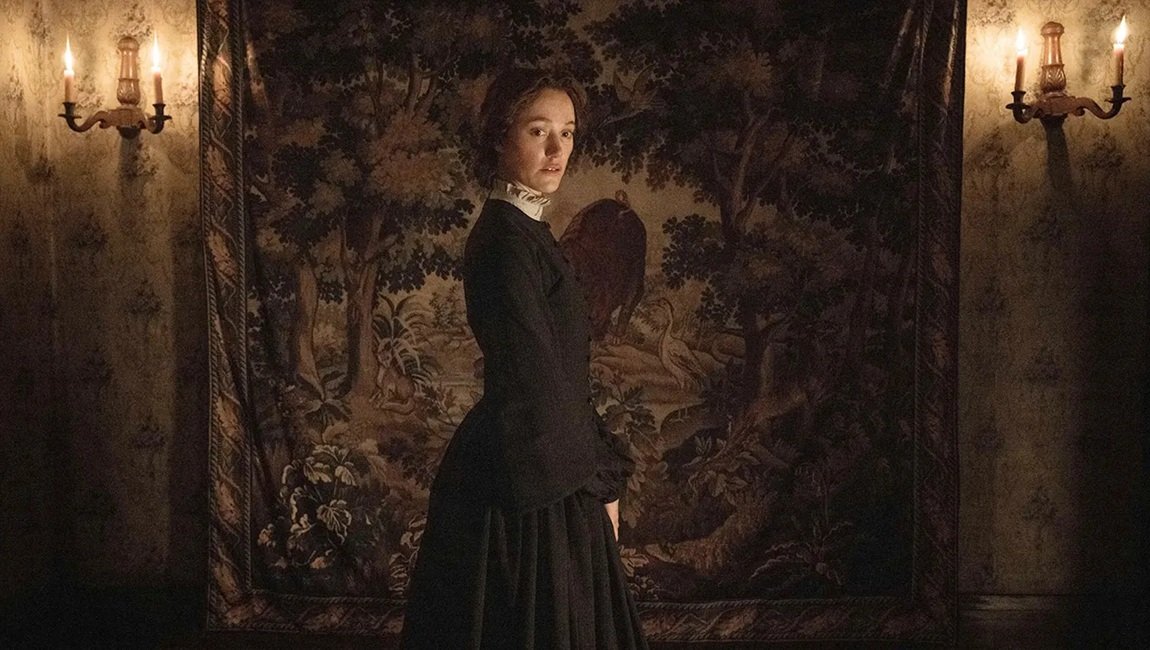
The specter of the Gothic lurks in contemporary culture, so much so that the New York Times recently asked “Why Is Every Book ‘Gothic’ Now?” (Potential explanations offered by journalist Deirdre Coyle: its adjacency to the booming romantasy genre and, perhaps more pertinently, the allure that controlled fear poses in chaotic times.) Virginia Feito’s 2025 novel Victorian Psycho is one such example of the genre’s ongoing resurgence. Narrated with mordant wit by a psychopathic governess whose menace is matched by the cruel upper-crust family she works for, Feito’s novel offers the nostalgic pleasures of classical Gothicism with a satirical, postmodern edge. In quick succession, Feito scripted the screen adaptation of her own novel, which has been directed with visual verve by Zachary Wigon, Indeed, the film is immaculately designed and energetically performed, yet something is missing at the heart of this adaptation. Neither Wigon, nor Feito, nor leading actress Maika Monroe are able to fully communicate the roiling inner life of the murderous Winnifred Notty through the medium of cinema, and as such the events of the film take on a weightless quality, its multivalent violence seeming to be unmoored from any sense of consequence.
The film does carry over a bit of the novel’s narration, delivered in voiceover by Monroe. This narration opens the film: Monroe proclaims in a steady voice that she is “the sanest person” she knows, followed by a Dutch-angled frame of Monroe staring at the camera with a dead-eyed smile. We already know, of course, that Winnifred Notty is not sane, but the Pounds family and their staff are not yet privy to her true nature, and they greet her upon her arrival at their sprawling estate with less-than-polite disinterest. Winnifred swears to herself that this appointment at Ensor House will be different from her prior posts, which ended in her young charges mysteriously disappearing and drowning, respectively. As members of the staff see dangerous hints of Winnifred’s true nature, and the finicky Pounds family grows distrustful of her — often for reasons entirely unrelated to her increasing bloodthirst — Winnifred takes increasingly drastic and impulsive actions, and in doing so risks her own standing and the safety of everyone around her.
Victorian Psycho is more of a gruesome comedy than it is a traditional horror film, and the performances follow suit. The supporting cast represent basic types, and the seasoned actors play them to the hilt: Jason Isaacs and Ruth Wilson give comically broad performances as the wealthy and boorish Mr. and Mrs. Pounds, and Thomasin McKenzie is amusing as a mousy maid who frets about a supposed “ghoul” haunting Ensor House. But Monroe’s task as an actor is formidable in comparison to those playing secondary characters. She must set the film’s humorous tone, while also undercutting this humor with an unpredictable danger, while still further providing hints of emotional complexity. Though she is a horror veteran, Monroe’s performances have typically been characterized by emotional restraint, and here she takes the opportunity to stretch to the furthest limits of her expressive capacities. In playing a fundamentally unhinged character who takes pains to present as respectable, Monroe emphasizes Winnifred’s crazed nature over her social performance. An antic grin is always threatening to break out no matter the situation, and her physicality is jerky and unpredictable; through it all, she maintains an unsettlingly even vocal tone.
Monroe’s full-tilt performance is consistently entertaining and often compelling, yet her interpretation of Winnifred has fundamental limits. Even as Winnifred tries to win over the Pounds family and their staff, Monroe only modulates her performance slightly, with the effect being that Winnifred often plays as a one-dimensional slasher rather than a character of any legitimate complexity. Monroe succeeds admirably in committing to Winnifred’s extremes, but she ultimately struggles to ground her in a more tangible humanity.
Wigon’s direction demonstrates similar highlights and drawbacks as Monroe’s performance. Wigon cultivates a visual style that recalls the work of Yorgos Lanthimos, with all its distorted wide-angle shots of stately Victorian interiors, and he maintains an off-kilter tone to match. In collaboration with director of photography Nico Aguilar, Wigon also commits to antic camera movement — in scenes where Winnifred commits violent acts, for instance, the camera makes the same rapid swings as her weapon of choice. (Tellingly, Wigon has named Brian De Palma as a key stylistic influence for Victorian Psycho). Wigon’s visual direction undeniably evinces ingenuity and technical skill, but the film as a whole bears all the hallmarks of over-direction. Wigon’s visual flourishes too often draw attention to themselves rather than illuminating the narrative or characterizations, and these attention-grabbing tactics can begin to feel tedious rather than invigorating.
Wigon and Monroe’s collaborative reliance on maximalism reveals a lack of substance underneath the flash. By taking big swings, the film’s director and leading actor mask the thin narrative, with limited success. The style-over-substance approach is all the more frustrating because Feito’s source novel does pose a trenchant social critique. As the title indicates, Winnifred is a Patrick Bateman type: she outwardly represents a nonthreatening cultural type of her time, and her violent actions reflect the broader violence of her society back to the audience. The hard kernel at the center of Feito’s novel is that the Pounds family, and by extension the social system of imperial Britain, were as morally debased as Winnifred — and may be even worse than than the victorian psycho they’ve hired, because she is at least honest about her own moral vacuity. In her own screen adaptation, Feito neither sufficiently grounds the narrative in Winnifred’s psychology nor foregrounds the social critique, which is mostly relegated to the background. The result is that while reliably stylish and never less than energetic, Victorian Psycho is an insubstantial film, its parade of exaggerated violence neither provocative nor illuminating.
DIRECTOR: Zachary Wigon; CAST: Maika Monroe, Thomas McKenzie, Jason Isaacs, Ruth Wilson, Jacobi Jupe; DISTRIBUTOR: Bleecker Street; IN THEATERS: November 13; RUNTIME: 1 hr. 42 min.
Comments are closed.