
Let us establish at the outset that it’s gauche to talk about the Oscars in any context other than noting events from the historical record or for regaling your friends with useless knowledge. But having said that, it’s impossible to deny that the enduring legacy of 1976’s Rocky is inextricable from the film’s unlikely triumph at the 49th Academy Awards and how much the film’s journey as a scrappy underdog mirrored both the plot of the film as well as the life of the film’s star-screenwriter, Sylvester Stallone. A genuine word-of-mouth sensation at the time of its release — it was the highest-grossing film to be released in 1976 — Rocky didn’t spawn five sequels, a spin-off franchise, and even a boxing-themed reality show simply because it made a lot of money. (Don’t believe me? Rocky made $10 million less than the 1977’s Smokey and the Bandit, and yet we’re not getting legacy sequels about Buford T. Justice’s illegitimate son carrying on the family tradition nearly 50 years later.) The triumph of Rocky was in the slobs overcoming the snobs and elevating feel-good populism over more artful, emotionally prickly films that functioned as a splash of cold water in the face. All the President’s Men, Network, Taxi Driver… take your pick, but any one of them would have made a better choice for the night’s final prize.
So there’s something quite apt in I Play Rocky — a sourdough-soft account of the making of the original Rocky that both bolsters Stallone’s legend while keeping prized IP in the public spotlight in between Creed films — being directed by Peter Farrelly. One half of the eponymous Farrelly Brothers directing team of such ’90s comedies as Dumb & Dumber and There’s Something About Mary, more recently Peter is better known for reinventing himself as a more serious filmmaker who similarly shocked the world by directing his own Best Picture winner, 2018’s Green Book. Putting aside for a moment that “serious” in this instance means having Viggo Mortensen fold an entire pizza in half and consume it like a pita sandwich, as well as schooling Mahershala Ali about the pleasures of fried chicken and R&B music, there’s a spiritual kinship between Farrelly and Stallone. They’re both, deep down at least, working-class artists prone to sentimentality and low-brow tendencies. They both populate their films with friends and loved ones in distracting supporting roles that feel like they’re paying off an old favor. They both fought against being put in a box by the industry based on their previous work and both proved the doubters wrong. And they’re both responsible for Best Picture winners that felt like a terrible mistake before the time it took to walk to the stage and collect their prizes had even elapsed.
For whatever its foibles, the first Rocky, which was not directed by Stallone but rather by John G. Avildsen (more on him anon), is undeniably a much more idiosyncratic film than its reputation, and certainly more than its numerous sequels which grew increasingly bombastic, materialistic, and nationalistic with each subsequent installment. Evoking the bashful humanism of Delbert Mann and Paddy Chayefsky’s Marty and the volcanic emotional directness of John Cassavetes’ works more than your typical sports movie, Rocky notably features a lot less actual boxing than you probably remember. An ultra-low budget character piece about lonely and damaged people living on the fringes of society, it argues for the heroism in simply attempting the impossible (so much so that the outcome of the film’s climactic heavyweight title match is fundamentally irrelevant). Although the film is credited with popularizing the training montage sequence and the use of Steadicam (both of which would eventually become omnipresent in the genre), the film never feels formulaic or derivative; it’s lumpy, unpolished, and its seams are occasionally visible, but it’s always true to itself.
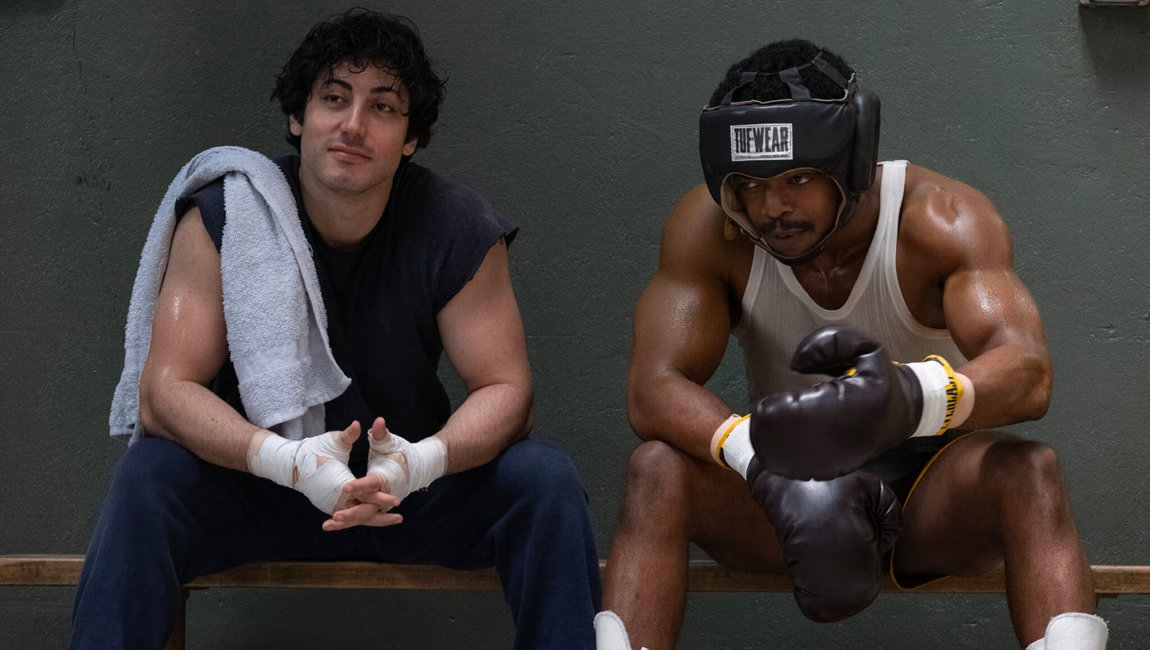
None of which can be said for I Play Rocky, which feels like watching the trivia page on IMDB being dramatized by actors. Every canard and oft-repeated bit of self-mythology associated with the production has been dutifully retained and recreated in an antiseptic, spot-the-reference manner with all the depth of a Planet Hollywood display case. This film exists solely for the purpose of valorizing Stallone (newcomer Anthony Ippolito, doing a fine talk show impersonation of the actor’s instantly recognizable mumbly drawl) as a self-made legend. How Stallone, then a struggling actor with a speech impediment, an endearingly misshapen face, and a pregnant wife (AnnaSophia Robb), wrote himself the role of a lifetime — the first draft was allegedly completed in three and a half days — after watching Chuck Wepner go fifteen rounds against Muhammad Ali. How he caught the attention of mega-producers Irwin Winkler (P. J. Byrne) and Robert Chartoff (Toby Kebbell), who fell head over heels for his script about a southpaw boxer and were repeatedly stymied in their efforts to get Stallone to sell them the rights to the screenplay without also attaching himself to play the title role. How Stallone turned down a small fortune ($360,000 in 1975 dollars!) at a time when he couldn’t even afford the rent on his Hollywood apartment or to feed his beloved dog, until he finally wore down the suits at United Artists (personified by Tracy Letts here, giving a wonderfully pissy performance as a fictional studio head still steaming over letting The Godfather slip through his fingers) who allowed the film to go into production with an all-in budget of a million dollars and how that required the crew to beg, borrow, and steal in order to make their days.
Indeed, I Play Rocky is primarily focused on the weeks-long brinksmanship of Stallone sticking to his guns about playing the lead role when anyone else on earth would have taken the money to walk away (in the end, the actor received around $24,000 in acting and writing fees for the film; clearly he negotiated a more favorable deal for the sequels). Overlooking how much these events have been both embellished and streamlined for dramatic convenience — to name just a couple examples, we’re told that Stallone didn’t have an agent and negotiated on his own behalf, and that he surreptitiously slipped one of his screenplays into a script reader’s pile (which is how Winkler and Chartoff discovered him), both of which are provably false — the film never finds a dramatic toehold for these scenes, which take up nearly a third of the runtime. The audience obviously knows Stallone’s going to play the part, and there’s no actual gamesmanship to the obstinance. Ippolito is a talented mimic, but he has little success bringing the viewer inside Stallone’s pathological stubbornness, which would see he and his pregnant wife thrown out onto the street and risk the entire project collapsing (it’s never entirely clear why Winkler and Chartoff don’t themselves lose interest in the project after all this unprofessional nonsense; the amount of attention they pay the negotiation at the expense of everything else does, however, somewhat explain how New York, New York turned out the way it did). I Play Rocky also trots out Farrelly’s There’s Something About Mary star, Matt Dillon, to play Frank Stallone Sr., Sly’s emotionally withholding, slightly racist father who never has a kind word to say about his kid (sort of reminds you of a certain fictional crotchety trainer, no?) in order to make the argument that he’d be set for life if he took the $360,000 and that he has a family to look after now. Stallone the younger is unmoved. Sly believes in himself and more than that — he’s a winner.
It would take less time to list the things this version of Stallone isn’t remarkable at. Although Stallone has no formal creative attachment to I Play Rocky, he’s clearly blessed it. And in return, he’s been given a sloppy wet kiss of a biopic that finds him doing everything short of washing the feet of lepers. In addition to his talents as a writer and actor — and it should be acknowledged that Stallone’s performance in Rocky is genuinely touching; free of ego and achingly vulnerable at times — we observe the character reading Whitman aloud to correct his lisp (he also geeks out in front of Winkler and Chartoff about his brief “existential phase” as a teenager, a thread the film has zero interest in interrogating). He has a “gift” for identifying flaws in films, criticizing the use of subjective sound design in The Conversation as “cheating” (one wonders if Stallone felt compelled to share this insight with Coppola’s little sister, Talia, when he was acting opposite her in Rocky). He rescues a hungry puppy from the streets and later makes the heartbreaking decision to sell the dog to a loving family when he can no longer afford to care for it. We’re told Stallone turned himself into a convincing boxer in roughly six weeks despite never having attempted it before, and he even comes up with all of the film’s fight choreography after running off the most accomplished fight choreographer in town. He acted through a litany of debilitating injuries and the flu and never complained or let the production get behind schedule. We also learn that he was cast in a softcore porno entirely because he has an enormous penis. Stallone is presented as such an all around swell (and modest!) guy that it’s no wonder he’s cultivated such an unassailable reputation over the last five decades.
Farrelly isn’t especially interested in the art of filmmaking, which should be evident to anyone who’s ever seen a Peter Farrelly film before. In contrast to Avildsen’s warmly atmospheric 35mm direction of Rocky, I Play Rocky is shot on overlit digital and looks visually lifeless (the contrast is especially noticeable when we see dallies from the production, which at least makes some effort to recreate the grain of film stock). The film is far too fond of hackneyed visual gags, predictable setups, and payoffs you can see coming a mile away. At one point, we get an argument between Ippolito and Robb that spills out into the middle of a torrential downpour, seemingly for no good reason other than that the filmmaker staged a similar confrontation in Green Book and they inexplicably gave him an Oscar for it. Also, this film surely sets an unofficial record for most cutaways to reaction shots of pug-ugly animals in a film ostensibly about fisticuffs (although Every Which Way but Loose gives it a run for its money).
But what’s actually quite odious about I Play Rocky is the disdain it shows for Avildsen, a journeyman filmmaker who parlayed the success of Rocky into a long career making sports-dramas in the same vein, like The Karate Kid and The Power of One, who still deserved better than this. Played by Jay Duplass, within 90 seconds of being introduced Avildsen admits that he thinks boxing movies are stupid and that he shoots films quickly, cheaply, and that he’s “kind of a prick.” And yet the character seemingly has no clue how to run a set, direct actors, or make aesthetic choices that serve the script, instead preferring to speak largely in pithy bromides. The decision to employ Steadicam inventor Garrett Brown for the film is presented entirely in terms of cutting down the number of setups in order to stay on schedule, and when Brown improvises an elaborate camera move during Rocky’s famous ascent of the Philadelphia Museum of Art steps, the director is remarkably sanguine about it. Avildsen often defers to Stallone to make sense of the script, and when Stallone struggles to get through a key scene with the actor Burgess Meredith, the director all but throws his hands up in the air and tells his leading man to go figure out what isn’t working off on his own (good thing Stallone’s wife is also on set to help her husband understand the subtext of the scene that he wrote). Maybe this reflects how Farrelly runs sets; a sort of laissez-faire, make-it-up-as-you-go pile-up of indifference and stumbling ass backward into inspiration. One can only hope that someday another Oscar-winning director demonstrates the same level askanceness towards Farrelly should they ever make I Direct I Play Rocky. It would be well-deserved.
DIRECTOR: Peter Farrelly; CAST: Anthony Ippolito, AnnaSophia Robb, P.J. Byrne, Toby Kebbell, Tracy Letts, Stephan James; DISTRIBUTOR: Amazon MGM Studios; IN THEATERS: November 6; RUNTIME: 2 hr. 8 min.
Comments are closed.