
Grief might be modern horror’s hardest-working monster. It crawls from basements and treehouses and Swedish countrysides, a metastasized metaphor wreaking terror on families trying to move on. Harboring loss is a world-crashing ordeal that can seem to demand extreme solutions; in Paolo Strippoli’s The Holy Boy, the people of the remote Italian village Remis turn to divine intervention. To the townspeople’s credit, it seems to be working. Remis pins “The Valley of Smiles” to its chest as a proud town motto, and the sunny faces of its humble occupants pay the bill — even if something darker lurks beneath all that cheeriness.
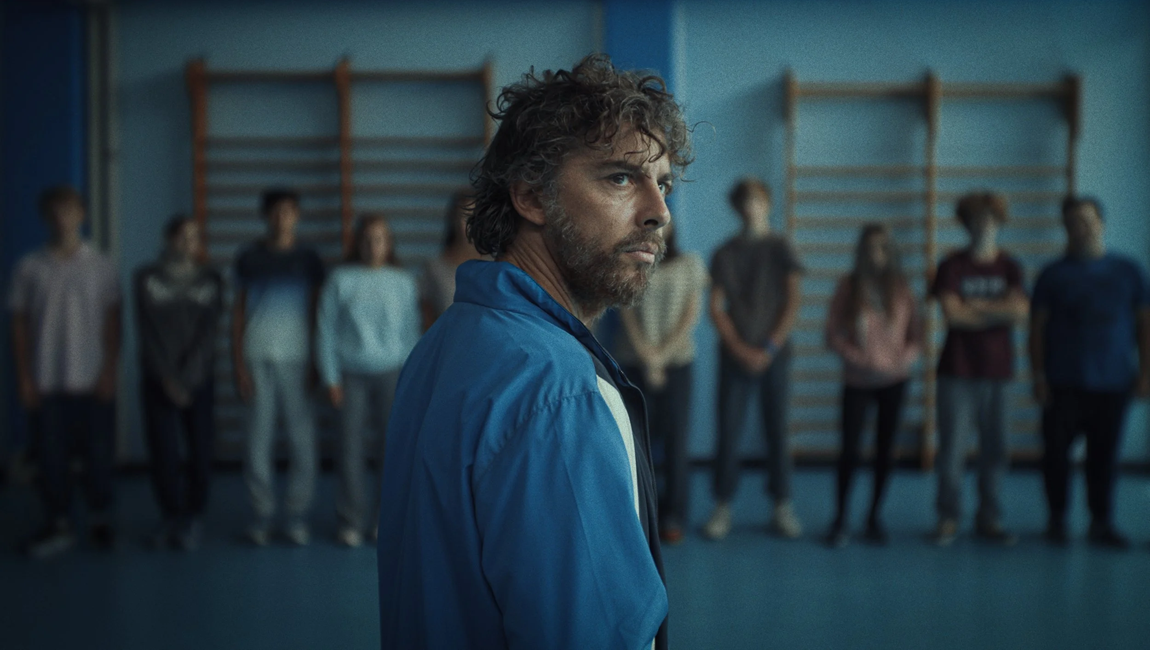
Sergio (Michele Riondino) happens upon the uncanny hamlet under uncanny coincidence. The former judo champion’s athletic career was derailed by a closely lost match and a personal loss he keeps close to his chest. Now, he bounces between temp gigs as a PE teacher and washes down sleeping pills with beer to keep the demons at bay. Sergio’s latest gig lands him a three-month stint in the Valley of Smiles, where his stubbled frown confirms his status as an outsider. “We prefer smiles,” says Elisabetta, the high school principal who’s less than enthused with Sergio’s militaristic command over his class. He’s particularly tough on Matteo (Giulio Feltri), a 15-year-old loner with wisps of albinism through his shaggy locks. Before Sergio, Matteo would sulk on the sidelines during gym class. Now, he’s hitting drills with the rest of them.
It isn’t long before Sergio’s depression chides enough against the happy people of Remis to spark action. One-too-many whiskeys turns a flirtation with local bartender Michela (Romana Maggiora Vergano) sour, but she’s not put off enough to leave Sergio on his own. “You need to see him,” she says knowingly. Michela drags Sergio down a labyrinth of darkened corridors in the town’s center, each replete with notionally Roman Catholic rituals and signifiers. Finally, we’re presented with him: Matteo, now robed in a white cassock, standing like a beleaguered Raphael in the center of a church gymnasium. Sergio’s head is spinning from drink and dogma, but he’s instructed to embrace Matteo, whose touch can erase the pain of memory. Miraculously, it does the trick.
The Holy Boy is no enemy of the familiar, and its first half is set comfortably on a low simmer. Sergio’s stranger to Remis’ strange land finds a close neighbor in the hallmarks of The Wicker Man: a quirky town removed from the comforts and complaints of modern living, its denizens painted in plastered smiles with conspiratorial uniformity. Strippoli isn’t shy to fashion his folk horror after the shadows in which it stands, and while The Holy Boy hits its marks competently, its well-trodden grounds leave little room for shock and awe.
But Matteo’s divinity is introduced with enough vinegar to shake The Holy Boy out of its comfort zone. Sergio was hard on Matteo in gym class, but that beatific embrace seems to have changed his tone (erasing the pain of grief will do that). As Sergio gets his act together — he’s seeing Michela on dates and no longer clawing his way through a daily hangover — he starts spending time with Matteo and gets curious about what makes the kid tick. And, more so, about how Remis ticks around him.
Pain-healing hugs aside, Matteo is your average 15-year-old outcast. His headphones are glued to his ears, he harbors a queer crush on his own bully, he thinks trying judo might be fun. His divine gift, of course, gets in the way. Matteo shoulders the responsibility of keeping the entire town of Remis free of mourning, which is no small feat; years ago, a local train crash had killed 46 people in the sleepy village. That means Matteo must adhere to a brutal routine of administering hugs with the piety of a Catholic confession. Lest his teenage angst or whims get in the way, Matteo’s vape-toting father, Mauro (Paolo Pierobon), plays the hard-nosed drillmaster. Conspicuously, Mauro’s one of the only folks in town who has denied Matteo a hug.
Matteo’s anointed loserdom also finds its roots in classic horror: this time in Carrie, whose telekinetic villainy provides a deliberate beacon to guide Matteo’s own descent from the chosen path. But Strippoli and cowriters Jacopo del Guidice and Milo Tissone craft a fine enough character in Matteo to stay safely on the right side of homage’s border to derivation. It’s hard to fault Matteo for the chip on his shoulder, especially as Sergio’s attention reminds him that he really is just a teenager. The reverence Matteo receives from the adults of Remis fashions him a pariah among his peers, a gifted-kid syndrome in hyperdrive that proves a solvent catalyst for Matteo’s darkness. It’s also a vessel for The Holy Boy’s most potent questions and provocations: of duty to community, of possession’s violation of autonomy and consent, of the ouroboros of religion and morality.
Morality might be The Holy Boy’s most glaring vulnerability. Grief’s reluctant necessity is familiar enough within the genre to feel pedestrian, a shorthand trope to get the eyes rolling among elevated horror’s detractors. For all the rust the movie inherits with its borrowed routines, though, it sings through the nuance it finds in Matteo. A collage of bold influence is a risky gambit, but The Holy Boy proves, eventually, that it can bear original fruit: one that tempts doubt in divinity, a reevaluation of God’s position above — or below — suffering.
DIRECTOR: Paolo Strippoli; CAST: Michele Riondino, Giulio Feltri, Paolo Pierobon, Romana Maggiora Vergano, Roberto Citran; DISTRIBUTOR: Shudder; STREAMING: November 27; RUNTIME: 2 hr. 2 min.
Comments are closed.