
With 2024’s Ghostlight, Kelly O’Sullivan and Alex Thompson took on one of the great challenges in narrative cinema: of depicting grief, that most personal and variable of human experiences. The script, written by O’Sullivan, tackled not only the permeating and profound sadness of family loss, but also toxic masculinity and the innate anger that comes with the death of a son. Casting a real family (Keith Kupferer, Tara Mallen, and daughter Katherine Mallen Kupferer) in the central roles was a choice that certainly could have backfired, but instead it created a connection that almost certainly would have been impossible with any other group of actors. Now, the directors (along with the women of the Mallen-Kupferer family) have returned with Mouse, another look at how humans handle the loss of loved ones, but this time through the lens of young friends.
Once again written by O’Sullivan, Mouse follows Minnie Dunn (Mallen Kupferer), begrudgingly nicknamed Mouse by the mean girls at her school. Minnie’s life isn’t what a teenager dreams of — her mother Barbara (Mallen) works long hours and doesn’t cook beyond nuking frozen dinners, she has to walk everywhere because she can’t afford a car, and she herself must work long hours at an indoor playground to help her single mom pay the bills. But what she does have is Callie (Chloe Coleman), her best friend and an escape from her difficult home life. Callie’s family is much wealthier, and her mother, Helen (Sophie Okonedo), is a stay-at-home mom who cooks, cleans, plays piano; in other words, she represents everything Minnie believes she is missing. But in the summer before their junior year, while Minnie is suffering through just another day at the job she hates, Callie gets in a car accident and dies.
In an instant, Minnie has lost not only her best friend, but also her safety net. Callie was friends with everyone. She was smart, talented, and she shielded Minnie from the mean girls in their class. Without Callie, Minnie is just that: without. In her mind, she has been minimized to nothing but a loser who has no one. To make matters worse, Cara (Audrey Grace Marshall) is even trying to rewrite history and claim Callie is her best friend. It’s through this isolation that Minnie ends up back at Callie’s house, this time connecting with her mother. As they journey through their individual yet intertwined cycles of grief, Minnie becomes attached to Helen. Like Callie, Helen represents escape, and provides everything that Minnie’s own mother can’t. Naturally, this co-dependency escalates to a breaking point for both Minnie and Helen, who each must learn to confront their suffocating grief rather than striving only to replace the person they lost.
There’s a lot going on — and successful — in Mouse outside this central dynamic. David Hyde Pierce movingly plays Mr. Murdaugh, the school’s theater teacher who adored Callie and offers support by giving his students an artistic outlet for their grief. Elsewhere, Kat (Iman Vellani), a clerk at the local record store, becomes Minnie’s love interest, but where many films would have exploited this queer storyline for added dramatic heft or promoted it to singular focus, Mouse is savvy enough to more naturalistically keep Kat as only part of Minnie’s life and grief process. Cara and her minions, meanwhile, plan an entire pageant around honoring Callie’s memory. If this sounds like a lot of moving parts, it can feel like that at times, and this overabundance of incident is perhaps be the film’s only significant flaw; trying to orchestrate too many feelings and pivotal life moments into the film’s runtime can leave certain threads, like Kat and Minnie’s romance, feeling rushed and underdeveloped.
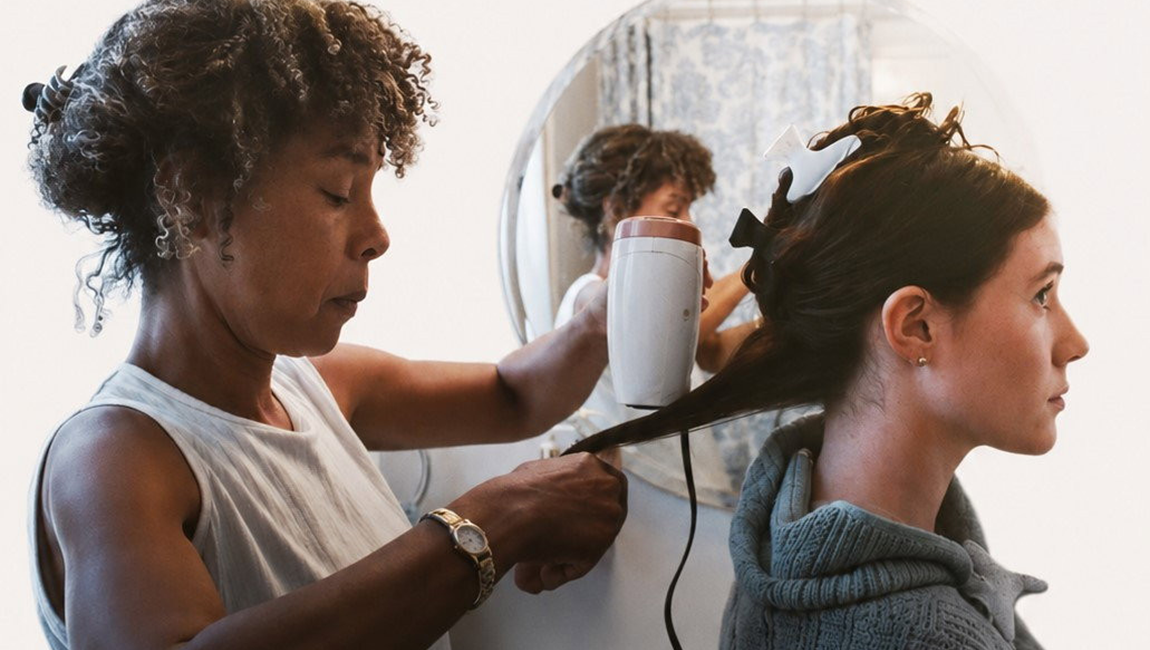
Beyond that, however, Mouse is separated from other standard, coming-of-age stepstone films in its relationships, both those that exist on and off screen. In once again pairing Mallen Kupferer and her real-life mother, the film’s dynamic is supported by the duo’s ability to channel the built-in tension that will be familiar to any mother or daughter, especially that which exists during a daughter’s teenage years. As in Ghostlight, it’s not a given that this approach will reap rewards, but also as in Ghostlight, it does, with Minnie and Barbara’s relationship moving with authenticity and genuine feeling. Minnie resents her mother for not being more like Helen, while Barbara struggles with an inability to connect with her daughter. When Minnie goes to the homecoming dance, it’s Helen who is there, ready to help Minnie get ready and take photos, while Barbara is stuck at work, rushing in at the last minute without a camera and without much acknowledgment from Minnie.
Set in 2002, there’s also an appealing aesthetic familiarity to Mouse that works in its favor. Any viewer of a certain age will be able to immediately jump back to that time of Nokia phones, chunky sneakers, and flared-leg jeans, and the rural Arkansas setting lends a nostalgic early-aughts haze to the proceedings. But O’Sullivan and Thompson are also careful not to let their film slip into the realm of spot-the-reference: there may be plenty on screen that will stir memories, but it’s all in service of establishing the versimilitude of Mouse’s world, rooting its emotional stakes in viewers’ lived-in past. This organic patina is also supported in the savvy casting choices. The performers all bring a certain early-internet era naivete that keeps their work here feeling appropriately grounded, while Okonedo in particular depicts a mother’s grief with deeply felt emotional vacillations, whether it be seen in her rage (at Minnie for getting drunk), her avoidance (by helping Minnie prepare for a recital), or all-consuming anguish (as seen during a support group for grieving parents).
When asked what they would want people to take away from Mouse, O’Sullivan answered, “I’d like people to take away a sense of kindness and connection, and an understanding that nobody knows what they’re doing.” It’s a dual ambition harder to achieve than it seems, given our culture’s desire of pat, spoon-fed resolution, our social media-conditioned push toward both cynicism and tribalism, and our attention-starved need for familiar narrative shape. But there’s a beauty to be found in irresolvability, a beauty in watching humans fumbling for meaning and trying to put themselves back together, a beauty in our reckoning with life’s lack of a playbook. It’s a beauty captured tenderly and intelligently in Mouse.
DIRECTORS: Kelly O’Sullivan and Alex Thompson; CAST: Sophie Okonedo, Katherine Mallen Kupferer, Chloe Coleman, David Hyde Pierce, Tara Mallen; DISTRIBUTOR: ddd; IN THEATERS: November 6; RUNTIME: 2 hr.
Comments are closed.