
Earlier this month, SNL had an increasingly rare zeitgeist moment with a sketch for a fake in-home care service for elder, medically failing parents called “Sister.” (If by some chance you haven’t seen it, the gist is that live-in help can be cripplingly expensive, so instead, why not get your sibling to put her life on hold to dedicate herself to caring for them for the low-low cost of “nothing”?) Part of the reason the segment was so resonant is that it tapped into the uncomfortable hierarchies and paternalism of sibling dynamics, where male offspring are held to a different standard than female ones — pointedly, you can’t expect a man to pause his career to talk with pharmacists or help a loved one off the toilet — but also there’s a whistling-past-the-graveyard quality for many adults that a large debt is coming due and sooner than we’d like to admit. There but for the grace of God will we be the ones changing the diapers of the people who changed our diapers (if we haven’t already).
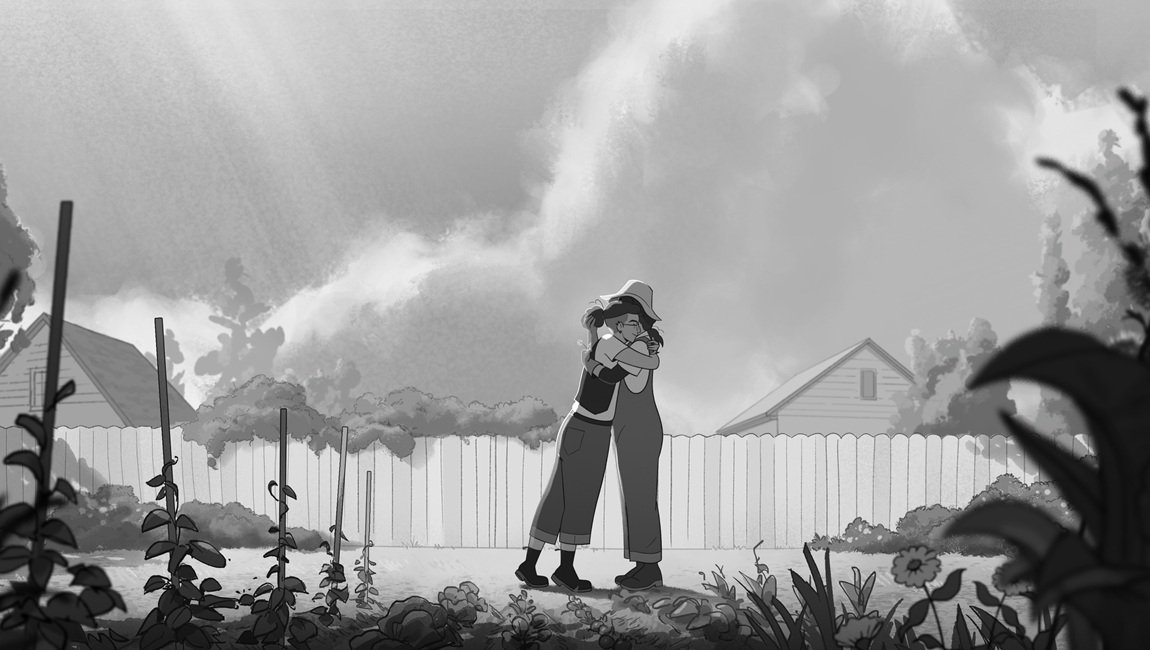
In a bit of synchronicity, this sentiment is also at the heart of Leah Nelson’s animated feature Tangles, based on a graphic memoir by Sarah Leavitt. While there’s less ingrained sexism in the delegation of responsibilities — both of the adult children who are living in the wake of their mother’s early-onset dementia diagnosis are women — the film explores the all-consuming and disruptive nature of caring for an enfeebled parent, where such niceties as professional goals, a personal life, and a sense of independence and human dignity are casualties to the immediacy of caring for the person who was your childhood protector and is now slowly slipping away. Employing a stylistically heightened, monochromatic palette and a mordantly self-deprecating sense of humor, the film takes an unblinking, unsparing gaze at the long and arduous road of palliative care, sparing as much a thought for the infirmed as it does the person who assumes the burden of caring for them.
Directly inspired by Leavitt’s own experiences tending to her mother Midge while simultaneously trying to find herself as a queer woman living 3,000 miles away in the late ’90s, Tangles introduces us to Sarah (voiced by Abbi Jacobson) riding a desk at an edgy San Francisco alt-weekly, answering phones while doodling lurid fantasies in her notebook. Socially awkward and ill at ease with the dating scene as a semi-recently out lesbian — it should be noted that because the film is animated and it’s made by and for grown-ups, there’s a sense of casual liberation in depicting such “unsexy” but everyday qualities as unsightly body hair and cellulite — Sarah crosses paths with the more self-possessed Donimo (Samira Wiley). The two women grind on each other at an underground club, which the film punctuates its black-and-white, hand-drawn images with judiciously applied color highlights to underscore the reckless abandon of the moment, before retreating to Sarah’s apartment to fool around. And it being the ’90s, that requires a mutual struggle session to remove combat boots before hastily getting their pants off. Sarah also finally starts to garner attention at work, largely by being present and less of a headache than her coworkers, and is tapped by the newspaper’s editor (Wanda Sykes) to illustrate the cover of an upcoming LGBTQ-themed publication. She’s finally establishing herself as a sexually active, career woman, bopping around to an alt-rock soundtrack in the exciting big city.
That’s right around the time she’s beckoned back to Maine; or, in the parlance of the film’s passive aggressive in-flight announcements that serve as interstitials throughout, “that crappy little town where you grew up.” Returning to her childhood home in a scene that’s sketched a little too similarly to something out of a quirky Sundance dramedy, Sarah gets the bum rush from assorted kooky aunts (Pamela Adlon and Sarah Silverman), her blinkered academic father Rob (Bryan Cranston), and her boy-crazy younger sister Hannah (Beanie Feldstein) — none of whom want to talk about or even notice how different the family matriarch, Midge (Julia Louis-Dreyfus), seems lately. It’s small but dismissible things at first: leaving an iron unattended, becoming irritable when questioned about her flightiness, being let go from her long-time position as a school administrator (“Stupid computers. HTML? What’s wrong with a hand-written report card?”) With Sarah briefly back on the scene with fresh eyes, she tries to raise alarm bells with her father and sister, only to find they’re both in denial. Besides, it’s probably “just menopause.”
Over the course of several months and a handful of cross-country flights (including an ill-advised family vacation to Mexico where Sarah has Donimo tag along to meet the parents), Midge’s disorientation and struggles simply expressing herself clearly become more pronounced, to the point that Rob finally accepts reality and takes her to a neurologist, who delivers the gutting news: Midge has Alzheimer’s. It’s a devastating revelation, although, typical of the film’s morbid flights of fancy that usually stay just this side of glib, Sarah spends the moments before the diagnosis is imagining herself at an especially macabre casino where different scenarios play out in games of chance (e.g., willing “come on syphilis” as she pulls on on the handle of a slot machine). With Midge on a long, irreversible trajectory of decline, Sarah increasingly feels a gravitational pull to disengage from her life in San Francisco with Donimo to spend more time caring for Midge, particularly as Hannah seems too preoccupied with her oafish, townie boyfriend Zach (played by Seth Rogen, who in addition to serving as a producer on the film has been a longtime Alzheimer’s advocate). And it’s around this time that Tangles starts growing into itself as a film. Truth be told, the film’s early scenes can be a trudge as Nelson leans awfully heavily on broad archetypes and sitcom tropes (you don’t cast Bowen Yang as a gay coworker and not ask him to not play a dishy flirt, one supposes). And while there’s real candor (and sensuality) to Sarah’s relationship with Donimo, she ultimately feels more like a lighthouse on the horizon; signaling what life could be for Sarah someday rather than a fully realized, multidimensional character.
What’s compelling here is Sarah dedicating herself — to the exclusion of nearly everything else — to Midge, which is wrapped up in her misplaced sense of superiority over Hannah (who in turn resents Sarah for “waltzing” into town once or twice a year for holiday weekends while she chose to stay local and be a constant presence in her parents’ lives) and perhaps guilt over shirking her daughterly duties while she was off discovering herself on the west coast. But more than anything, it’s an abiding devotion to Midge, who we see in a prologue wielding a flashlight like a lightsaber to fend off the “monsters” in young Sarah’s bedroom, now reduced to a scared shell of her once vibrant self; wandering the house in the middle of the night confused and soiling herself. Tangles addresses these sorts of indignities without being exploitative about it, instead equating Midge’s loss of self with Sarah’s own loss of identity. Sarah is self-imprisoned in the town she once escaped as months bleed into years. Gone are the days of political marches, gossiping with coworkers over drinks, and canoodling with Donimo at artisanal coffee shops, replaced by strip mall Chinese restaurants in a “socially conservative backwater,” contact with the office limited to emailing sketches and sleeping alone in her childhood bedroom every night, racked with anxiety at the thought of Midge rolling out of bed and hurting herself. Hers is not the greater tragedy (or even an equal one to Midge’s), but the film is still arguing that something profound has been lost here and it’s intensely relatable.
It’s a slightly uncomfortable thing to present this subject matter from the perspective of a caregiver and foregrounding what the toll of that care is — on your sense of self, your emotional wellbeing, your social life — particularly for a disease that could take half a decade to arrive at its end stages. Tangles, befitting the film’s title, does so by acknowledging that internal messiness without being myopic about it. While live-action dramas like The Father and Still Alice present Alzheimer’s from the inside out, emphasizing the first-person horror in losing one’s tangible grasp on the world (and serving as a springboard to winning acting prizes), Tangles mostly keeps us outside Midge’s increasingly shrinking perspective, emphasizing the extent to which the disease steals the afflicted person’s joie de vivre while reducing them to a near-catatonic state over time. Midge is alive but no longer present, while the members of her family pretend to carry on with a version of their lives (including planning a hasty wedding based around the quixotic desire for Midge to attend it) that only underscores what a sad facsimile of an existence this has become for all of them.
In truth, it all risks becoming unbearably depressing, which Nelson attempts to mitigate with varying levels of success. To that end, Tangles is perhaps a bit too indulgent of Rogen’s unique comedic stylings, and building the emotional crux of the film around his earnest rendition of The Pretenders’ slow dance staple “I’ll Stand By You” veers awfully close to mawkishness. Rather, Tangles does better when it really embraces visual metaphor — like having Sarah trudge through waist-high flood waters as she dreads approaching Midge’s front door — or employing irreverent, vividly animated daydreams as a temporary reprieve from despair. Still, it remains a film that will inspire no shortage of sniffles, and the most unexpectedly heart wrenching moment arrives after the film proper has ended, during the end credit crawl. Without forewarning, the film begins to flash the names of dozens of relatives and loved ones of the film’s cast and crew, all who have been lost to Alzheimer’s, with its power derived from the sheer endlessness of it all. It’s a fitting and moving capper for a film expressly about a disease whose scars are shared between the living and the dead.
DIRECTOR: Leah Nelson; CAST: Julia Louis-Dreyfus, Abbi Jacobson, Bryan Cranston, Samira Wiley, Beanie Feldstein, Seth Rogen; DISTRIBUTOR: Independent Film Company; IN THEATERS: November 27; RUNTIME: 1 hr. 42 min.
Comments are closed.