
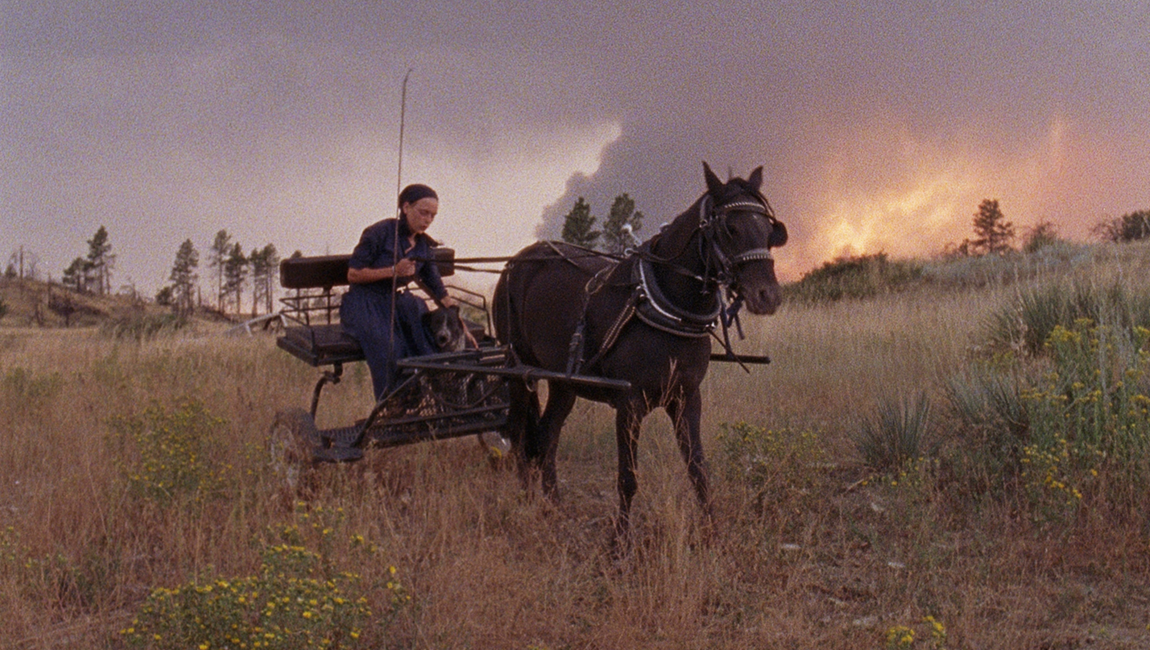
A girl, likely in aged in the single digits still, follows on horseback as a cow saunters down a wooded path. A man, old, wizened — ancient, even — fries an egg for breakfast and eats it with a delicate hand. An Amish woman points to the gigantic pile of wood she cut with a chainsaw and warmed herself with during winter. These are but three of the many characters exuberantly sketched in Ashland, Wyatt Maw’s homespun documentary about the Montana town of the same name. Maw is a proud native of the state, opening his film with a dedication to its “inhabitants… Two legged, four legged, and the spirit that guides them” in handwritten titles reminiscent of Les Blank. While Maw does not probe Ashland, Montana, with the same anthropological acuity found in Blank’s best work, his film is a delightfully kaleidoscopic bit of Americana demonstrating that all American cinema, or at least that which is honest about the American condition, is really regional cinema.
Ashland is more interested in the feel of its setting than it is drilling into the details of its subjects’ lives: no one subject emerges as whole, and it shuffles between them with guileless glee as it straddles the fine line between expressionistic and outright experimental. Maw grabs Ashland by the handful, dispensing with docu-narrative convention and giving us nothing but the good stuff — the film is a mélange of impressions we’re entrusted to imbue with our own sense of curiosity. Ideas do emerge amidst the turning and sifting, however. The passage of time is a major preoccupation, and how a place adapts (or doesn’t) to that passing. A Native man rides through town on horseback, insisting he must keep the tradition alive; a teen practices a dance set to folk music infused with dubstep; children at school work on laptops, and then find their way to the evening rodeo. Time collapses in Ashland, and when that aforementioned old man talks about the year ’89 and Maw cuts to a picture of covered wagons hanging on his wall, you believe for a moment he’s talking about 1889. These different people, and the different ways they relate to the space in which they live, emphasize how diverse the experiences found in a town like Ashland really can be.
Nourishment also builds a home in Ashland. After a brief establishing shot, the first image in the movie is not of a human being but of a foal drinking its mother’s milk. The symbiotic relationship between land and its populace comes up again and again in the film, in both explicit and implicit ways. When Ashland points toward the infinite in dialogue, it does so with dull platitudes and its relationship to spiritualism reads as vague. The notion is much more resonant when we see an Indigenous gathering and its corresponding rituals than when we hear “we’re supposed to be linked to the land” outright. Yet the drive to clearly state his position comes from an observably well-intentioned, heartfelt place, and Maw more often than not recognizes that this ecstatic connection is best communicated directly through form.
Ashland was shot on 16mm film, and Maw uses the texture of the format to explore the rich geographic nuances of his setting. Water shimmers and bends much in the same way it does in Ralph Steiner’s 1929 film H2O; a horse runs in a circle in a quick series of shots that echo Le Grice’s Berlin Horse; and, most famously and obviously, Terence Malick is called upon as the camera lingers on fingers touching grasshoppers before they bounce away. God (or whatever you may call Her) is in the playful squirting of a cow’s milk on your sister, going on your first bull ride, and, yes, taking your pet chicken to the store and feeding it ice cream.
Ashland comes to us in a media landscape awash in faux-transcendentalism — last year alone gave us insufferable pseudo-Malickian work like Hamnet and Train Dreams — and it injects a much-needed earnestness into the mode. Maw may not reach the heights of his progenitors, but his observations on lives lived plugged into America’s source are more astute than many of his contemporaries. In one brief and moving sequence, he follows buffalo as they stomp freely through the prairie, stops to gaze frankly and nonjudgmentally on one as it decomposes, and lands on a calf wandering with wide eyes. Let the circle be unbroken.
Comments are closed.