
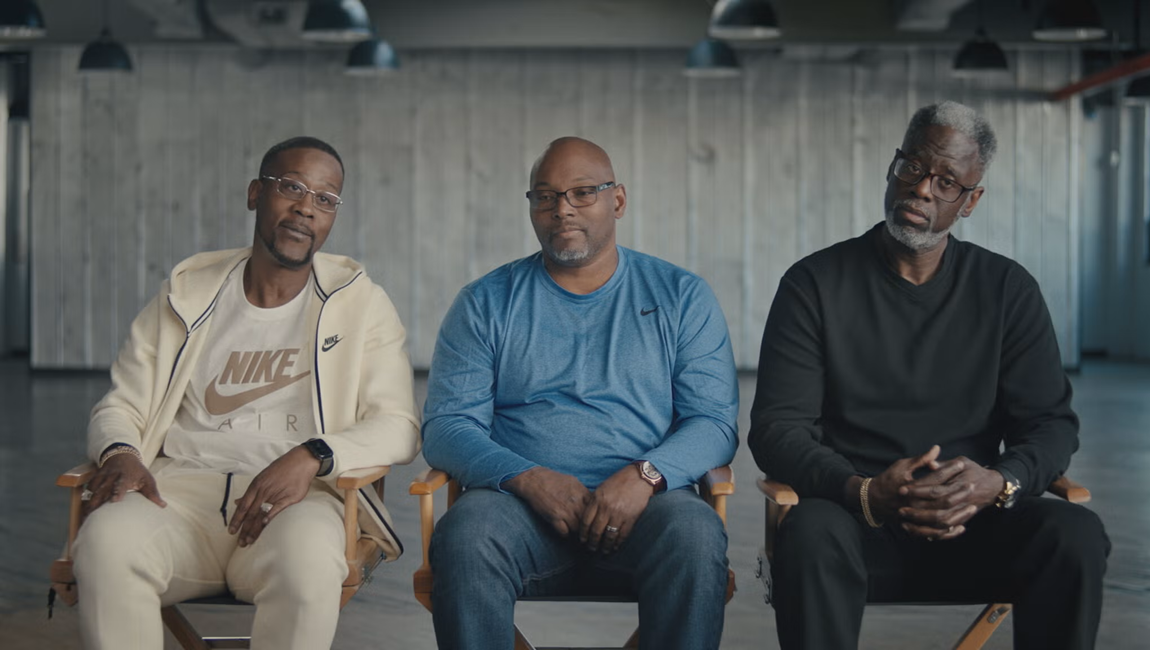
Near the end of Dawn Porter’s HBO documentary When a Witness Recants, the director has her subjects sit in a circle, facing each other. Her subjects are four men. Three of them are Andrew Stewart, Ransom Watkins, and Alfred Chestnut, men who, in Baltimore in 1983, were wrongfully convicted of the murder of DeWitt Duckett. The fourth man is Ron Bishop, whose witness testimony contributed to the three men’s imprisonment. It’s the first time Stewart, Watkins, and Chestnut are seeing Bishop since ’83, when the four were 14 years old and attended the same school.
The media dubbed Stewart, Watkins, and Chestnut the Harlem Park Three at the time of Duckett’s murder, which took place in Harlem Park Junior High. The reason for the murder was Duckett’s sports jacket. Bishop was one of Duckett’s friends, next to him at the time of the shooting. Though Bishop and another of Duckett’s friends identified only a single shooter, testimony, which Porter shows through lead investigator Donald Kincaid’s deposition tapes, was falsified and forced by the authorities, placing Stewart, Watkins, and Chestnut at the scene of the crime. The three children were sent to prison after a trial that Porter illustrates was deeply flawed: evidence was suppressed by the prosecutors, a witness was placed at the scene who was never there, and Bishop gave incredibly ambivalent and halting testimony. The three spent 36 years in prison before being released in 2019, after their convictions were overturned, largely due to Chestnut’s persevering and determined efforts to have exculpatory evidence, such as police reports that were suppressed during the trial, brought under the purview of Baltimore’s Conviction Integrity Unit. Bishop also recanted his testimony. The men sued the Baltimore Police Department for their egregious misconduct, and settled for $48 million.
Executive produced and narrated by Ta-Nehisi Coates, who was also a child in Baltimore at the time and was deeply impacted by the trial, Porter’s film enlists Coates to provide cultural context for the three men’s stories. And When a Witness Recants is indeed the three men’s story. The facts of Duckett’s murder are presented, but never once does the film study or survey the incident in the blood-thirsty manner that many true crime documentaries do with regard to their respective subjects; Porter’s film never become predatory, understand that approach to be a means of victimizing the victims all over again through sensational and leering terms. Rather, When a Witness Recants carefully understands that there are two crimes that have been committed: Duckett’s murder, and the three men’s wrongful convictions at the hands of the state. Porter concerns herself more with the latter, and does so with humanity and respect for Duckett, Stewart, Watkins, and Chestnut.
There is a spacious and calm pace to When a Witness Recants, a clear refusal to hurry through the facts and events. This is because, unlike most true crime documentaries hitting theaters and streaming this days, Porter’s film isn’t self-indulgent, has no interest or aim to break any case wide open. It’s not that the director doesn’t care about who really murdered Duckett (a person much of the Harlem Park community was aware of as the culprit), but rather that focusing on any murderer would be beside the point. And so, while we certainly are given the facts around Duckett’s murder, that is never what the film becomes about. Instead, When a Witness Recants seeks only to allow Stewart, Watkins, and Chestnut to speak, and so gives them time and space to do.
Movingly, the men talk about how they felt as kids being forced into a brutal prison system, how they were terrified, how they survived, what they lost as the state forced them to abdicate the lives they wanted to live. They couldn’t be normal in the way Bishop was, who graduated college, and they couldn’t be normal like their other peers were, who became fathers and employees. Their only course was to face violence, all because of a callous, racist, classist judicial system that is actively antagonistic toward its own citizens.
When a Witness Recants is an exposition of a truly diseased system, but perhaps more poignantly than that, it’s a film about men who, though they are free now, lost so much of their lives, were made to lose so much by a man like Kincaid, who cared more about closing a case — which is to say, cared nothing for justice or about ruining three kids’ lives. As a grace, Porter allows Stewart, Watkins, and Chestnut the care and safety to tell their stories, to give voice to their interiority: we see them working toward happiness now, and we see all that the carceral system forced into them. They are indecisive about what they want for lunch, having spent so much of their lives in a violent and paternal system that made such decisions for them. We see in the three how much we all are damaged by the police and a crooked legal system, how we often have to advocate for ourselves and our community, how we save each other.
And so, near the film’s end, Stewart, Watkins, and Chestnut sit before Bishop, who expresses how the racist Kincaid bullied and victimized him as a kid, forced him to say untrue things, how he has lived with titanic guilt for the past 36 years. And after Bishop has spoken, Stewart, Watkins, and Chestnut sit for a moment in silence. Finally, each takes his turn and speaks. Neither of the three can forgive Bishop, because forgiveness still can’t erase the fact of it all, of all that the three men have lost, losses that circumscribe their movements today.
When a Witness Recants isn’t a swanky true crime film filtered through the trappings of pop documnetary entertainment, one that wants to present long-lost evidence, that wants shatter the earth. It knows our worlds are already shattered. The evidence has always been there, and Chestnut fought so hard for it. Rather, then, it’s a deeply and profoundly human film, one that shows us the costs so many have had to pay for these lumbering systems that serve only rich white men. Punctuated by beautiful black-and-white animation by artist Dawud Anyabwile, which brings the past to life, and maintained by Coates’ commentary, always clarion and searing, When a Witness Recants brings us into three men’s lives, lives defined by a story of wrongful conviction, a story unfortunately far too common.
DIRECTOR: Dawn Porter; DISTRIBUTOR: HBO Max; STREAMING: November 17; RUNTIME: 1 hr. 52 min.
Comments are closed.