
Long before Russia commenced its full-scale invasion of Ukraine in the winter of 2022, preeminent cineast Andrey Zvyagintsev already saw dark clouds gathering over his motherland. With Leviathan (2014), he delivered a ferocious dissection of the rampant economic and moral corruption running amok in Russia’s bloated bureaucracy. Follow-up Loveless (2017) was even bleaker in its morbid portrayal of a dissolved marriage, in which a separated father and mother vainly look for their missing son. As its title implies, Loveless was also about the charred hearts of Russian denizens, who opt to ignore the moral failures of their collapsing society and retreat to smartphones, lavish restaurants, and luxury wines to remedy the sepsis gradually growing within their borders. The final shot, of the embittered mother aimlessly walking on her treadmill while sporting a Russian Olympic tracksuit, made it brutally clear that Zvyagintsev was not just criticizing the bourgeois values of his protagonists. His last film in Russia, like many of his works inevitably banned in its country of production, delivered a critical diagnosis of an entire populace that drank too copiously from the poisoned chalice.
Many things have happened since Loveless‘ bitter condemnations. Although respected for his artistic pedigree, Zvyagintsev has also always been reviled for his scorching critiques of his fellow men, making him never too comfortable within Russia’s borders. The perverted “Special Military Operation” then forced his definitive exile to France, where — having nearly lost his life to COVID — he spent years rebuilding his health before returning to filmmaking. While the global film community awaited his cinematic response to the externalized evil of Russia’s militarized era, there was a serious risk that Zvyagintsev would never make a film again. That’s why the inclusion of Minotaur, his first film in nine years, in the main competition at Cannes anxiously amped anticipation for the entire festival. Would the world-renowned director and chief skeptic of Russia be able to deliver another relentless dissection of his homeland?
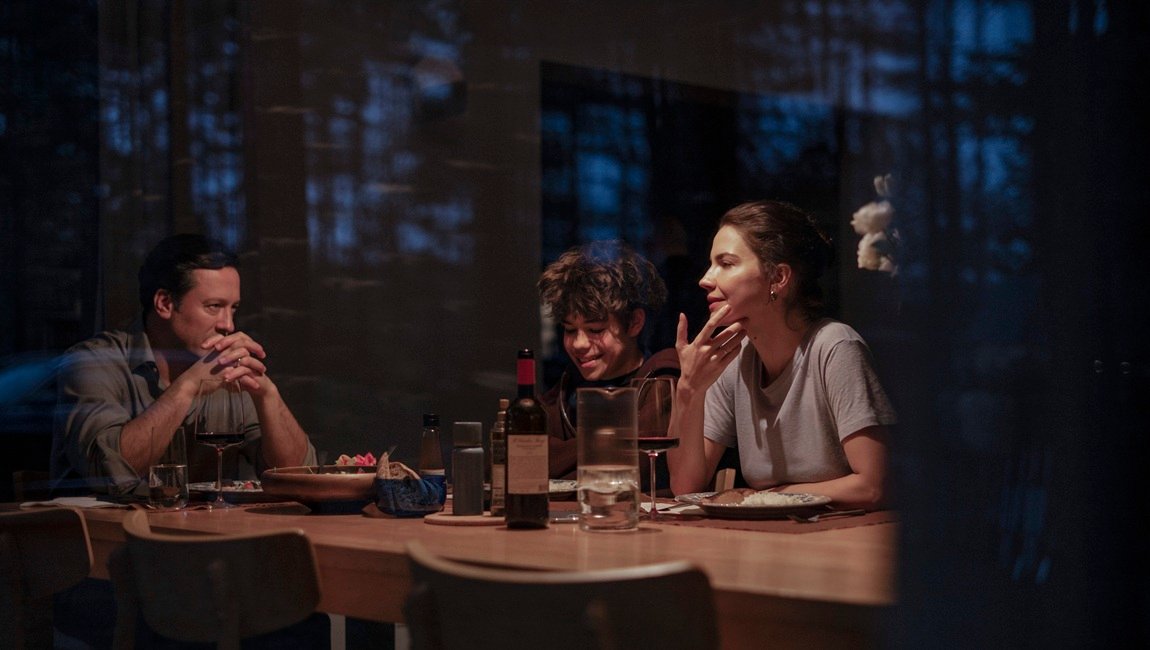
Fortunately, Minotaur is another highlight of this year’s competition, a solemn melodrama with tinges of a brooding thriller, set against the backdrop of Russia’s heightened militarization shortly after the invasion of Ukraine. Although produced in exile, the exterior shots of Latvia perfectly resemble an unspecified Russian city not too far from the border with Crimea’s occupied territories. Every billboard in town is a military enlistment ad; armored tanks are hauled toward the front by rail; mothers and lovers send their beloved off to war. This demented vibe naturally seeps into daily life at Gleb’s logistics company, where the phlegmatic director (Dmitriy Mazurov, in his most accomplished role) is forced to compile a list of expendable employees he is willing to give up on and send to the front as cannon fodder. It’s slim pickings already, as plenty of staffers have recently bolted to Georgia and Kazakhstan — just like one of his friends, who over dinner announces his cowardly departure to Thailand to keep on enjoying “the good life.”
It’s tempting to think of Gleb as a victim of circumstance, especially given the fact that the bloodthirsty political epoch is the backdrop against which his own marriage violently collapses. However, there are no victims in this loose adaptation of Claude Chabrol’s La Femme infidèle (1969). Without any trace of polemics or overt sentimentality, Zvyagintsev insists that not a single person depicted on screen is in any way opposed to the supposed military operation. There are no conscientious objectors, nor “good Russians,” so to speak. What we have are scheming individuals who realize that, in this shifted reality, they simply have to scheme a bit harder to stay afloat. It makes the many readings of critics who insist on the presence of bothsidesism here all the more disappointing, as Zvyagintsev is the last person imaginable to extend an olive branch to his protagonists.
Rather, he lets them sink even deeper in their own swamp, until the personal and the political are conflated to the point of no return. Gleb’s discovery of an affair between his wife, Galina (Iris Lebedeva), and a younger photographer (Yuriy Zavalnyouk), inspires the most violent sequence of the film. After that crime of passion, the Russo-Ukrainian war slides even further into the background, implying that most Russians have other things on their mind than the pointless destruction they have unleashed in the West. This is Zvyagintsev’s most brutal indictment of his native land and its people, as he dissects how the war machine actually becomes a convenient tool for Gleb to cover up his murder. It’s an uncomfortable truth for those who still choose to speak of “Putin’s War” and are afraid to point to the inherent evil residing in the Russian soul — we can trust Zvyagintsev, however, when he points to all these people and tells us they are actually fine.
Most remarkable is the steadfastness through which Zvyagintsev frames this feverish environment. His trusted cinematographer, Mikhail Krichman, once again composes austere tableaux in which the bleakness plays out on its own. One inspired long take, in which the camera pans through the apartment where Galina consummates her affair, especially evokes the transcendental rigor of Andrey Tarkovsky — the most common reference point for critics and academics who seek to place Zvyagintsev in a lineage of Russian and Soviet film history. This comparison has become all the more ironic given the fact that the spiritually imbued formal qualities of Tarkovsky are now being utilized by Zvyagintsev to scrutinize a spiritually vacated society. The preeminent contemporary Russian auteur remains a bitter skeptic of modernity, one who uses his formal exactitude to capture the dissolution of the soul. While this dourness might sound off-putting, it’s Zvyagintsev’s thoroughness that alleviates the sour material and sculpts it into something grand.
The director remains a master of seemingly literal narratives that carry much greater depths. Minotaur‘s title finds an apt connection between the monstrosity lurking in the labyrinth underneath Crete and the young men who are ritually sacrificed to feed the mythological beast. The association with the expendables who await pointless humiliation and certain death at the front carries a historical weight that pries Minotaur out of the present and places it within a cyclical pattern of suffering and sacrifice. Still carrying the torch of transcendental cinema, Zvyagintsev has thus made the most ferocious film that speaks to our times. As the foreboding final image of gathering clouds in stark black-and-white suggests, this highly localized story now addresses the entire world, alongside its doomed population.
Comments are closed.