
Sometimes the first shot of a film tells you enough to know you’re in the hands of a great director. Arthur Harari’s The Unknown — so far the genuine standout of this year’s Cannes competition — opens on such a note, with an awkwardly framed hyper-digital POV shot of David Zimmerman (Niels Schneider) behind the wheel of his car as he parks it in some anonymous Parisian neighborhood. Janky, disorienting, out of place, Harari’s departure point is the scenery that has been taken for granted, so violently ugly and devoid of meaning that it merely serves as thoroughfare. Only David seems to be interested in these forgettable places. The creeping photographer has tasked himself with shooting the liminal spaces of Paris’ suburbs, capturing them on the exact spots from which they were photographed a century ago for what are now sepia-tinged postcards of the past. This Quixotian undertaking seems to be his way of mapping marginal environments that have been violated by the architectural onslaught of capitalist postmodernity.
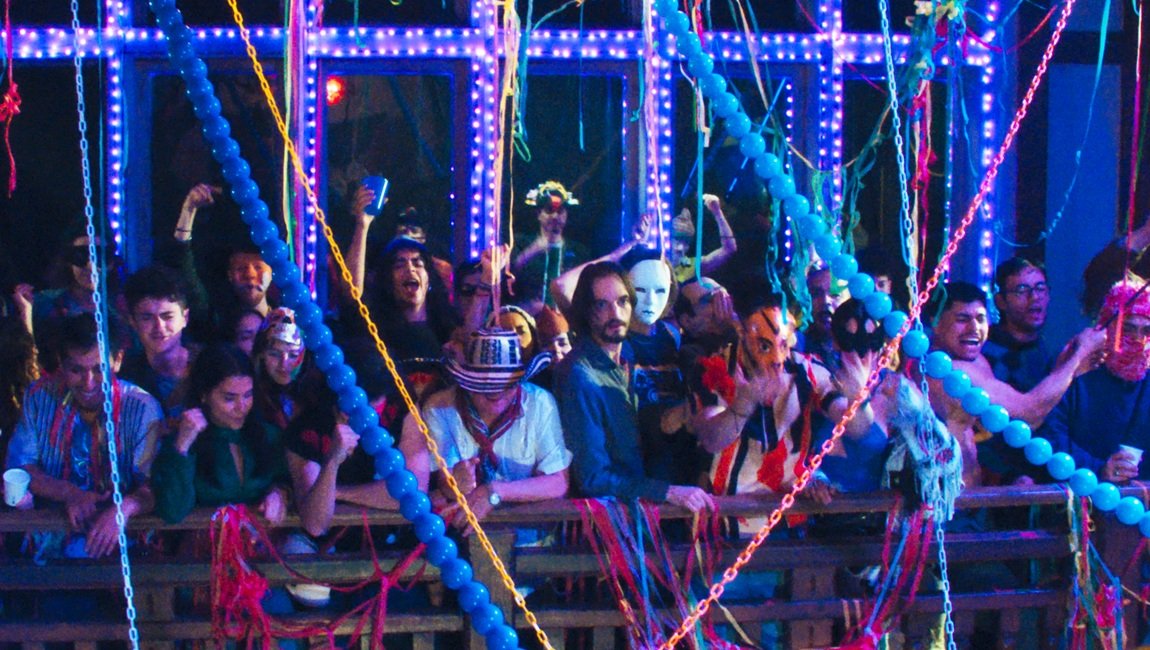
Already an antisocial recluse with an off-putting visage and a hunchback-like posture, David himself will soon be violated by a mysterious condition that displaces him out of his body wholesale. While on the high of an ecstasy pill he reluctantly accepts at a party he clearly doesn’t want to be at, he’s inexplicably pulled in by the gaze of a mysterious woman (Léa Seydoux). And as if he were the one now driven by higher powers, he follows her on autopilot to the club’s basement, where he stoically and speechlessly fucks her to the point of completion. This early climax is when The Unknown starts a second time, with a post-coital David suddenly inhabiting the body of this woman called Eve. The realization of this body swap is physically disorienting and revolting to him. On an existential level, it is wholly terrifying. For a film about the creeping condition of out-of-placeness, David’s sudden “metempsychosis” is the Freudian uncanny embodied in extremis.
The simple genre trope of the body swap opens up an exciting can of worms for Harari, who based his third feature on the graphic novel The Case of David Zimmerman, which he published in 2024 alongside his brother Lucas. With this mysterious feature that cannily resists any linear interpretation, the director of underrated war epic Onoda: 10,000 Nights in the Jungle (2021) and Oscar-winning co-screenwriter of Justine Triet’s Anatomy of a Fall (2023) is now staking a claim as France’s strongest cinematic voice. The agility of his roaming screenplay and the dexterity of the enigmatic digital cinematography by Tom Harari — another Harari brother — most closely resemble Bertrand Bonello’s conceptual approach to genre filmmaking. Both share a pleasure in stretching the conventions of genre to near-impossible dimensions, and in the case of The Unknown, it only makes sense that a film about bodily displacement itself feels constantly displaced, as if we’re on an impossible quest to course-correct the narrative’s sudden rupture at the beginning of the film.
Finding the right tone to navigate the broad parameters of the thriller-like screenplay is a huge task that mostly falls on the stellar acting of Schneider and Seydoux, who give some of the most demanding and impressive performances of their storied careers. Much like John Travolta had to act like Nicolas Cage was living inside his body in the legendary body-swap extravaganza of John Woo’s Face/Off (1997), these French thespians perform with and against their own physiques, which bestows on The Unknown a kind of corporality that is endlessly fascinating to unpack. Matters get even more complicated when Eve, now residing in David’s body, finds a new prey in teenage girl Malia (Lilith Grasmug), resulting in a second post-intercourse body swap that demands Schneider play with the hormonally charged insecurities of a pubescent girl within his emaciated male build.
Aptly titled, The Unknown is an exercise in depicting what it feels like to be a stranger in your own body, and a nobody in the world around you. While the gender-swapping hijinks might provoke a need for queer readings of transness and non-binary states of being, Harari seems wholly uninterested in dealing with such identity politics. And why ask such literal interpretations of a film that is already highly political, in the way that people stripped of everything have become the ultimate outcasts of an uncaring society? The film is quite literally about their individual uncertainties, amplified by the exchanges of body and problematized by the incongruity of how they now navigate their surroundings.
The heart-wrenching yearning of Malia, now within David’s physique, as she tries to reconnect with her father — a brilliant cameo of Romanian film maverick Radu Jude as a Marcus Aurelius-quoting crane operator — points to an impossible melodrama. Meanwhile, David (still performed by Seydoux) is looking for answers about this condition that the film naturally never gives. The pleasure is in not knowing and simply surrendering yourself to the strange cinematic construct the Hararis have set up — to make a film that is allowed to go in whatever direction they want to take it. This is where the disquieting cinematography and Andrea Poggio’s haunting score take center stage as a formal inquiry into 21st-century malaise.
Given that he is also one of the great classicists of our era, it’s all the more impressive that Harari made such a formally daring and forward-thinking film that fully embraces the cinematic unknown. Onoda: 10,000 Nights in the Jungle was his pitch-perfect ode to formalist forefathers like John Ford and Raoul Walsh that, while wearing its influences on its sleeve, never veered into Fordian pastiche. As if he has shed his own cinephilic skin, none of these classical traces are present in The Unknown anymore — the anxious uncertainty of this film simply demands a less absolute visual language. This disquieting sense of something always missing is what proves omnipresent in this highly unnerving film that masterfully and boldly ventures deeper and deeper into the void.
Comments are closed.