
Harmony Korine gleefully threw genre cinema in the deep fryer with the hitman miasma of Aggro Dr1ft (2023). This year, Nicolas Winding Refn took it upon himself to put that oozing concoction back into the freezer. The chilling Her Private Hell, his first feature in 10 years, shares Korine’s end-of-cinema philosophy, insisting with equal conviction on a formally daring film that is light on plot and heavy on vibes. Inspired by flicking through television channels as a young Danish boy who had just relocated to America, the auteur behind elevated genre fare like The Neon Demon (2016), Drive (2011), and The Pusher-trilogy (1996–2005) wanted to craft a cinematic universe in which narratives lowkey bleed into each other. Turns out, Her Private Hell is not so much a film concerned with stitching those divergent storylines together, however, as it is an audiovisual experiment in how to evocatively mesh manifold emotional registers within the same frame.
The television analogy suggests sensorial overload. Refn, however, unapologetically goes against the grain by ruthlessly pitching the tempo down. Imagine the overstretched narratives of his direct-to-streaming miniseries Too Old to Die Young (2019) and Copenhagen Cowboy (2023), now sprawled out to an even more violently glacial effect, and you get a good sense of the subzero cinema Refn sought to make. Her Private Hell‘s insistence on narrative minimalism allows us to be somewhat brief about its story, set in a hyper-capitalist non-place that feels like a futuristic perversion of Coppola’s Megalopolis and the influencer hell of Dubai. In search of his missing daughter, an American soldier called Private K (Charles Melton) drifts through this spiritually devoid realm, completely shrouded in mist. It is understood that his daughter is captured by a devilish serial killer called The Leatherman, who preys on young women and drags them to hell. Played with stoic exactness by heartthrob du jour Melton, Magnus Nordenhof Jønck’s camera feasts on his hulking physique, painting him as something between an action figure, a Jesus-like redeemer, and a fetish object from a Tom of Finland drawing.
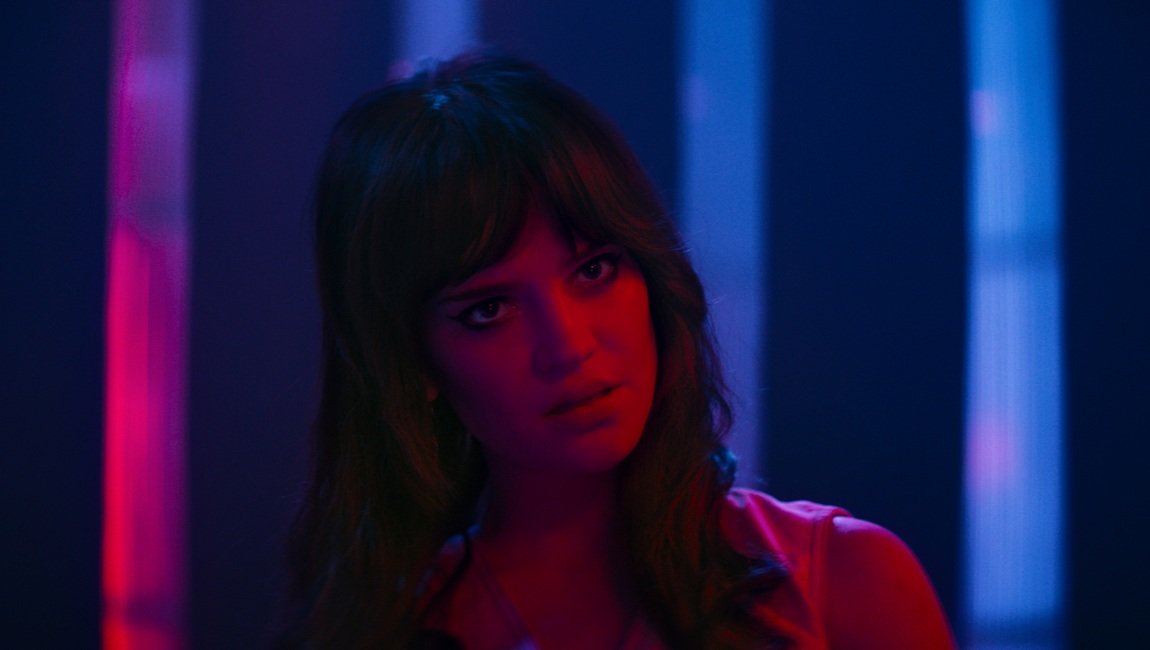
Private K’s hyper-masculine and ultra-violent journey to the depths of this neon-lit hell is not quite offset, but rather supplemented, by the story of Elle (Sophie Thatcher). This anxious starlet resides in the penthouse suite of one of the film’s many generic skyscrapers, a wasp’s nest of female betrayal not unlike the connivery of Keeping Up With the Kardashians (2007–2021). Riddled with daddy issues and tormented by her best friend-turned-evil stepmother, Elle is a lost soul in familial captivity, making her an easy mark for The Leatherman. If and when he will strike doesn’t really matter, though. How Refn laces these patchwork stories into one majestic piece of genre cinema is where the excitement of this film resides.
His approach is nothing less than operatic. Actors move in statuesque fashion through a heavily abstracted mise-en-scène that recalls the existential alienation of Michelangelo Antonioni. Meanwhile, the grandiose score of Pino Donaggio turns the stilted performances into a literal opera. Instead of aping his pastiche-friendly scores for Brian De Palma classics, the legendary Italian composer delivers the most accomplished musical piece of his storied career. The depth of his operatic scoring functions as the main canvas on which Refn spins out his intricate web. The clarity of the music also helps give shape to the conscious opaqueness of Her Private Hell‘s narrative, allowing the internal logic of the film to naturally emerge from the mist. The pitch-perfect maximalist approach to an extremely minimalist storyworld tastefully steers Refn’s eleventh feature away from cathartic failure toward somnambulistic masterpiece.
When Refn pulls open all the registers, some of the most poignant imagery of his oeuvre seems to appear out of nowhere. The way Private K’s blood-riddled descent into hell slides into the sexually charged emotional minefield of Elle’s domain is nothing short of breathtaking, with the most accomplished scene taking place in an avant-garde nightclub sequence that stands in as the literal peak of Refn’s neon-tinged genre distillations. Best described as slow cinema’s take on club strobes, the gradually sliding lighting on the actors’ gorgeous visages becomes Her Private Hell’s pathway to the realm of conceptual video art.
Not much else is happening here, but who cares at this point — not when one of the most gifted genre auteurs treats you to such texturally dense imagery. You have to feel sorry for the people who reject such visions of the cinematic, only because the conventional plotting suffers for it. Admittedly, getting into Her Private Hell takes some work, but it’s the type of demanding viewing that pays to the benefit of willing viewers. For once you have fully embraced the mist, you will see that Refn’s rentrée to cinema is one of the rare works that infuses the visceral excitement of pulp with the sanctity of high art.
DIRECTOR: Nicolas Winding Refn; CAST: Sophie Thatcher, Charles Melton, Havana Rose Liu, Dougray Scott, Kristine Froseth; DISTRIBUTOR: NEON; IN THEATERS: July 24; RUNTIME: 1 hr. 10 min.
Comments are closed.