
What a strange thing, the Olympics. In 1896, with the tools for globalization just barely on the horizon, the world (or, rather, Greece, leveraging its historical claim to the games) decided to know each other better through friendly contests. World competition predated the world wars, which should strike one as a rather optimistic fact if it weren’t for everything that came after. Still, the games represent such naive optimism about world affairs, and most competing countries see them as equal parts diplomacy and opportunity to flex on the world stage. The overall winners are never a surprise, but any athlete from a smaller country who wins gold will immediately enter that country’s history books. It’s nice.
And yet, films have long struggled to communicate what’s so interesting about the games. Leni Riefenstahl’s Olympia is infamous for rather obvious reasons, but the body worship that frames the film wasn’t a commentary on the event itself. It was effectively a remake of UFA’s Ways to Strength and Beauty from a decade earlier; for Riefenstahl, the Olympics was simply a meeting of hygienic specimens who collect points. Kon Ichikawa’s Tokyo Olympiad abstracted this further, showing victory, defeat, slow-motion running, and the roar of spectators. It’s a beautiful commercial for the concept of sports, but the games could have easily been the World Cup or a local Little League. Only fiction films like Spielberg’s Munich seem to grasp what a bizarre and potentially dangerous thing it is to have all the world together.
Giulio Bertelli’s Agon stands apart from this history by incorporating all of it. Like Olympia, it focuses on the body itself, documenting motion and — for rifling — the lack thereof. Like Tokyo Olympiad, it finds drama in the games themselves (”agon” being Greek for “struggle” or “contest” or “gathering” and the root for “protagonist” and “antagonist” and “agony”). But, like Munich, this is a fictional film, and one that knows that much of what makes the Olympics special lies behind the scenes.
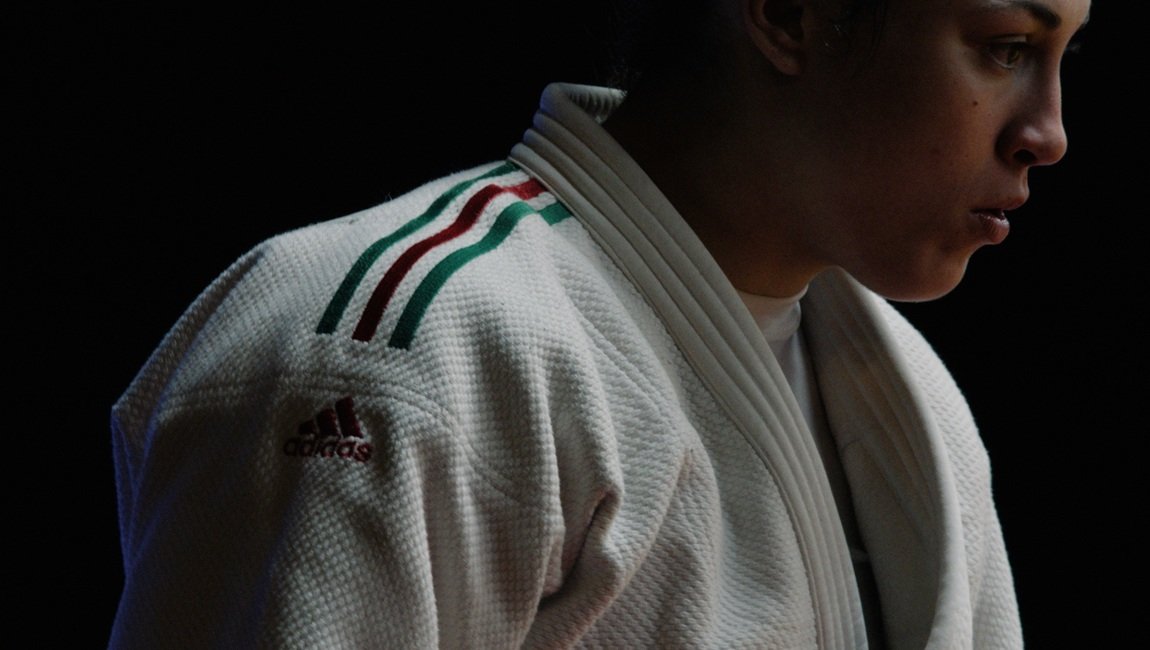
Yet it would be easy to mistake Agon as a straightforward documentary on its subjects. The film features very little dialogue, and the narrative can only be parsed through bits of voiceover and blink-and-you-miss-it moments. The camera mostly keeps a respectful distance from its three Olympians — a fencer, a sports shooter, and a judoka — as they prepare for the games, much like the fitting room scenes of last year’s Afternoons of Solitude. Yet, as the games begin, these athletes fall into scandal and misfortune. Their attitudes and histories suddenly matter much more than sheer physical prowess, and their once surefire victories are challenged.
These little dramas are rarely interesting, but they serve as a solid foundation for some exceptional filmmaking. So much of Agon resembles the work of the Sensory Ethnography Lab as it records an environment full of specialists whose silent work begins to look like ritual. During judoka Alice’s (played by real judoka gold medalist Alice Bellandi) leg surgery, the film frames the doctors all in a row tending to the hole in the sheet, as if they’re priests consecrating holy ground. Just like De Humani Corporis Fabrica, the film often switches between this observational mode and the strange visual language of medical imaging technology like endoscopy cameras and MRI models of the human framework. Perhaps Riefenstahl wishes she could have been so intimate with the body.
The film is at its best when it’s effectively a documentary about the bizarre kinds of sports medicine software and equipment available to the best of the best. When Alice begins walking during her physical therapy, she’s placed in an anti-gravity treadmill, which inflates a plastic shield around her and which DP Mauro Chiarello frames to look like a Cronenbergian Bubble Boy suit. Similarly careful attention is given to the processes that make the Olympics possible: the manufacturing of Olympic-grade gear. Bullets are formed and sorted; the metal of the fencing masks is carefully woven into the impressive stitching that guards these combatants from injury or death. The accident that haunts fencer Giovanna (Yile Vianello) revolves around this manufacturing, one that, with any even slight mistake, results in a global investigation with fingers pointed in every direction. Every little stitch is political here.
And, just as the medical imagery accentuates the judoka, the rifle shooter Alex (Sofija Zobina) uses video game imagery to focus on holding her breath for her event. A particularly lengthy scene in the pool is suddenly overlapped with gameplay from the cult rhythm-shooter Rez Infinite; other training montages use clips from FPS aim trainer KovaaK’s. Their contextless bits of lights and colors rhyme with the equally surreal videos of human organs — all of these screen-based images and UI are seen as pertinent to these athletes’ training and recovery. Screens are also used to calm the athletes’ jitters such as when Alex wants to take her mind off her hunting scandal by masturbating to hentai. This technology plays more of a role in their lives than any of their trainers.
Much like Theo Anthony’s short Subject to Review, Agon seems interested in the ways that technology has redefined the athletic event by making everything so inhumanly precise. But it’s also interested in politics and scandal, such as in Alex’s inability to be represented by her country after her poaching photos were discovered or the kind of international blame game that arises when anything goes wrong. It’s good at asking these questions, but it quickly retreats from prodding further, lest it take a stance. Still, even if this is not quite a Farocki film, nearly every minute Agon is visually exciting, and many of its dozens of ideas stick the landing. Bertelli seems to be a deft painter of the weird-chic, and his Agon shows just how strange the Olympics can be.
DIRECTOR: Giulio Bertelli; CAST: Yle Vianello, Alice Bellandi, Sofija Zobina, Michela Cescon; DISTRIBUTOR: MUBI; STREAMING: April 24; RUNTIME: 1 hr.
Originally published as part of New Directors/New Films 2026 — Dispatch 2.
Comments are closed.