
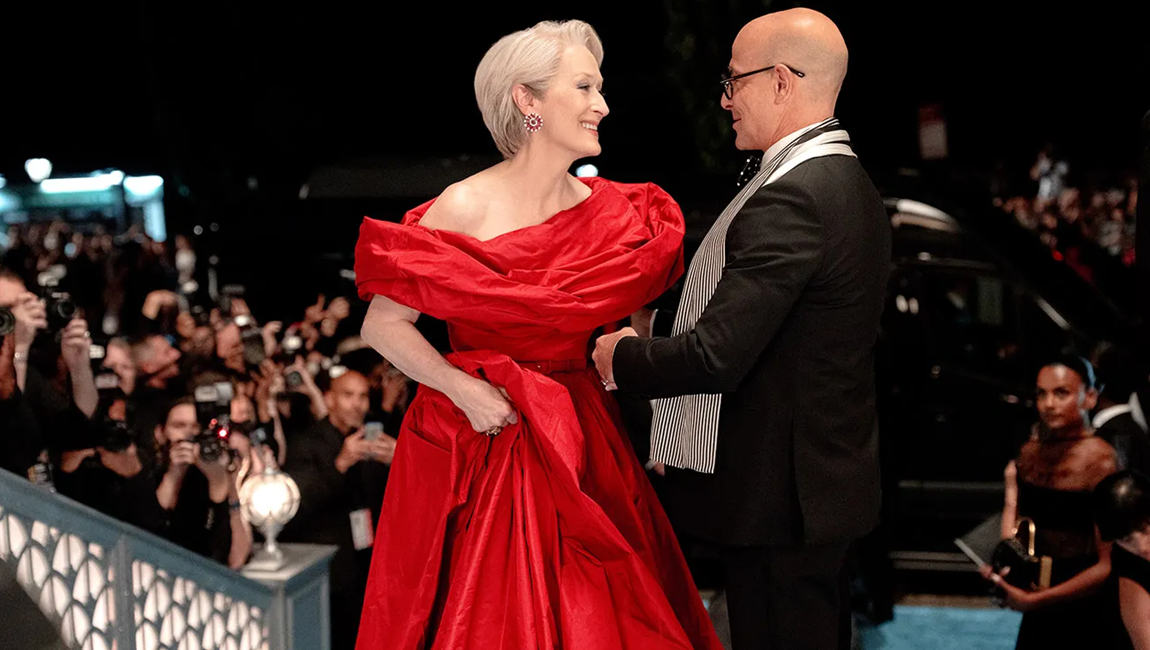
Maddening as it is that the middlebrow (leaning low) fodder of yesteryear continues to serve as a lightning rod for conservative megacorporations eager to cash in on nostalgia well into the second half of the 2020s, it’s a fact that those of us who continue to care about the sorry state of mainstream American cinema must face. Some, like Happy Gilmore 2, manage to rise beyond their progenitors’ cult makings to address the moment. Others, like Spider-Man: No Way Home, reek of insincerity and greed. (Yet still others, like Nirvanna the Band the Show the Movie, make a playground of cultural time, although Matt Johnson hails from the less-infected land of Canada.) Of all the recent back-asswards-looking gold doubloons drudged up from the IP dungeon, however, The Devil Wears Prada 2 is by far the most self-loathing.
A rewatch of the original Devil Wears Prada inspires no small amount of awe that, despite the catty dialogue, its modest ambitions are achieved with baseline competence and more than a little optimism. In it, New York City is a real place populated with flesh-and-blood human beings; characters are broad, but portrayed with sincerity; scenes are photographed with affection; and it dares to argue that suffering the indignities of a shitty job is not worth your time — you can learn from it, walk away, and follow your passion. Most importantly, it depicts the fashion industry as something aspirational and amusing, but ultimately disposable. In The Devil Wears Prada 2, New York, its denizens, and especially the fashion industry, are distractions from and symbols for America’s decline.
It’s a deeply pessimistic, deeply strange, and deeply confused film. It brings to mind Sex and the City and its various mutations over the decades, aging from harmless utopian fantasy of New York in the ’90s into head-in-the-sand celebration of nouveau riche decadence amidst the Great Recession (and back again during the Great Pandemic), but with a smarmy self-awareness that indicates its creators know how ridiculous it is for them to be returning for sloppy seconds. Just like Andy Sachs (Anne Hathaway) as she returns to Runway Magazine: after 20 years carving out a career for herself as a journalist at a paper that goes belly up the moment she takes the stage at an awards ceremony, Andy gives an impassioned speech decrying the state of the journalism industry, only to have a clip of that speech land in the lap of the CEO of Runway, Irv, who offers her a job as the features editor in a bid to rehabilitate the magazine’s image after Miranda Priestly (Meryl Streep) published a poorly researched article singing the praises of a fast fashion company with shady business practices.
Dreadfully contrived, no ifs ands or size-4 butts about it, and the very fact that Andy returns to work for Miranda at all undoes the power of the original. But it does speak to the state of our economy, and it’s refreshing to hear the terms layoffs, downsizing, and consolidation crop up in a blockbuster. There’s just an enormous tension between those stated contemporary problems and the depiction of them onscreen: the film pays lip service to the sanctity of fashion and journalism, only to devolve into a jamboree of parties, cameos, and an unsettling thesis: if you burn yourself out and work past retirement age, you might be able to preserve the thing you love for just a little while longer in bastardized form. It plays, intentionally or not, like a sly self-own and a eulogy for the motion picture business.
The sense of the funeral is compounded by the fact that the characters we get are so completely nerfed — particularly Miranda, who returns here a husk of the embittered, caustic Devil of the original. Sure, Streep still knows her way around a severe look, but she’s given nothing to chew on and is rendered as having been totally beaten down by life: she and the rest of the characters mostly sit around brightly lit tables, bristling against the standards of the day. That is, until they stop talking at all when the crew moves camp to Milan, and we’re left on the outside of a major business transaction. Conversations happen behind closed doors, deals are made, and backs are stabbed, none of which we’re privy to. It’s a sort of anti-Hitchcock — don’t show the bomb, and don’t get the audience invested in the outcome. Director David Frankel was never a Hitchcock, but his work used to have some verve. Here, only a few brief montages signal any spark left in his process.
As a cultural artifact, though, The Devil Wears Prada 2 is priceless — it points straight at our zeitgeist, and there’s a single conversation between Miranda and tech billionaire Benji Barnes (a truly, rattlingly frightening Justin Theroux) toward the end that opens the whole movie up. Framed underneath The Last Supper, Benji ponders the impermanence of human endeavor, likening all of human achievement to the great civilization of Rome. “The world is about change,” he says. “The future just keeps rushing at us like the lava of Pompeii… one day it’s going to come, and it’s gonna smother us all. Maybe that’s the way it has to be.” Miranda looks on in horror, and then removes her glasses. “Maybe,” she responds. Shocking in its frankness, it puts a magnifying glass to the yawning 70-something oligarchs of the 2020s and the sadistic tech demigods swooping in to replace them. It’s a brilliant scene, and a version of the movie that leaned into this nihilism (á la Joker: Folie á Deux) might have been a great achievement that lost tens of millions of dollars. Instead, it just loads the inevitable happy ending with an acrid smell, and we leave the theater feeling bad sushi-style queasy.
500 years from now (or even 500 days from now — our cultural half-life has become so short), we can look back on The Devil Wears Prada 2 as a peacock in the data-driven coal mine: it makes a grand show of griping about how the structures and formats that made something like the first Devil Wears Prada possible have disappeared, while indulging in the very same contemporary decadences that led to the demise of the classic workplace/romantic comedy. Like a spurned lover, the genre has become a broken promise. “This is what it was all about, wasn’t it? Promises?” Joan Didion writes in her essay on leaving New York. We could ask the same of The Devil Wears Prada 2, or the Hollywood comedy writ large: where has its promise gone? The response of its practitioners? Goodbye to all that!
DIRECTOR: David Frankel; CAST: Meryl Streep, Anne Hathaway, Emily Blunt, Stanley Tucci, Kenneth Branagh; DISTRIBUTOR: 20th Century Studios; IN THEATERS: May 1; RUNTIME: 1 hr. 59 min.
Comments are closed.