
Centered in a sepia-toned frame, two young, Black girls sit on a park bench, their backs to the camera. Another child passing by smears one as “ugly,” prompting one of the girls to follow him offscreen and beat him mercilessly. Having defended her sister’s dignity, she returns to her place next to her, their bond protected against the world’s cruelty. This brief jolt of a scene opens writer-director Aleshea Harris’ debut Is God Is, adapted from her Obie-award-winning play of the same name, and instantly reveals the cinematic ingenuity she brings to her own adaptation. Like the source material, Harris’ film is at once experimental and thrillingly narrative, a blistering, protean road-trip revenge thriller that encompasses a complex tonal palette and a diverse array of styles and techniques.
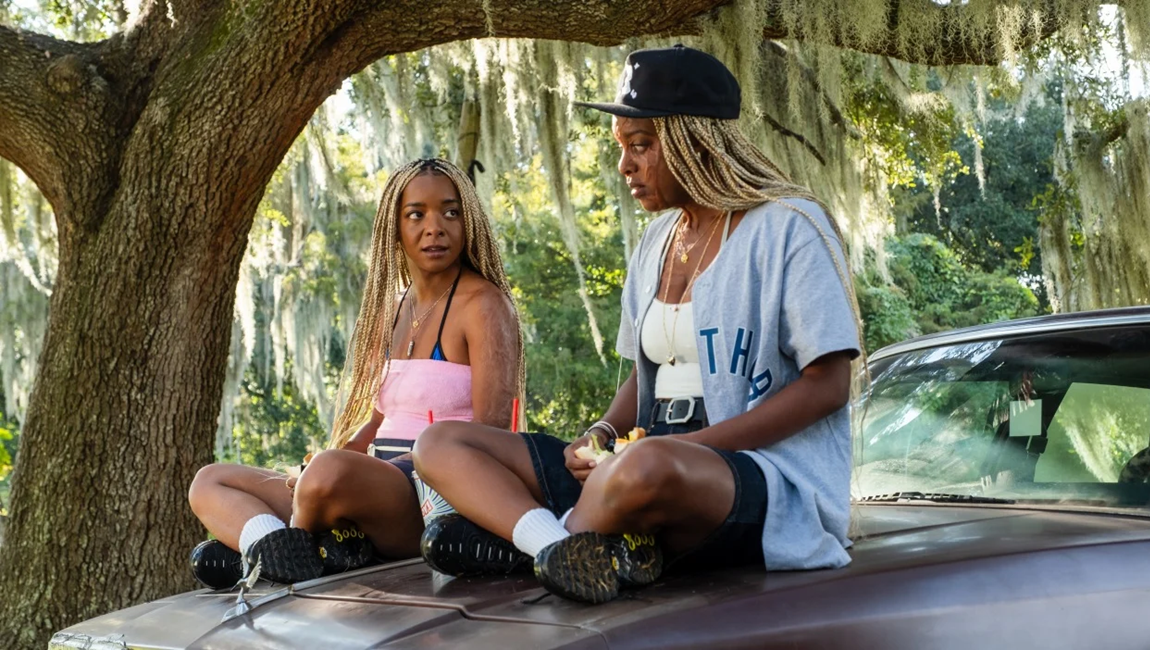
The (anti-)heroines of Is God Is are Racine (Kara Young) and Anaia (Mallori Johnson), twin sisters dependent on one another for companionship and stability. Both bear the scars of severe burn injuries; Anaia’s scars cover her face while Racine’s are mostly confined to an arm. With her less-visible disfigurement, Racine has taken on the role of fiery protector to the more sensitive Anaia. Their tenuous status quo is broken by a letter Racine receives from their mother. Racine and Anaia had presumed her dead in the same fire that injured them; now, they learn that she survived but is now on the verge of death, and she wants her daughters to come to her bedside.
Despite Anaia’s trepidation, they obey their mother, Ruby (Vivica A. Fox), who they find scarred and bedridden, yet regal, attended to by nurses who braid her hair. With commanding quietude, she tells them the long-buried story that has unwittingly shaped their lives. When the twins were children, their estranged father (Sterling K. Brown, billed only as “Man”) broke into their home in violation of a restraining order, choked Ruby into unconsciousness, doused her with liquor, and lit a match. Racine and Anaia were left with burn scars after they attempted to rescue their mother, and Ruby decided to feign her own death in the aftermath so that her children would not have to live with a mother who, in her own words, resembles an “alligator.” Now, so she can finally die in peace, Ruby gives her daughters a mission: to “make your Daddy dead. Real dead.” Racine — who refers to her mother as “God” — zealously assents, despite Anaia’s insistence that they are “not killers,” and they set off on a cross-country quest in which they encounter a multitude of eccentric characters and leave behind an ever-accumulating trail of destruction.
Harris’ highly stylized direction is at once propulsive and reflective, and she effectively marshals a formidable cast and creative team to form an often-staggering whole from disparate parts. Harris maintains inexorable forward momentum in following Racine and Anaia’s odyssey, which grows increasingly perilous, while making space for flashbacks and fantasy sequences that reveal the twins’ inner worlds and the characters’ complex pasts. Director of photography Alexander Dynan creates hypnotic images in the numerous sepia-toned flashbacks — a recurring image of Brown standing in a doorway laconically smoking a cigarette, just after his character has ignited the mother of his children, is particularly striking — and editor Blair McClendon weaves these scenes into the film’s present-day action without letting the pace slacken. The sense of time collapsing is heightened by Leslie Shatz’s densely layered sound design; the immersive soundscapes are particularly striking when Joseph Shirley and Moses Sumney’s polyphonic, genre-expansive score comes into play.
The considerable craftsmanship undergirds an absorbing and textually dense narrative. In Harris’ original play, she notes that the script “includes adventures in typography,” with emphasis, pronunciation, and speech rhythms illustrated through eclectic font sizing and placement. Harris brings a similarly experimental approach to text in her film adaptation, using medium-specific qualities of film to bring new shades to her characters. Harris makes frequent use of voiceover — particularly notable in the case of the character Chuck Hall (Mykelti Williamson), a paranoid lawyer whose tongue was once cut out of his mouth by the twins’ father — and she playfully captures the twins; nonverbal communication through text onscreen, mediated by knowing glances between Young and Johnson.
As in her original play, Harris’ dialogue is remarkable, both muscular and musical, and the ensemble of actors delivers it with vocal richness and thundering emotion. The experienced supporting cast — which, in addition to Fox, Brown, and Williamson, also features Erika Alexander as a deluded preacher who had a child with “Man,” and Janelle Monáe as his jittery current wife — collectively fulfill the tricky responsibility of bringing their characters to vivid life in one scene each. Young and Johnson are tasked with the equally challenging proposition of carrying the film’s emotional and narrative weight from start to finish, and both prove to be magnetic performers.
Young, a two-time Tony winner who is here in her first leading film role, is a volcanic presence. She lends the vengeance-thirsty Racine a physical and vocal dynamism that, while reminding one of her theatrical experience, is nevertheless expertly modulated for the screen. In Young’s portrayal, Racine’s rage is untrammeled and incandescent, making her rare moments of retreat all the more absorbing. Johnson, counterbalancing Young, gives the more subtle and internal performance, yet her quiet approach pays dividends when her character is forced to take on a more active role in the third act; Johnson offers a gripping portrayal of the push-and-pull between Anaia’s typically tentative nature and her long-repressed grief and anger.
Is God Is grows hyper-violent in its final act, yet the strong emotional backbone Harris has given the film lends the carnage an undeniable pathos. While Is God Is pulls from a wide array of influences — the text of Harris’ original play notes that it “takes its cues from the ancient, the modern, the tragic, the Spaghetti Western, hip-hop, and Afropunk” — the reference point that is easy to return to as a viewer is Toni Morrison’s novel The Bluest Eye, in which a Black girl deemed “ugly” becomes the unwilling receptable for the soul-deep ugliness of the society she lives in. Much is made of Anaia’s “ugliness” in Is God Is, and the persistent effects of physical and emotional violence against Black women form the film’s thematic backdrop. The revenge fantasy is a structure that allows the Black women at the film’s center to respond to the violence visited upon them; while Harris emphasizes the extensive collateral damage incurred by this vengeance, the film also provides space to relish Racine and Anaia’s rebellion against their abuse and dehumanization. That these textual and thematic complexities resonate so richly is not only because of their social pertinence, but also because of the immaculate craft and prodigious imagination Harris brings to her debut feature.
DIRECTOR: Aleshea Harris; CAST: Kara Young, Mallori Johnson, Vivica A. Fox, Sterling K. Brown; DISTRIBUTOR: Amazon MGM Studios; IN THEATERS: May 15; RUNTIME: 1 hr. 39 min.
Comments are closed.