
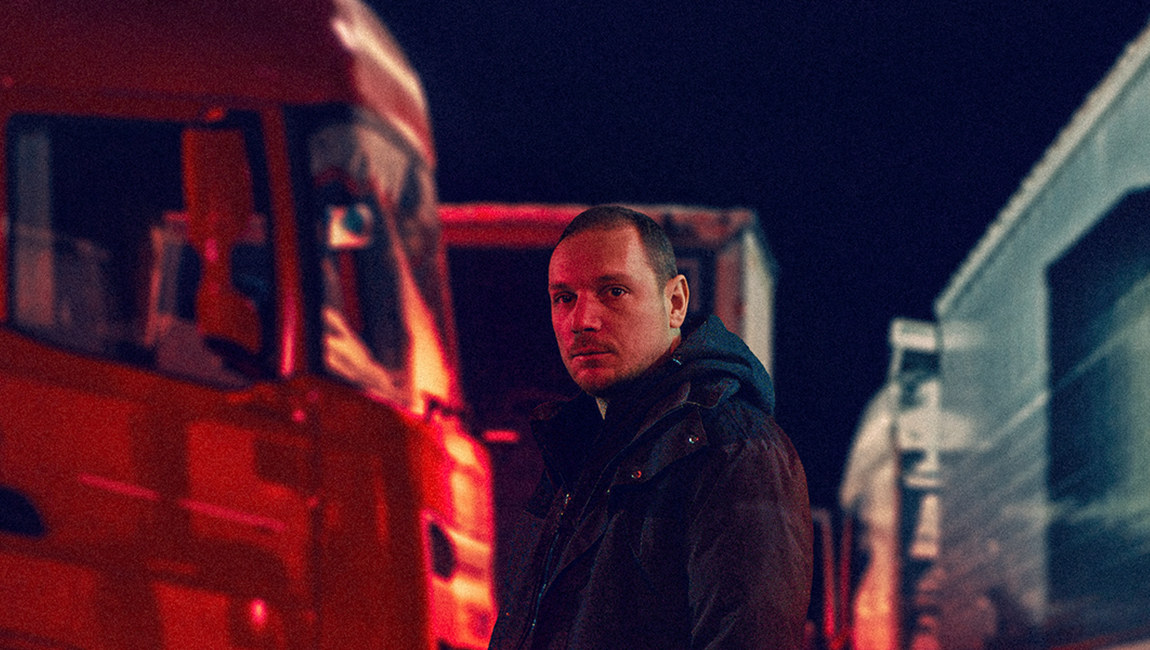
While possessing the backdrop and aesthetics of a social realist drama, the narrative foundation of writer-director Pierre Le Gall’s debut feature Flesh and Fuel takes a more classical form: the love story. Set in the world of long-haul trucking in France, with attention to the rote details and psychological challenges of the profession, Le Gall’s film zeroes in on soft-spoken and isolated French trucker Étienne (Alexis Manenti), who falls in love with his more gregarious Polish colleague, Bartosz (Julian Świeżewski). On different routes and with different working conditions — Étienne is higher-paid but his company is losing contracts, whereas Bartosz works constantly for lower wages — the two men nevertheless connect almost instantaneously and pursue a relationship with abandon. Despite some stylized sequences and the film’s unique setting, at its core Flesh and Fuel is an open-hearted and straightforward romance, grounded by earnestly emotional performances from Manenti and Świeżewski.
Étienne first encounters Bartosz while cruising in a patch of forest off the highway. The film’s early scenes, up to this point, have been dominated by shaky handheld cinematography and quick cuts, reflecting Étienne’s hectic and physically demanding job. The cruising scene, though, introduces a different visual language and narrative pace. As shot by director of photography Antoine Cormier, Étienne meanders past entangled couples in search of a partner for himself, as trucks drone in the distance and the distant lights of the highway cast shadows of tree branches across his face. This dreamy scene culminates in his discovery of Bartosz, seen at first only in silhouette, his features gradually coming into focus. The romanticism is disrupted by police flashlights. The men all scatter, and when the police catch up with the pair, Bartosz talks his way out of charges for him and Étienne. They share a flirtatious few minutes in Bartosz’s truck afterward, and though Bartosz has to leave soon after, Étienne is so enamored that the next time he spots Bartosz’s truck, he runs in front of it to catch his attention.
Thus begins a long-distance romance, consisting largely of video calls and brief meetings when their routes cross paths. Le Gall repeatedly finds deep romance within the constraints of this relationship; while the scenes focused on the day-to-day tasks of Étienne’s work are effective, the most involving are those that center his and Bartosz’s romantic and erotic bond. Two particular highlights are a sweaty and intimate sex scene in Étienne’s truck, and a transportive fantasy sequence of an encounter between the lovers back at the cruising site. Manenti and Świeżewski imbue their performances with embodied sensuality and sincere adoration, and while one could quibble that the relationship becomes too serious too quickly, that would be a difficult argument to make given how effectively the leading actors convey their characters’ love for one another.
Plot contrivances predictably separate the lovers in the film’s third act, which force Étienne to reflect on how meaningful his relationship with Bartosz has been to his heretofore lonely life, and to take great efforts to seek him out. The final stretch of the film unfolds with some narrative awkwardness, but the film’s emotional core remains palpable, and Manenti’s fully realized performance carries it through to an inevitable reunion. A queer love story told with refreshing frankness and class-consciousness, Flesh and Fuel proves to be a well-crafted and affecting debut feature.
Comments are closed.