
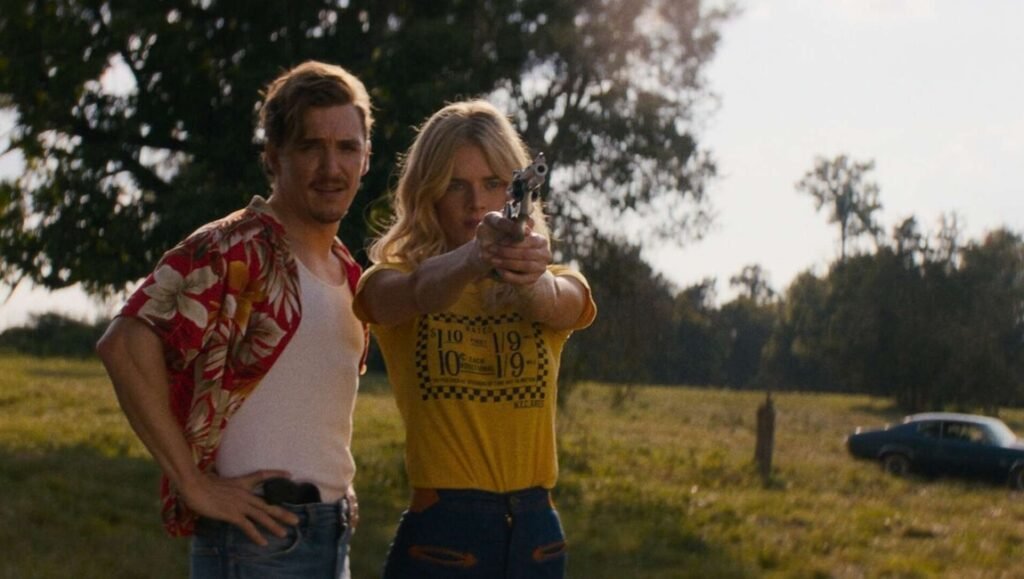
In his 2020 dark comedy Dinner in America, director Adam Carter Rehmeier captured the stifling stagnancy of life in suburban America and the simmering urge to break free, a sentiment that recurs in his latest, the crime thriller Carolina Caroline. For sheltered West Texas filling-station employee Caroline (Samara Weaving), a chance encounter with Oliver (Kyle Gallner), a seasoned con artist passing through her town, brings the enticing prospect of a more enduring partnership. As they quickly graduate from small-time convenience store scams to bank heists, the hotel rooms grow more luxe, the clothes get fancier, and the intoxicating thrill of being outlaws animates their relationship. As with anyone speeding ahead full-throttle, however, these lovers on the run soon find themselves cornered.
Catching up with Rehmeier before the film’s theatrical release, the director spoke about Carolina Caroline being a “delayed coming-of-age movie,” how the film evolved from William Thomas Dean IV’s original script, the shifting dynamic between his lead pair, and the challenges of shooting at 100 locations on a 25-day schedule.
Gayle Sequeira: The film that came to mind while I was watching Carolina Caroline was Bonnie and Clyde [1967], but what outlaw movies or road movies were you drawing on?
Adam Carter Rehmeier: I like the grindhouse exploitation stuff — movies like The Great Texas Dynamite Chase (1976), Dixie Dynamite (1976), and other obvious movies like Badlands (1973), Bobbie Jo and the Outlaw (1976), Dirty Mary, Crazy Larry (1974). It was just films of the ’70s that were like: hot girl, hot guy, muscle car. I love a genre mashup, and so I saw this as a road movie but also a bank robbery movie, and a romantic movie, and then ultimately a tragedy. I wanted to make sure it was about two people falling in love.
GS: Tell me about building the dynamic between Caroline and Oliver. She starts out as innocent and a little naïve, but she’s the one escalating the stakes — to commit bank robberies, then to accumulate enough cash to be able to leave the country. He’s established as a con man, but the one thing you’re never doubtful of is his love for her.
ACR: The original script played more as a thriller. I loved the first act — how Caroline and Oliver met and came together — and the film felt like it wanted to go more in that direction instead. So we did an overhaul of the script, and once Samara and Kyle were cast, they were so collaborative and professional that I knew we could push things further. They have a certain likability and feel great as a pairing. I’d made Dinner in America with Kyle, and we’re very close. Samara and I bonded really quickly. We all trusted each other. Since it was a 25-day shoot, we had very limited time, and as we rolled into production, I was still making tweaks to the script. It extended even to the last week, when we were about to shoot the ending. They sat with me, and we discussed making changes to the script to accommodate everything we’d shot and the tone we had been playing with throughout the film. It came down to even modifying the final scene.
We also needed to reduce the page count. On the last night of filming, we shot Samara driving and Kyle asleep in the car, and we shot the roadhouse exteriors for the big set piece. We shot all of the interiors as well after lunch. It was a 16- or 17-hour workday.
GS: What was your approach to scheduling on a 25-day film? Was there a day you were particularly anxious about in terms of cramming in everything you wanted?
ACR: I was anxious every day. We had 25 days of shooting, but 100 locations. There were so many days that required multiple moves within the day, and that was the real killer. So advice-wise, you gotta work with people you really love and who can get the job done in that amount of time. Luckily, I have a great, regular crew I work with.
GS: I’ll ask you the opposite — was there a day you just couldn’t wait to get to because of how excited you were to film those portions?
ACR: The big roadhouse set piece. The scene with the trooper on the side of the road was also very hard to shoot, and we had to shut down three-quarters of a mile with people in safety vests. I was optimistic about shooting on a train, which is where one of the film’s first big cons happens. We shot on an actual moving train, and it was horrible. Along with trains, there are things I otherwise don’t like to shoot — buses, cars, kids, dogs.
GS: What is it about trains that makes them challenging?
ACR: You have very little control. Had we shot the scene at high noon with the light directly above, that would’ve been optimal. But it started to creep down at the end of the day and was going nuclear at certain points — just flashing through the windows. The guy who was supposed to play the bartender got left behind at the depot. So some random extra got pushed into that role. We didn’t have a costume for him, so we had to manufacture stuff on the fly. It was nightmarish. It was also really hot on the train, no AC. The actors were trying not to sweat. I hate trains.
GS: The bill exchange scam at the beginning of the film is one I had to pause and rewatch a few times to orient myself and get the math right. Where did that come from?
ACR: Films like Paper Moon (1973) have used it before. At a screening we did at a little festival, a gentleman stood up and told me that on his first day of working at a gas station, that very scam was pulled on him and he lost 10 bucks. It’s called a quick-change scam, and he confirmed that it’s still happening. The purpose is to catch people off guard, which is what happens in the film.
GS: You’ve crafted a world of payphones and coin-operated jukeboxes. People watch news on TV instead of seeing it online. Could you talk to me about that?
ACR: The thing about bank robbing in 2026 vs. 2000 is that it’s a lot easier to get caught now. Post 9/11, there’s cameras everywhere. Every intersection and light post has cameras, and so for (convenience of) the bank-robbing aspects, I wanted to set this film in a bygone era. It felt like a ’70s road movie when I read the script, but at the same time, I also wanted it to feel like a turn-of-the-century film and make a semi-period movie. My production designer and I were really specific about that, and so we looked for vehicles that matched that time period. There’s hardly a car in the film that’s from outside that time. I’m really proud that we were able to do this on a budget.
GS: I love how you can trace the lead pair’s arc through the film’s interior locations — the cheap motels turn into luxury hotel rooms, then they’re back to local dive bars.
ACR: The really opulent, nice interiors you see were shot at The Brown Hotel in Louisville. It’s a famous hotel, and we shot some of the more romantic scenes in the Muhammad Ali suite. The hotel you see with the red doors in the film is maybe one of the sketchiest hotels ever. It’s called the Red Carpet Inn and is very seedy — lots of drug-dealing going on. The door Samara had to come out of didn’t have a doorknob, so we had to have the art department make one so it looked legit.
Comments are closed.