
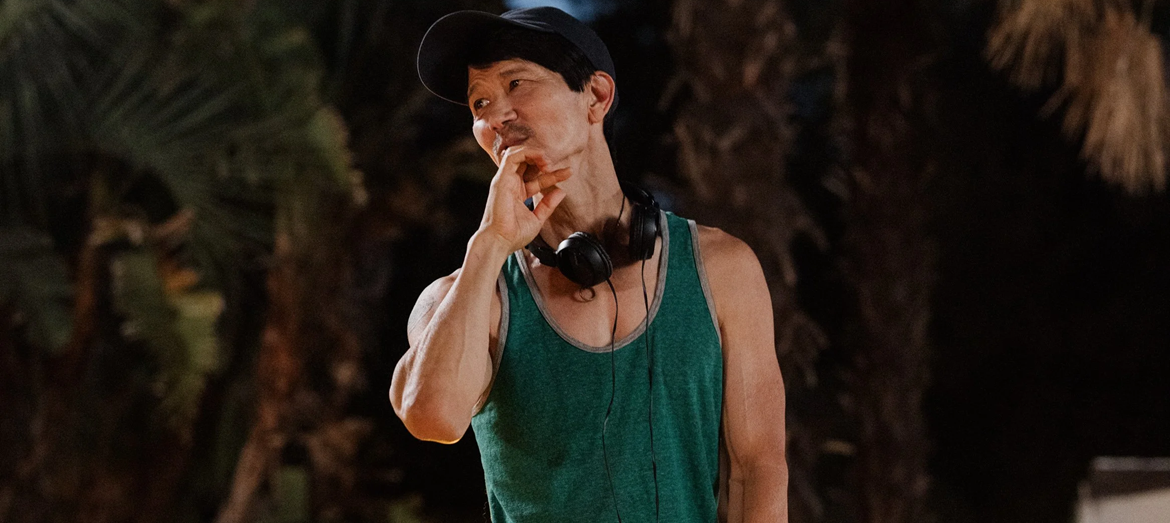
Descriptors like “off-kilter” evoke something crooked, unbalanced, slanted, strange. These words are all, more or less, synonymous with the original meaning of the term “queer.” In the films of Gregg Araki — New Queer Cinema classics like The Living End and the Teen Apocalypse trilogy, which sent up the ruins of the Reagan era with wounded punk-hauteur; the breathless, motion-sick comedies Smiley Face and Kaboom; the unutterably harrowing Mysterious Skin — nothing is ever quite right. Actors stretch their characters taut, just shy of the breaking point, where Araki’s figures often reside; settings drip with outlandish artifice; bouncing absurdity is plated with hopeless malaise; wisecracks sound more and more like cries for help. Above all else, pathos merges with pantomime.
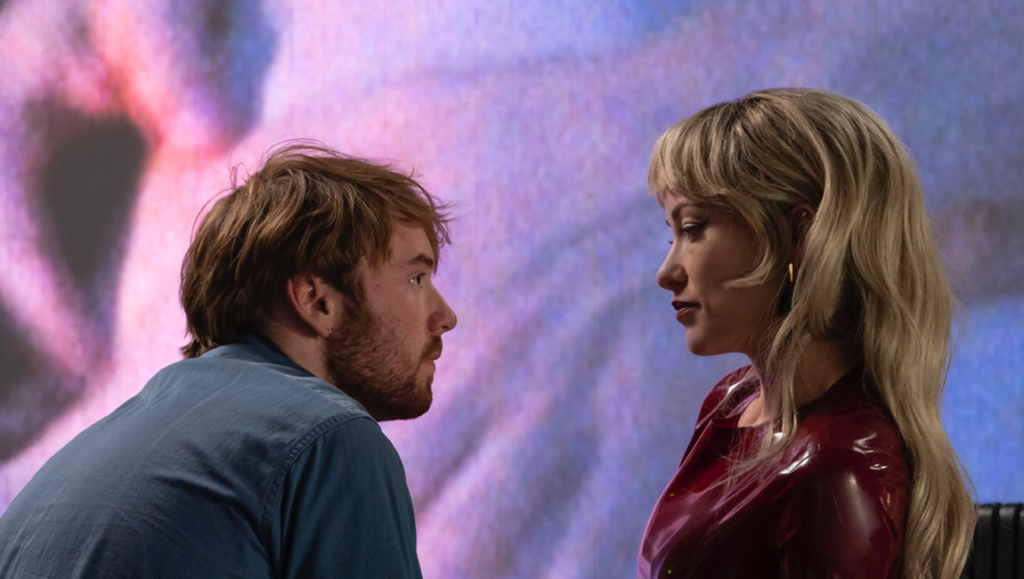
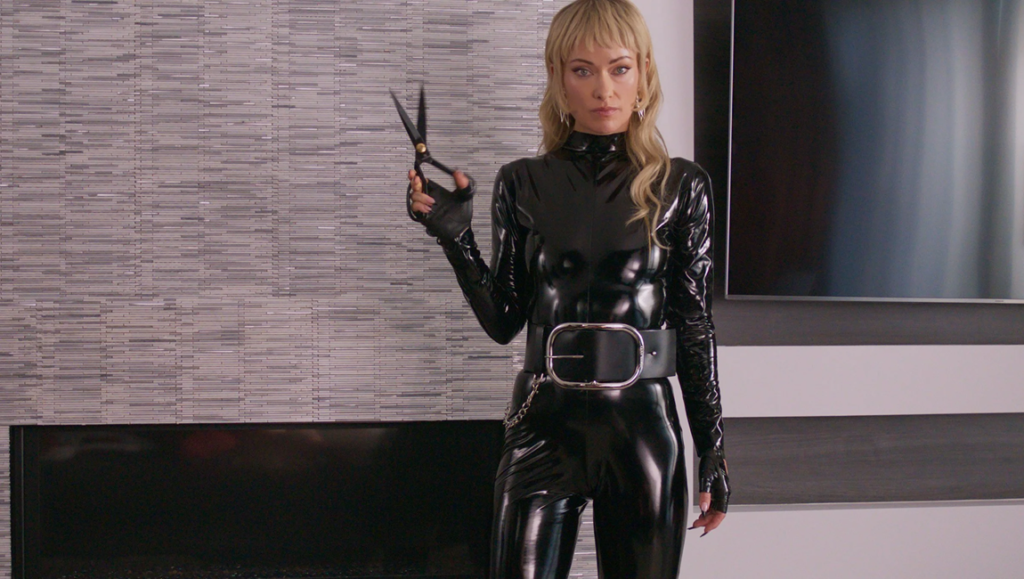
His films are queer in an immediate and tangible sense, though his latest, I Want Your Sex, in which a fresh-faced and sex-starved intern is bewitched, bothered, and bewildered by an art world provocateur who moonlights as a dominatrix, is another “heterosexual film by Gregg Araki” — a perversely mocking epithet that the filmmaker commits, time and again, to unsnarling. Starring Cooper Hoffman as the puppy-dog submissive Elliot and Olivia Wilde as the bullish femme fatale Erika Tracy, this deliriously off-kilter film moves to the beat of their unforgettable (al)chemistry, veering and lurching between irrational and erratic and erotic shades of feeling.
After 40 minutes in a virtual junket waiting room, an emergency restart of my frozen computer, and 15 more in a breakout room, I spoke with Araki over Zoom.
This conversation has been edited for concision and clarity.
Alexander Mooney: It’s such an honor to meet you. I’ve been showing your films to my partner, and he just loved Totally Fucked Up. But I’m going to jump in because we’re working against the clock here. In the press leading up to the film’s release, I Want Your Sex has been positioned as a coming-of-age movie for a generation whose growth was stunted by COVID — I’m Elliot’s age, so I resonate with this — but it feels like the flip side hasn’t been talked about as much. Erika, in many ways, seems to be experiencing a different sort of arrested development, at a point of crisis in her career and her sex life, and there’s a slightly tragic element to Wilde’s performance that really brings it to the forefront. Tell me about creating that character.
Gregg Araki: I mean, Erika Tracy is one of my favorite characters I’ve ever created. She’s such an interesting paradox. I love her. I find her creative, passionate, confident — I sort of refer to her as a cross between Madonna and Robert Mapplethorpe. Olivia and I have both talked about Madonna’s Sex book a lot, and that period where she was really tweaking the culture with in-your-face sexuality, and people were freaking out about the book and that album, Erotica, and she was just pushing the culture’s buttons. That was very much, to me and Olivia, what Erika Tracy was all about. She’s a really fun character to play with, but at the same time, obviously, she does things that are questionable, she’s crossing boundaries that maybe she shouldn’t be crossing. She’s fucking her interns, you know? So she’s definitely a narcissist, definitely self-obsessed. She’s flawed, but I find her flaws very interesting.
AM: Maybe what sets her apart from Madonna circa ‘92 is that it’s implied that, for Erika, that era was quite a few years in the past, and that the consensus is that she’s past her prime. I was compelled by the opening with the pool, which reminded me of Hustler White‘s homage to Sunset Boulevard.
GA: A lot of layers there.
 AM: Yeah, there’s like a chain reaction. There’s a Norma Desmond element that combines with the Madonna references. But you don’t make too fine a point of it. In other interviews you’ve been saying, almost verbatim, some of the opinions that Erika voices on Gen Z’s repressed relationship with sex, and a Variety article called her your “mouthpiece.” But do you see yourself in Elliot as well?
GA: Oh, absolutely. Maybe I’m a narcissist, but Elliot, in a way, is me as well. There’s a lot of me in Erika. As the script was developing, I found that I was putting more and more of my perspective, my voice, into her character. But my voice is in all the characters. The things that Zap says are literally straight out of my mouth: “I’m just fucking gay, like enough with the labels. Oh, you’ve never sucked a dick? Then you’re straight.” That’s all my sensibility. But for Elliot, he was patterned on when I was a young early 20s undergraduate film student at UC San Barbara. Confused, trying to figure it out, trying to figure out what my place in the world was. Just starting to come out, coming to terms with my identity, with being an artist — not sure what was going to happen to me. That level of uncertainty that comes at that age was all very much a part of his character, and we went so far as Cooper piercing his ear for the part, and we put these little tattoos on him, like my tattoos; it was interesting for me to have these two sides of myself colliding. The way the movie was put together — the soundtrack even, there’s songs from the period when I was Elliot’s age — the way the tapestry of the movie is woven together is very specific and very personal.
AM: Absolutely. More on their dynamic: I mean, you kind of can’t imagine any other actors in these parts. So I was wondering if you had written the roles with them in mind or not — how the actors came to their roles?
GA: It was fate, I think. The script was slipped to Olivia. My manager was friends with her agent, and didn’t even tell me, but she’d slipped it to Olivia’s agent over the weekend and then she responded to it, and so my manager’s like, “Olivia Wilde read it and really wants to meet.” I said, “One, how did that happen? And two, that’s fucking such a cool idea.” Like, I love Olivia Wilde. I followed her from the time she was in The OC, when she was with Seth and — what was her name? The other girl…
AM: I’m not sure either.
GA: Maria…
AM: A copy edit can fix this.
GA: Okay. It’s the one that’s played by… Marissa! Yes. That’s the name of the female character. So I met with Olivia, and she was fantastic. So cool, so fearless, so ready to jump in and do it. And then the movie got financed, and we were looking for Elliot, and we auditioned a million people, had a bunch of meetings, and Cooper was thrown into the mix, and I was like, “Cooper Hoffman? The kid from Licorice Pizza? Really fucked up and weird. I don’t think that’s gonna work at all.” It was creepy to me, the idea of Olivia’s character fucking this child. He’s like a kid in that movie. Cooper was very young. I think he had just turned 21. He could barely drink. Cooper put himself on tape — he was very good, because he’s a very great actor — but it wasn’t until they did a chemistry read together… he flew out from New York to do a chemistry read with Olivia, and they instantly had incredible chemistry, and in person, Cooper has a lot of gravitas. He has a lot of presence, especially for somebody so young. And Olivia has a lot of presence because she’s a movie star. So I needed somebody [to be] an equal sparring partner for Olivia, and Cooper was exactly that. As soon as they met, as soon as I saw them together, they had this dynamic that was just fascinating to watch, so from then on it was pretty easy. Now I turn the camera on and make a movie around them.
AM: You mentioned a previous version you’d thought up with the genders swapped, more akin to Secretary, that you understandably changed post-MeToo. Was there ever a version that involved a gay relationship?
GA: There was never a gay version. Originally, it was a female intern and a male boss, and I got kind of uncomfortable with that imagery. I don’t want to kink-shame anybody, but as a man, I didn’t want to put that kind of misogynistic image into the world. When I swapped the roles, I was like, “Oh, this is so much more interesting.” And from there, Erika Tracy was born, and she became so fascinating to me. This sort of art superstar, a combination of these larger-than-life figures. I’ve always been a very hardcore feminist, and the idea of this very powerful female character, who’s abusing that power, really energized the movie for me, made it so much more exciting. From that point on, there was never a thought of, “Oh, maybe it should be gay,” because once Erika Tracy was around, the movie was already centered around her. I knew that I wanted that figure in the movie, this female top, rather than something like Pillion, with a male/male relationship.
AM: I was going to ask you about that.
GA: Not to diss Pillion in any way, but it lacks that inversion of the patriarchy because it’s two guys.
AM: I’m always compelled by the tone of your films, and felt a very destabilizing sense of pity and almost horror during the final stretch, even as the film was still making me laugh quite a bit. That mortifying three-way sequence definitely contributes, but there’s a very clear line that’s crossed at the art show that feels like a point of no return, but return he does. Do you find the film romantic?
GA: He is desperate. I’ve been doing press with Cooper today, and it’s funny hearing it from his perspective, because he was talking about how [Elliot] in the movie is a yearner. There’s so much talk about male yearning now, particularly in light of Heated Rivalry and all that. And so he’s definitely this kind of yearning character, but there’s a point with him where his yearning crosses over into desperation. He goes too far in that direction. But I think that’s being young. When you’re young, your emotions are so strong. I think that’s why a lot of my films have been about young people, because your emotions are always at 11. Everything is not like, “it’s all just, whatever.” It’s very, like, “I’m so in love with this person. I’m going to fucking die if I don’t see them tonight.” You know what I mean? That level of intensity, I think it comes from being young. You haven’t learned all the lessons of life yet, so you’re just living life to the absolute fullest.
Comments are closed.