
It is a time of apparent magic. Two mega-budget adaptations of world literature classics were released in 2026, both unprecedented spectacles. The first, Nolan’s globe-trotting A-list Hollywood affair, The Odyssey, was the first film shot entirely on 70mm IMAX film. The second, Ramayana: Rise of a Legend, is the most expensive Indian film ever made. Directed by Nitesh Tiwari and co-produced by visual effects company DNEG, Rise of a Legend is part one of a planned epic trilogy adapting the Ramayana, an ancient Sanskrit poem composed in 24,000 verses. The expected budget for the entire enterprise — the follow-up is projected to release for Diwali in 2028 — runs up to $480 million, reflecting the project’s massive undertaking, featuring the most advanced VFX in Indian cinema to date. It also features a massive — and massively exciting — cast, music by Hans Zimmer and A.R. Rahman, and comes in at a runtime of 197 minutes. In other words, this is spectacular cinema at its most spectacular — the kind of grand, roadshow entertainment Hollywood balks at producing in 2026. To revisit that Odyssey comparison briefly: while it’s predictable that Rise of a Legend is playing on far, far, far fewer screens than Nolan’s gritty, vaguely discouraging Homer adaptation did, what’s more surprising is that despite being the longer film, and the more comprehensive treatment of its epic source text, it’s simply the much more fun slice of blockbuster entertainment — loud, fast-paced, and emotionally potent. At best, Nolan’s Odyssey earns two of those descriptors.
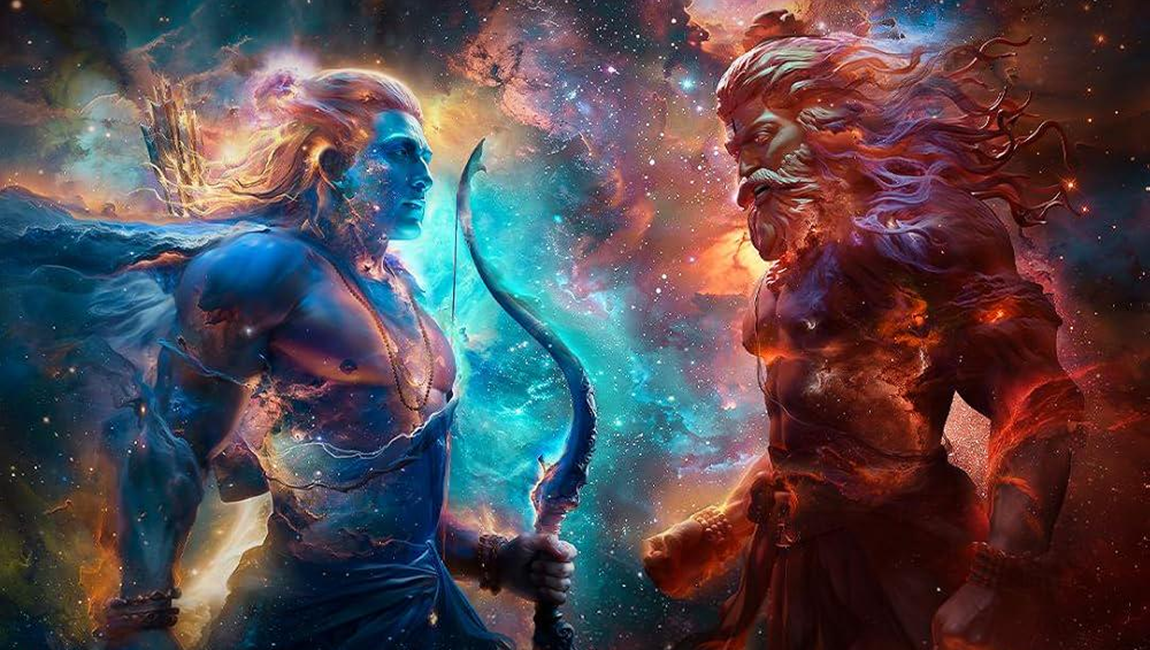
The quality of Rise of a Legend‘s VFX — its photorealism, anyway — is stretched thin across the massive runtime, on occasion dipping into the “uncanny valley,” yet the buoyant, epic register of the film’s style elevates these visuals into a fantastical space, a space beyond reality. The visual world of Ramayana, a swirling cosmology overseen by vaporous, gargantuan deities, where entire worlds — worlds within worlds — with vast and diverse vistas are filled with giants and anthropomorphized creatures, is rendered in sparkling, impossibly unreal CGI. This unreality is ethereal, heavenly. Rather than arriving as distracting anomalies, they function as profoundly strange, immaterial apparitions. We are dealing with a story grander than our base, human understanding of reality, to the degree that Ramayana makes one wonder what opportunities Nolan might be missing by swearing off CGI. Perhaps his Odyssey, bogged down as it is by the cumbersome cult of realism, could have benefitted from some of this perverse digital magic-making. The sublime strangeness of the film’s appropriately mythic, spiritual visions is nearly hallucinatory, and when seen on the biggest of screens, these visions envelop and overwhelm us. At its best, Ramayana is quite literally awe-inspiring.
When every frame is unstoppably grandiose, bursting with sensuous physicality and opulence, it’s easy for Ramayana to sweep us swiftly through narrative movements that sway with the choreography of dance. At its most fleet-footed — and it does drag, here and there — Tiwari’s film fulfills the operatic Gesamtkunstwerk promise of cinema: choreography, movement — dance — in light and sound. Indeed, more than anything, movement is the film’s underlying magic. When in motion, Rise of a Legend is unstoppable: dialogue scenes are interspersed with montage, and montage interspersed with dialogue, so that we viewers are left with the impression of the entire story happening at once. When this momentum slackens, the film becomes susceptible to each viewer’s sensibilities, which for some might mean dismissing the outrageous pathos of this frantic dramatic energy. It’s in the film’s lulls that the debilitating prejudice against cinematic melodrama that American audiences have been programmed to reject can creep into the air. But Ramayana, like other international epics, reminds us that grandiosity isn’t just found on the screen or on a budget sheet, but in the work of the performers, the words on a page, the emotions of the audience. It’s a cinematic register that Hollywood has largely set aside, or forgotten.
Given this grandiosity, it shouldn’t surprise that Rise of a Legend is also absurdly immersive. For then in most other films in recent memory, it’s possible, while watching, to completely forget your place and time: to lose track of where you are in the story, or to forget where you parked your car, that you have a car; to forget that you aren’t, yourself, a part of this wild, unbridled spiritual journey. The film’s scale makes it difficult to do justice, in so few words, to the scope of its narrative, in which an entire lifetime, full of unimaginable adventures, passes before the opening credits appear; before Rama, the central hero, is even born. Halfway through the film, one senses that the story is only just beginning — and it is. Rise of a Legend deals only with Rama’s coming of age, with the seeds of strife that lay the groundwork for his cosmic battle with Ravan. Which is to say, Ramayana is, from the beginning, an epic. There is an obvious depth to its drama, if not to the interiority of characters, who are drawn in classically exaggerated heroic strokes. This is Joseph Campbell’s “hero’s journey” writ large, an eternal tale of outrageous trials and tribulations, stirring sentimentality, and human nature bending toward the light. Story time is superfluous. This isn’t a three-act screenplay structure taught in intro-to-screenwriting classes, but rather a world constructed on the logic of legend.
One aspect of this epic register is a certain interactivity in the narrative structure itself. There are heroic pauses, moments in which to admire feats and triumphs, or marvel at the beauty of a gilded bow or a hero’s shredded physique. We find these pauses in Homeric and Virgilian verse, as well as in the Sanskrit of the source text. It’s an approach to narrative familiar from other South Asian imports, and Indian cinema, at its most extravagant, is more suited to this epic register than Hollywood especially. The openly melodramatic style of Ramayana: Rise of a Legend, which isn’t so different, really, from that of a film like RRR, brings the grandeur of the source text to the fore, without reducing its cosmic ideals and heroic invention to modern sensibilities. Instead, we — the audience — are elevated to meet these intangible ends. But more than a mere aesthetic object, another key element of this epic register is the timbre of performance. Yash — also a co-producer on the film via Monster Mind Creations — embraces hair-raising machismo as the villainous Ravana, who sets out to defy the gods, literally. Ranbir Kapoor plays Rama with sweet naivety tempered by a rigid moral code and a demi-god’s physical and mental acumen. Sai Pallavi, meanwhile, is resplendent — and equally resourceful — as Sita, considered the human avatar of the goddess Lakshmi — Rama, an avatar of the god Vishnu, means their smoldering romance has massive cosmological significance. And all of this is played to perfection on screen, with several of the most devastatingly romantic lines imaginable uttered amid this flurry of emotion.
It’s a shame, ultimately, that a film as preposterously extravagant as Ramayana: Rise of a Legend likely won’t get the critical, nor even the popular, reception it deserves — at least in the U.S. It reflects the kind of mind-blowing, all-encompassing cinematic spectacle that was typical, once, for Hollywood, before it petered out — after one last gasp — in the 2000s, only to be overtaken by multi-billion-dollar comic book movie franchises. But comic book flicks boasting the same astronomical budget don’t look half as great as Ramayana. But often lost amidst rhetoric of Hollywood’s decline is that this flavor of grandiosity in international cinema is on the rise, as anyone who’s seen other Indian, Chinese, and Japanese imports from this decade knows — the global hegemony of epic cinema has flipped. Much like the American automotive industry, which peaked in the mid-20th century before being steadily overtaken and outpaced by foreign manufacturers, Hollywood has ceded the job of making the big screen feel bigger to overseas imports. We can only hope that select screenings of Ramayana: Rise of a Legend will inspire some adventurous exec to take grandiosity to heart and spend their ill-begotten bucks on better spectacle. But in all likelihood, the best we can hope for is that international cinema resists going the way of Hollywood, and that as many Americans as possible can see Ramayana: Part Two on the biggest screen imaginable.
DIRECTOR: Nitesh Tiwari; CAST: Ranbir Kapoor, Yash, Sai Pallavi, Ravi Dubey, Arun Govil, Lara Dutta; DISTRIBUTOR: Sony Pictures Releasing; IN THEATERS: November 6; RUNTIME: 3 hr. 17 min.
Comments are closed.