
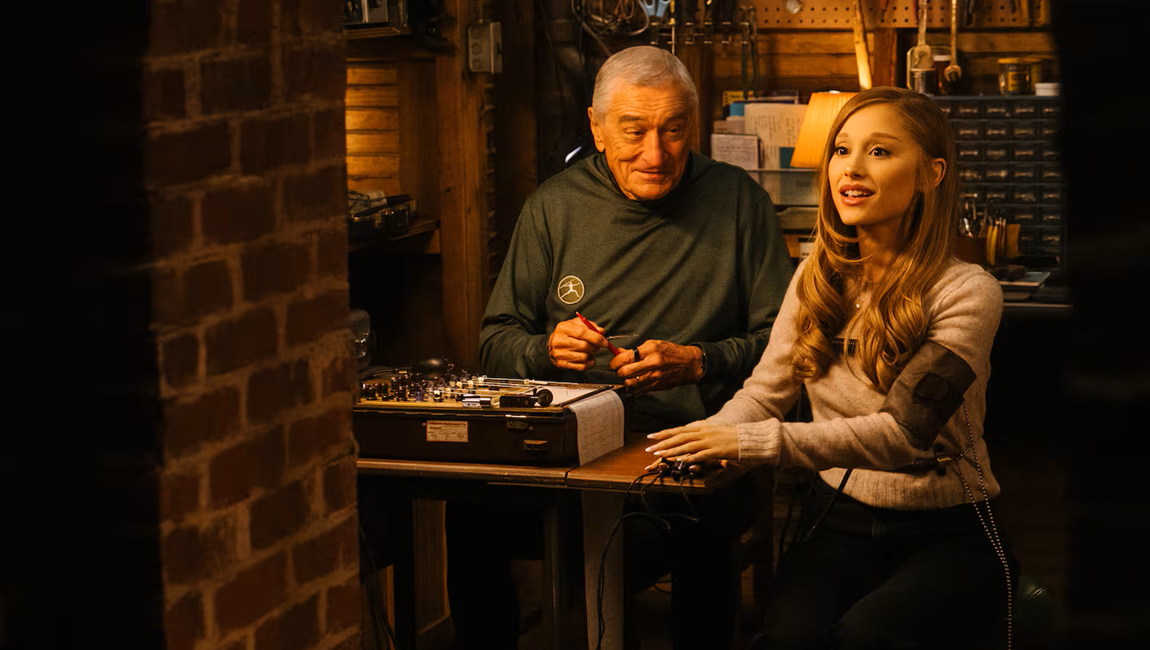
Give Robert De Niro a round of applause, everybody. Contrary to his narcotized work in this year’s earlier vehicle, The Whisper Man, he actually seems to have shown up to set with a cup of coffee in his system for Focker-in-Law. His character’s comic timing in this franchise doesn’t require much of him beyond his trademark emotes, so it was proabably inevitable he’d win over the audience of this latest sequel regardless. Still, we’ll look past ol’ Jack’s CIA background and bonding moments with Ariana Grande over their shared knowledge of “negotiation” tactics. That’s for another time, another place — the Middle East in particular, as glimpsed in a diabolically photoshopped image of De Niro in cultural garb, presumably undercover.
The rest of the film surrounding him is, strangely and surprisingly enough, also enjoyable. This term is used with caution, as the sense of enjoyment here is so consistent and smoothed out of all creases that it constitutes a moniker we’ll call “skeletal cinema.” Not to be even remotely confused with minimalism, this aesthetic is a symptom of budgetary preference for high-profile actors and unfathomably sleek, manicured mise-en-scène. So sleek, in fact, that it industrially enamels all potential edges or textures of lived-in-ness. Celebrities navigate an IKEA-floor simulation of space, isolated Hamptons-esque houses that haven’t left the showing phase for years due to being exorbitantly tailored to the ultra-rich. All spatial contours are pocked with tinted SUVs and Hummers and Pelotons so as to communicate nothing “marginal” or “unkempt” or, yes, specific. To be specific would be to infuse these characters with humanistic traits other than quips, punchlines, or signposted facial expressions, which would suddenly deflate the film’s hermetic balloon of: THIS IS FOR EVERYONE.
In studio-speak, this means that the product must be stripped to the bone in almost every department besides finances. We laugh at and with characters who, at the end of the day, are going to be fine. They have what the general audience doesn’t: wealth, time, and a perpetually clean surplus of upscale goods and wares. Nonetheless, this critic will admit at laughing quite a bit, will acknowledge that the comedic set pieces are more often than not genuinely funny — but the laughter is so pronounced because to allow oneself to experience anything further by way of emotion would mean existential suicide. The void of this film’s “Nassau County” (mentioned very briefly by De Niro’s character and nothing more) is vast and unnerving. What lies between the Focker residence and Owen Wilson’s even more hyper-affluent and servant-tended mansion? Do these characters go into dormancy between San Diego, Chicago, and Long Island? Do they have inner thoughts and more untoward jokes when not in a large family setting? Is Gaylord Focker’s unhealthy relationship with his son worse than this film makes it seem during their limited screen time together? Is the camera zooming in mockumentary-style at unpredictable intervals? Is that German Shepherd 98% CGI-rendered, or is that just an optical illusion?
The answer, perhaps, is who cares, because Ariana Grande joins the family as Henry Focker’s partner. She is a former hostage negotiator/corporate consultant/all-around renaissance woman, superior in almost every way to the rest of these characters: in skill, emotional intelligence, and moral compass alike. Egregiously successful and talented and omniscient, Grande instigates most of the film’s comedic high points, and proves a worthy cipher for bringing out the Focker antics. For someone who had such a traumatizing, pressure-cooker job of negotiating hostage crises, she seems incredibly put together and cognitively unbothered, any shred of her worldview or politics untainted by the violence and bureaucracy of federal law enforcement machinery. And, well… she seems like Ariana Grande. She and Stiller conjure plenty of amusement in their head-to-head hijinks, but ultimately — despite Olivia being the seasoned puppeteer and Gaylord her plaything — they are on common ground with each other, with the rest of the characters in the film, and with the audience. To quote Gaylord (who himself misquotes), everyone experiencing Focker-in-Law, regardless of their level of enjoyment, is being “puppetized” by the film’s complete disregard for both the art and the craft of storytelling. A simple YouTube clip of the sequence where Stiller sings John Legend’s “All of Me” to De Niro is likely the only remnant that will endure.
DIRECTOR: John Hamburg; CAST: Ben Still, Robert De Niro, Ariana Grande, Skyler Gisondo, Teri Polo, Owen Wilson; DISTRIBUTOR: Universal Pictures; IN THEATERS: November 25; RUNTIME: 1 hr. 45 min.
Comments are closed.