
For the past decade, James Gray has been talked about in cinephile circles as the last great American (neo-)classist, the only auteur effectively continuing to make mature narrative cinema with the formal precision and operatic scope of a Coppola, Lumet, or Michael Mann. He works within many of the big genres of yesteryear, when Hollywood still made films for adults: crime films, melodramas, colonial epics, big-idea sci-fi, and coming-of-age stories. His frames are always precise, beautiful, immaculately lit, yet never showy or self-conscious. He can mount an action scene like few others today, makes tidy work of familial conflicts, and knows how to create richly textured visions of our shared history, all semi-invisibly without ever showing himself showing or exuding an ounce of self-consciousness. He is a nostalgic director, in a sense, aspiring to a type of cinema which no longer feels possible in American culture, yet he’s also one who has never worked in the post-modern nostalgia modes of pastiche, irony, and self-referentiality.
Beyond rich traditions of film form, his narratives also often evoke the troubled emotional violence of Greek tragedy. Almost all of his films are about families torn apart, brothers working against one another, fathers abandoning sons, mothers suffering in their constrained domestic sphere. There’s a clear moral sense to his characters, and they almost always evince the will to do the right thing even if they run in the wrong circles. Even with the best intentions, fate and the larger contours of a world marching in step with Darwinian capitalism turn them against one another as self-preservation drags them toward moral and personal calamity. That this is often firmly rooted in a sharp sense of American immigrant history and the machinations of modern power structures is what makes Gray not just compelling, but an increasingly essential voice in contemporary cinema.
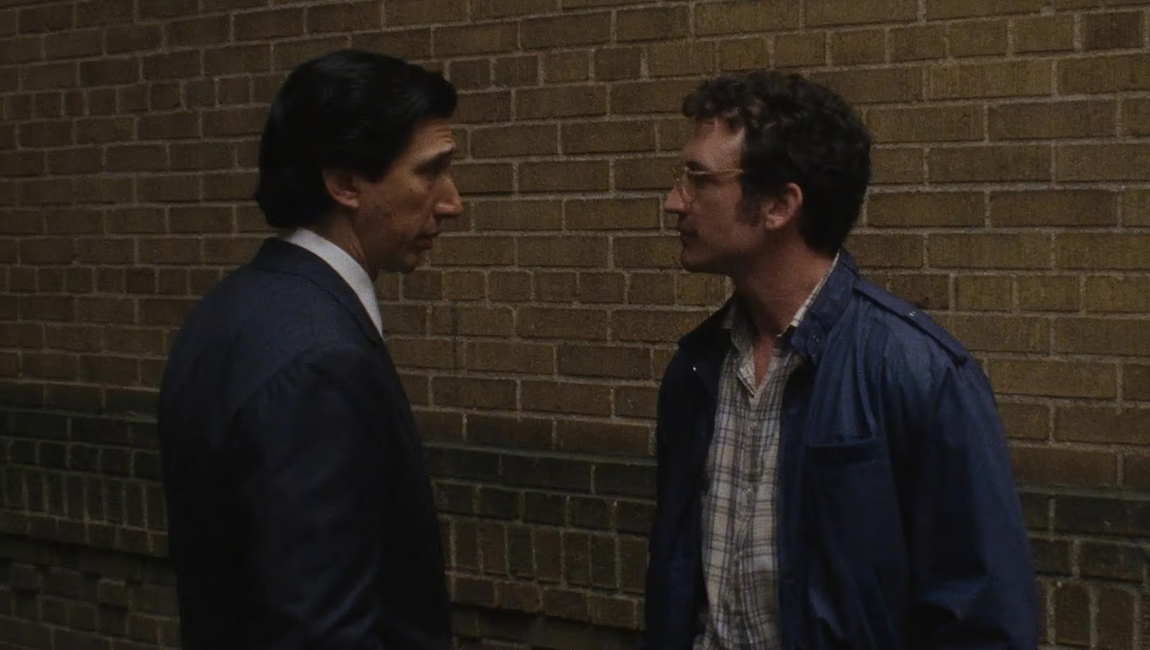
His latest, Paper Tiger, seemingly picks up where his last, Armageddon Time (2022), left off: the outer boroughs of New York City during the 1980s, where a seemingly perfect nuclear family finds themselves in deep shit for no good reason of their own. The dad, Irwin (Miles Teller), is a bookish engineer, content with his middle-class life yet eagerly taken in by his brother Gary’s (Adam Driver) idea for a quick $10,000. The city is trying to clean up the Gowanus Canal (a Superfund site still to this day), and Gary sees a chance to pick up some of the contractor money for environmental assessments. While starting as a small-scale portrait of industrial waste and the ineffective bureaucracy built around pollution standards, the film quickly grows into a panoramic vision of the immorality of Reagan-era power struggles. Irwin — nebbish, awkward, and a little clueless — innocuously pokes his nose where he shouldn’t one night, ticking off the mob-backed Russian contractors who have hired him and Gary. While threatening Irwin and his family, what they really want is Gary, an ex-cop with influential connections who refuses to become corrupt.
As a genre craftsman, Gray is economical and precise, spending more time on the construction of ambience than violent spectacle. On a beat-by-beat level, scenes unfold steadily and unhurriedly, with ample breathing room given to moments of pure character and scene-setting. Reuniting with cinematographer Joaquin Baca-Asay (The Yards, We Own the Night) and shooting on film, Paper Tiger is gorgeously textured, rich in its urban street scenes and bathed in beautiful neo-noirish greens, yellows, and reds in its nighttime scenes and interiors. Every shadowy close-up or well-timed camera move is at once incredibly precise, completely stunning, and gracefully understated — never sacrificing absorption and emotional consistency for spectacle.
With performances, Gray is one of the few remaining directors who can engender classical naturalism steeped in a method-like ability to capture micro-nuances of expression. Driver, who often leans into stolid, monk-like reserve, gives one of his nerviest performances as Gary, a man whose endless confidence and constant joking are mere wallpaper, slowly peeling away as we become more and more privy to how aware he is of how much is at stake and how quickly everything can unravel. When Gary is confronted by his former police-officer partners about his Russian connections, a whole unseen well of fragility and anxiety is glimpsed in pauses and small shifts in his gaze. Scarlett Johansson, meanwhile, has some of the film’s most startling close-ups as Irwin’s wife, Hester, whose fragile solidity corners her suffering into an almost exclusively private affair that lives in a world of its own. At moments she goes full Meryl Streep, with constant method-like ticks — a quivering lip alongside perpetually busy hands — but in other moments, such as when she’s in a doctor’s office after a cancer test, it’s a marvel to see her transform into pure suffocated interiority, self-doubt, and disbelief with micro-maneuvers of voice and eyes.
Beyond the operatic and socio-political dimensions of the film, one of the most compelling readings of Paper Tiger lies on an autobiographical level — James Gray’s father, Irwin, was an electronic parts salesman caught up in a Queens municipal corruption scandal in the early 1990s while Gray’s mother was suffering from terminal cancer. From this angle, the film is rife with Oedipal tensions, a power struggle for the contrasting generational visions of the American dream. The skeezy Russian immigrants — Gray’s grandfather was one himself — offer an atavistic idea of strong-man crony capitalism where the most savage takes all, while the Pearls offer something of the middle-class assimilationist dream, where playing by the book and working hard are supposed to offer clear paths to a simple, easy life. That Paper Tiger finds that this dream takes sacrifice and that moral purity is barely an option are both evidence of the film’s leftist leanings and signs of its inability to offer a unique exegesis on contemporary America’s ills.
The film’s almost Lynchian vision of a suburbanite society whose tranquil surface is just a band-aid to its savage underbelly is compelling for its efforts to crack below that surface, to take us into the belly of post-industrial globalist misery in the same way Dickens and Marx did for industrial capitalism, yet it’s also dated, too beholden to 20th-century ideas of corruption. Today’s greed and savagery are not below the surface — they are almost all that we have in public political life. To posit a moral world betrayed by its immoral shadow is to indulge a useless nostalgia mode of political action, one that reifies the idea that capitalism could function justly if only its savage (and, in Paper Tiger’s case, Slavic) side could be destroyed. This doesn’t, however, lessen the film’s aesthetic and dramatic impact, but merely functions to dampen its vitality. Like most filmmakers, Gray is a better craftsman and artist than political polemicist. Vastly more important than Paper Tiger’s socio-economic commentary, however, is its belief in a certain sense of spiritual suffering inherited from classical tragedy. It’s a movie that understands the connections between mothers and fathers and brothers and sons, and the emotional sacrifices we make for one another. It’s a beautiful work, one that lives up to its opening Aeschylus quote and achieves a level of accomplishment and scale very few American films have been capable of this decade.
Published as part of NYFF 2026 — Dispatch 1.
Comments are closed.