
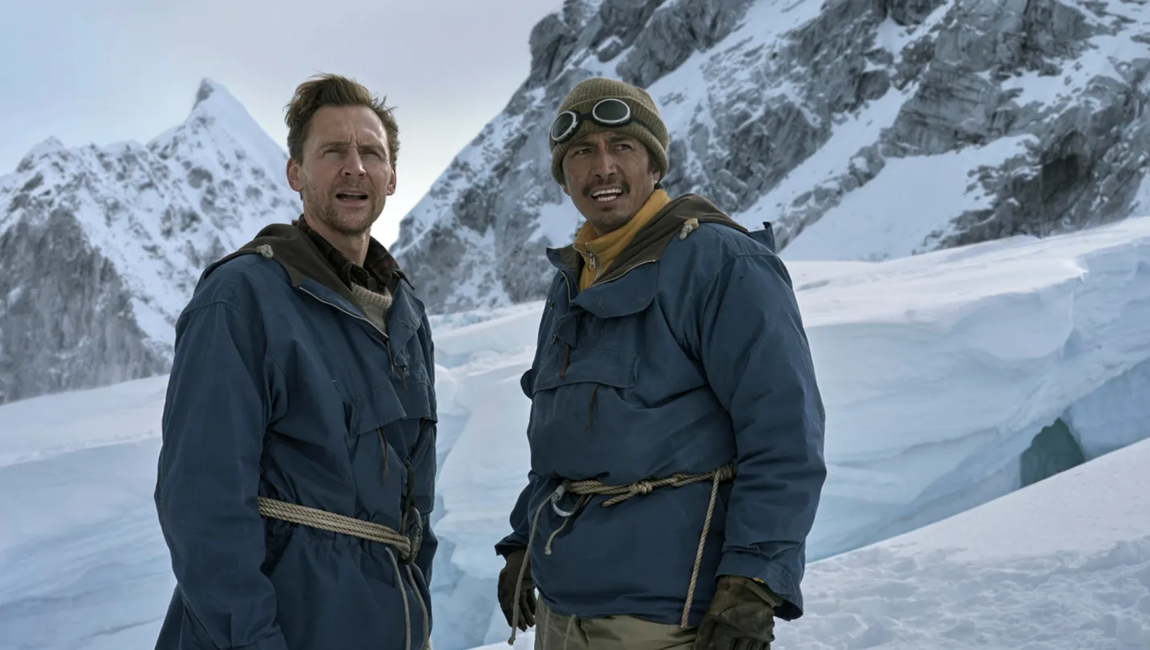
Though it certainly remains formidable today, both for its physical grandeur and its towering spectacle as a preeminent wonder of the world, Mount Everest is not exactly the pristine and unknown subject of speculation it had been prior to 1953, when it was summited for the first time by Edmund Hillary and Tenzing Norgay. Both members of the British expedition whose success had coincided luckily with the coronation of Queen Elizabeth II, Hillary and Norgay braved insurmountable odds over three gruelling months to glimpse the mountain’s elusive peak; today, the route yonder has been signposted with the aggressive presence of human activity: rubbish and detritus pile up across the snowy terrain, while the bodies of other climbers, both alive and frozen for eternity, litter the soaring landscape. Everest had been, prior to the Space Race, the last natural bastion thwarting modern civilization’s rampant self-expression, and the act of climbing that which “does not want to be climbed,” naturally, spanned ambitions both fervently national and individual.
For the most part, the tallest mountain in the world lay tethered to myths of British excellence and subsequently those of personal vainglory, overlooking its significance to indigenous fact and lore alike. Yet while Jennifer Peedom’s Tenzing invariably centers Everest around one of its inaugural climbers, the Nepalese-Indian Norgay (Genden Phuntsok), the film retains a polite and disinterested affect toward its subject matter. Peedom’s first narrative feature following a series of documentaries fascinated with the harrowing limits of man’s relationship with nature, Tenzing dramatizes the life of the eponymous sherpa who lived near the mountain and attempted to climb it as early as 1935. Serving first as a porter for the Brits and subsequently inducted into their climbing ranks, Norgay had a mysterious air about him, exacerbated by not only the conflicting accounts surrounding his early life but also the silence around his ascent relative to Hillary’s (Tom Hiddleston), which enjoyed a knighthood among other accoutrements of publicity. With his biopic now onscreen, this mystery has come to be eclipsed by a blander, more melancholic persona.
Based on Ed Douglas’ 2003 biography, Tenzing’s screenplay (written by Luke Davies) broadly recounts Norgay’s life story, affixing an earnest disposition to its protagonist and faithfully revisiting his desire to prove his merit against the casually racist attitude of the time. Always an outsider, whether as head sherpa or even as a full expedition member up for consideration to ascend the mountain, Norgay is portrayed in generic brushstrokes as a man native to the land, beset by an unspoken grief whose emotional black box is the impetus that drives his lifelong quest to be at one with Everest, known otherwise as Chomolungma, the mother goddess. As Tenzing glosses over its protagonist’s inner life with neat, sanitized flashbacks to his childhood, it bears noting that the film takes several liberties with real events, not least his subsequent marriages after the passing of his first wife, Dawa (Thinley Lhamo), one of which predates his historic summit. While the film’s depiction of the latter is competently staged and largely true to form, much of the tantalizing unknowability — both of the climber and the climb — gives way to an inoffensive hagiography of yesteryear splendor: a stage atop which Willem Dafoe, playing the kind but firm expedition leader Colonel John Hunt, can co-star with an ensemble of acquiescent, two-dimensional sherpas. Though certainly a corrective to the dearth of representation surrounding Tenzing Norgay, Peedom’s film is no less didactic and no more insightful than one of its erstwhile Nat Geo predecessors.
DIRECTOR: Jennifer Peedom; CAST: Genden Phuntsok, Tom Hiddelston, Willem Dafoe, Samdrup Dorje Lama, Thinley Lhamo, Johnny Flynn; DISTRIBUTOR: Apple TV; IN THEATERS: October 9; STREAMING: October 16; RUNTIME: 2 hr. 6 min.
Comments are closed.