
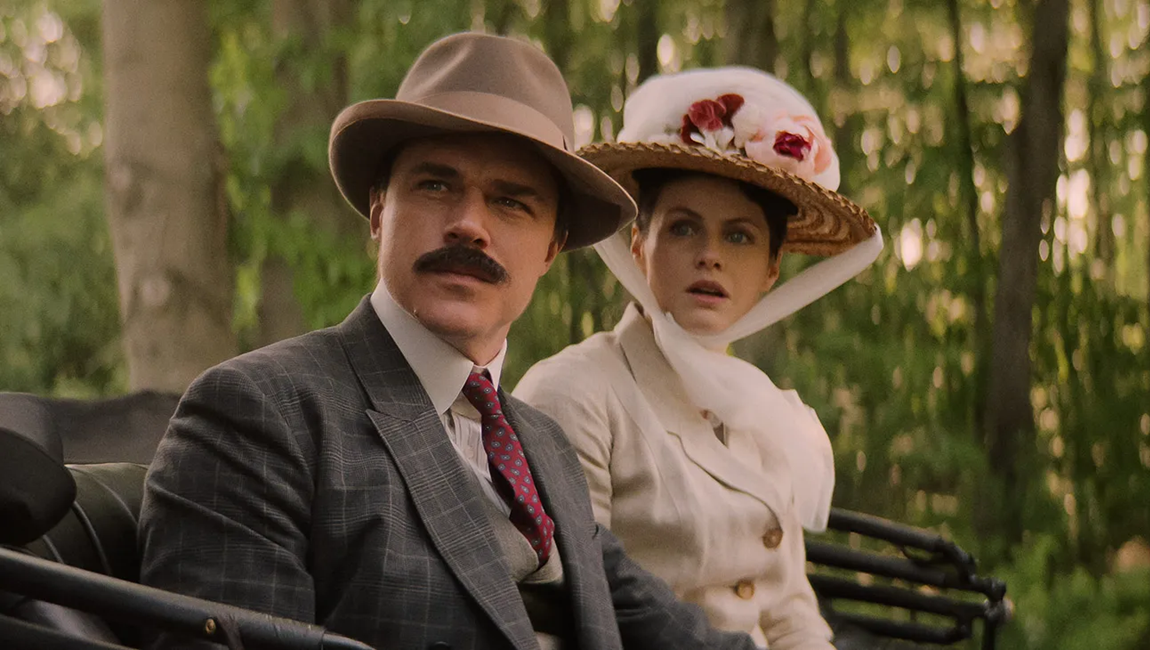
When one encounters a movie completely disinterested in putting in an ounce of effort for its audience, why should one offer any effort in return? Why not just cut to the chase and tell the reader everything they need to know in a single sentence: Angel Studios’ Hershey, a biopic about the eponymous chocolatier, is an ugly, frictionless film that fails to even be effective capitalist propaganda. To call the movie a commercial would be too generous, even though the general concept of “making people want to buy chocolate,” especially around holiday season, should be such an easy slam dunk that a film student could probably accomplish it in a weekend. Any focus on the product itself is on reminding the viewer of the classic milk chocolate recipe — possibly so they forget that Hershey may currently be implementing a cost-cutting recipe at the expense of flavor. As if that isn’t insult enough, the movie opens with a CGI shot of a Hershey Kiss, suspiciously indistinguishable from generative AI (though there are no mentions of it in the credits). Surely experienced filmmakers like Mark Waters can photograph an appetizing piece of chocolate, but Hershey is determined to fumble even its simplest elements.
Angel Studios has been releasing movies at a clip this year; the American Revolution-set musical Drummer Boy came out only two-and-a-half weeks prior to Hershey’s theatrical release, and the forthcoming Zero A. D.: The Birth of Christ — which yes, does feature Jim Caviezel, in case you were worried — is scheduled to come out just two weeks after Hershey. The studio has released eight films since May, including (but not limited to!) Andy Serkis’ ill-advised animated Animal Farm adaptation, the Zachary Levi star vehicle Angel and the Badman, and Young Washington (no affiliation with the Young Sheldon universe). For the uninitiated on Angel Studios’ whole deal, it’s worth reading this site’s review of the latter release. Like Young Washington and presumably every Angel Studios release, Hershey concludes with a QR code encouraging viewers to “pay-it-forward,” allegedly purchasing tickets for those who can’t afford to experience the “movie magic.” Hershey’s plea specifically compares this initiative (which helped bring Sound of Freedom to the top of the box office) to the Hershey family’s substantial philanthropy over the years, particularly in service of children. Small print below the QR code clarifies: “This is not a donation.” On the eve of the movie’s official release, the website claims 81% of the 200,000 ticket goal has already been sold.
The movie was partially funded by The Hershey Company, and it would be unsurprising if the script outline was pulled verbatim from the Hershey Legacy website. It sounds like an exaggeration, but every single paragraph on the page How Milton Hershey Built His Chocolate Business makes up Act I. Viewers would find more entertainment perusing the official website than staring at gray images for 108 minutes that unfold at the cadence of an SNL movie trailer parody, wondering why the hell Richard Kind is in this movie or whether Heléne Yorke knows she’s not on the set of The Other Two. Hershey is devoid of almost all conflict; we know it’s gonna work out handsomely for ole Milton (Finn Wittrock), and the movie doesn’t shed light on any particular interesting part of his upbringing. The death of his sister in childhood has no impact on Milton’s movement through the world, while a tense relationship with his father Henry (Alan Ruck, sadly) and any of the feelings associated with their estrangement mostly happens offscreen. Every problem Milton faces in building his candy empire is strictly financial, and the movie falls into a pattern where he is told he does not have money, he cheekily quips something like, “Guess we’ll just have to sell a lot of candy,” and then he does! Very little time is spent establishing Hershey’s industriousness or why exactly his work was innovative. It’s not even that the movie has poor, conservative messaging; it has no messaging at all.
The slightest attempt is made to string a plot together by showcasing the romance between Milton and his wife Kitty (Alexandra Daddario), but even in that regard the movie still offers little more than a series of things that just sort of happen, all very happy and fortunate, except for one event that isn’t. When Kitty isn’t the extension of Milton’s whimsy, she’s an inevitable source of despair (Kitty Hershey died at age 43 from an undocumented disease). That is short-lived too, however, occurring close enough to the end of the film that Milton just needs a few pensive moments and the idea to significantly fund the Milton Hershey School in her legacy. Also, she doesn’t appear to age throughout the movie, even though Wittrock is made up like Mad Men’s Roger Sterling at the time of the character’s death. The list could go on and on and on, but suffice to say that Hershey is much like whatever godforsaken ingredients are possibly going into the company’s candy coating: cheaply made and better off in the bin.
DIRECTOR: Mark Waters; CAST: Finn Witrock, Alexandra Daddario, Alan Ruck, RIchard Kind, David Costabile; DISTRIBUTOR: Angel Studios; IN THEATERS: November 25; RUNTIME: 1 hr. 50 min.
Comments are closed.