
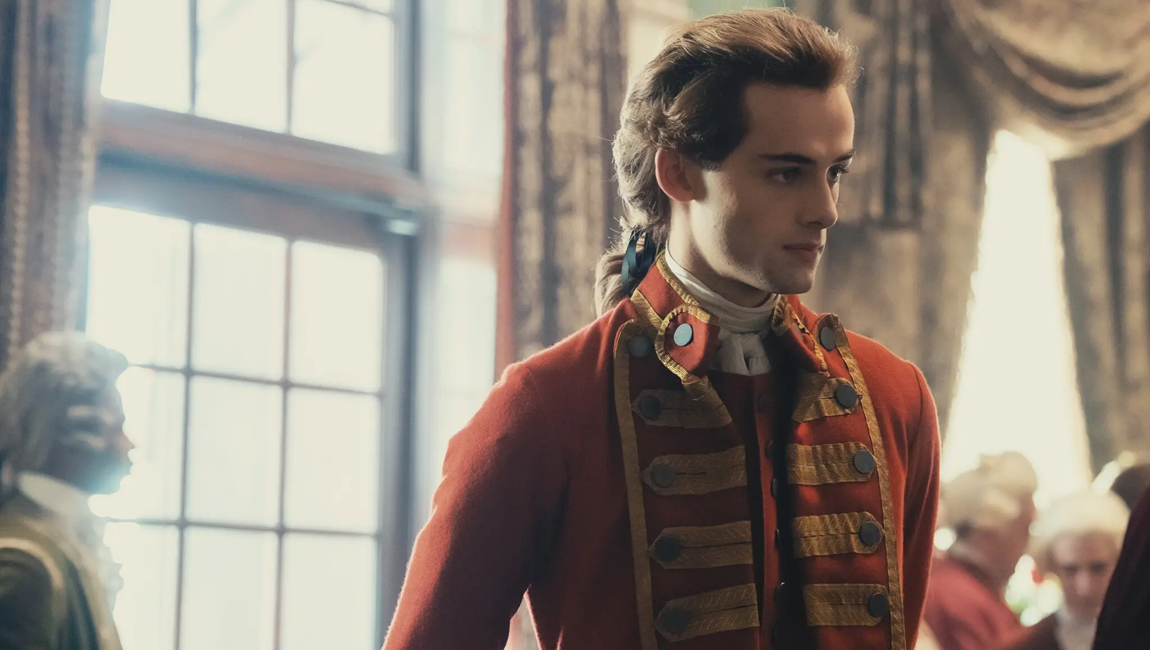
Young Washington, distributed by Angel Studios as part of a slate conspicuously timed for America’s 250th — including the forthcoming Revolutionary War flick Drummer Boy and the Reagan-versus-Gorbachev drama The Brink of War — is as transparent, bland, and vacuous as the trumped-up, and very empty, “great American state fair” that happened this past weekend at the National Mall. For those unfamiliar, a little context: Angel Studios is a faith-based distribution company that emerged out of VidAngel, a service designed to censor Hollywood productions for its predominantly Christian and Church of Latter-day Saints viewership, and which ultimately faced lawsuits from major studios and filed for bankruptcy in 2017. Initially supported by crowdfunding via its “angel” investors, Angel Studios now has the support of major venture capital firms such as Gigafund (a major investor in SpaceX). The angels, now part of the “Angel Guild,” still have a say, however. Anywhere from one to two million strong — a title card before Young Washington asserts over two million members — the guild is a combination think tank and censorship board which approves each project the studio takes on — Young Washington, for instance, assures us that it is “Angel Approved.” Young Washington also ends with a call-to-action of sorts, providing viewers with a QR code by which they might “pay it forward” and buy tickets for disadvantaged families who want to see the film. The goal, stated directly, is to make Young Washington the number-one movie in America, an aspiration that Angel Studios seems to assume is warranted given the film’s subject and timing. This request for patriotic support immediately gives the enterprise a decidedly Trumpian edge, not unlike the political theater currently ongoing for the country’s semiquincentennial.
Young Washington locates its protagonist, a severely blue-eyed Washington portrayed by William Franklyn-Miller, as an ambitious young man, a tenant farmer on his half-brother’s Mount Vernon estate with dreams of becoming a royal officer in the British Army. He’s disadvantaged, however. Virginia aristocrats view him as a “provincial.” They remind him constantly that a colonist can never become an officer, a “gentleman.” The character’s progression then proceeds to hit all the tired beats of “biopic” ascendancy. We see Washington reading Cato, Plutarch, and Alexander Pope, dressing the part of the gentry and worming his way into high-society parties as if it were a Rocky training montage. It is a trite mythos that depicts Washington several times taking his anger out on a cherry tree, borrowing that apocryphal image. It is, of course, a deeply American mythos: hollow, symbolic, emphasizing personal advancement. Young Washington, despite all its regurgitation, at least shakes things up in the presentation of its founding narrative in that it portrays this founding “father” as unmistakably narcissistic, an ironic consequence of the film’s aims.
To prove himself in the eyes of the British elite, Washington leads an expedition into the then-uncharted frontier of the Ohio territory, an expedition that becomes the flash point of the French and Indian War (1754-1763). The historical record of Young Washington goes no deeper than a Wikipedia article. Far from inspiring, it neither brings history to life nor examines its ramifications. Life in 18th-century colonial America is particularly alienating from a 21st-century vantage and requires something more than set dressing and costuming to evoke. Not to mention the political intricacies of pre-revolutionary expansion, an era severely underrepresented in the admittedly poor collective understanding of American history. Far from enmeshing us in the strangeness of the past, Young Washington reads like a McGraw-Hill high school history textbook. It is inane at every turn, never rising above basic competence. Dialogue is heavy with exposition, mostly of the sort that “patriotic” Americans are meant to predict. Scenes lack both space and imagination, and performances are either awkward or histrionic. Andy Serkis fares best as an arrogant, aristocratic General Braddock, mustering some actual gravity with an entirely unlikable performance, though it’s nonetheless designed to remain on the surface. Important moments, meanwhile, are telegraphed by swelling music, while transitions are marked by drifting landscape imagery. Young Washington asks that we turn our critical thinking down, or off — a dangerously disingenuous proposition in a film purporting to show real, consequential history.
“Even a pawn can take a king,” says Lawrence Washington, teaching his young half-brother to play chess, a game of strategic cunning. The phrase becomes totemic for George, and it repeats again and again throughout the film. We are meant to presume its prophetic assertion of the coming American Revolution, the sequel we all know is coming, when colonists indeed topple a king. After the crushing defeat at Fort Necessity in 1754, Washington asks a soldier, “What is the day today?” “July 3,” he answers. This day “will be etched in my memory forever,” Washington proclaims, at which viewers are like to do one of two things: either roll their eyes in vigor, or else screech in shameless patriotic glee. Later, amid another heated battle, Washington rises to the moment with a hole shot straight through the corner of his tri-corner hat. The image is a painfully obvious symbol of the character’s destiny made manifest. We know, of course, that George Washington did not die on the battlefield in 1755. He would, we know, be the general of the Continental Army before becoming the first president of the United States of America. Nothing illustrates the hollow history-making of Young Washington better than Washington’s final request, that he would “like to discuss the uniform,” changing the colors of the Virginia militia from red to navy blue, eventually the uniform of the Continental Army. It is a meaningless detail that functions no differently from a superhero deciding on their costume at the end of a prequel, serving only to satisfy fan expectations. As he rises, victorious against all odds, and is seen through powder smoke by the cowardly British officer who doubted him, we are witness to a cheap American imitation of Wagnerian hero worship. Neither operatic nor historically cognizant, Young Washington is nothing but cheap, uninspiring propaganda, as bald-faced as Donald Trump’s lies or Angel Studio’s shameless post-credits begging.
Comments are closed.