
American independent filmmaker and cinematographer Rob Tregenza broke onto the scene with 1988’s Talking to Strangers, a somewhat Jarmuschian dramedy that was notable for being composed of exactly nine 10-minute-long sequence shots. Every scene was elaborately choreographed, and since Tregenza was shooting on 35mm film and keeping to a minuscule budget, each scene entailed an exceedingly high degree of difficulty. Any mistakes would ruin the shot and represent a massive setback, so as one watches Talking to Strangers, you are acutely aware that Tregenza is pulling off a cinematic high-wire act.
This put the viewer in a state of self-awareness, since Tregenza’s “oners” are not exactly subtle. We are watching a narrative fall into place, but at the same time — maybe even more emphatically — we are watching the filmmaking process, noting how everything comes together, and considering all the things that threaten to go wrong. As a result, we can never lose ourselves in the story. Indeed, we are watching ourselves watch the film. This is not a problem in itself, and a lot of non-narrative experimental films operate on a similar basis. But they seldom add a fictional story into the mix. So this push-and-pull between diegetic and nondiegetic awareness is at the heart of Tregenza’s project.
In the intervening years, Tregenza worked as a cinematographer for other directors, most notably Béla Tarr and Alex Cox. After completing his first three features — Talking to Strangers, The Arc, and Inside/Out — the director had a lengthy fallow period, broken in 2016 with his fourth feature, Gavagai, made in Norway. His fifth and sixth films, The Fishing Place and Fast, have followed at a comparatively brisk pace, suggesting a welcome creative renaissance. But the film world has changed around Tregenza, in no small part because of his own contributions to it. When he made Talking to Strangers, “slow cinema” wasn’t a designated category, and so his newer work finds itself in an interesting position. There is an available discourse for understanding what kind of films he’s making, but those films then enter a critical matrix in which they are judged by other examples of the form. (One need only look at Paul Schrader’s infamous mandala diagram to recognize this odd terrain.)
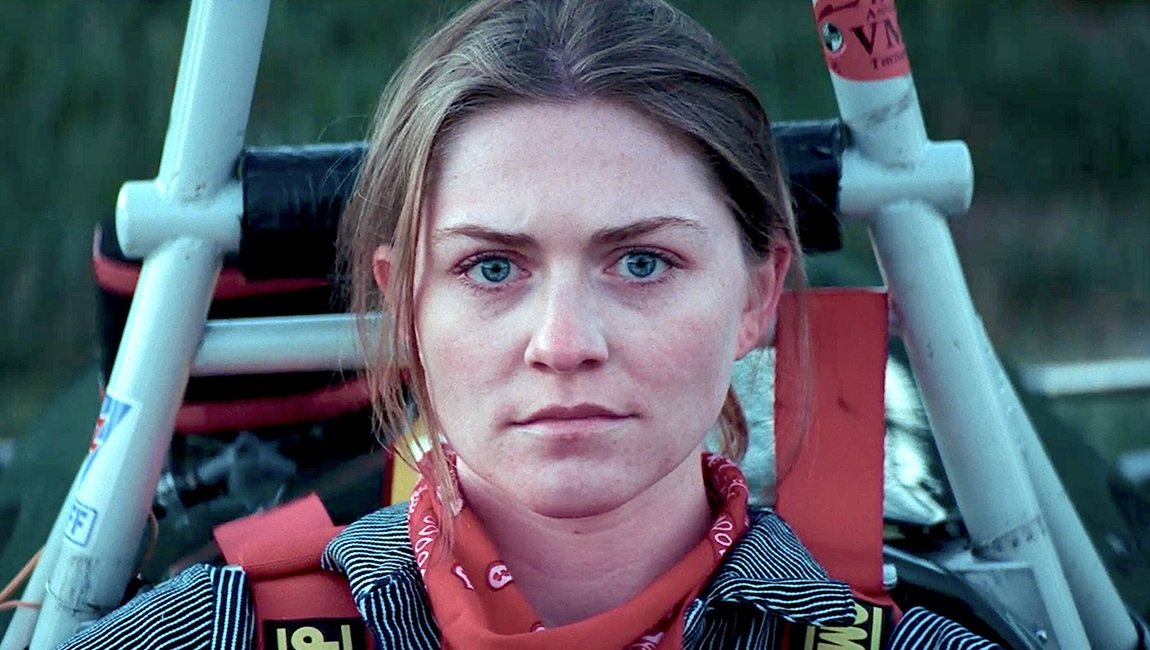
Tregenza’s new film Fast is a strange beast. While not entirely composed of plans sequences, there are a number of long, winding, unbroken shots, but the director appears to be using them in a rather different way here. There is not what we would typically consider a story in Fast, and each of its lengthy sequences maintains an almost maddening autonomy. That’s not to say there is no relationship among the scenes that comprise the film, but that relationship is less a causal or character-driven one and more of a conceptual fog. We observe the actions and struggles of a protagonist, Sterling (Madison Pankey), but her actions are difficult to place in the past or present. As a result, Fast operates as a kind of tone poem regarding a woman’s thwarted desires.
Sterling is a young woman living in small-town Virginia. She works at a junkyard and, upon discovering an old Lotus F1 race car, begins refurbishing it and working toward a goal upon which she’d presumably given up. She wants to be a Formula 1 racer. Within this laid-back Southern environment, she feels the need for speed, and this can be understood in a few different ways. Film and literary history are filled with small-town protagonists who feel stifled and want to make it out, but here, Tregenza overtly makes it a question of incompatible physics. This world moves slowly, and Sterling wants to go fast. On a metatextual level, Sterling as a character also seems to be at odds with Fast as a cinematic enterprise. She is a would-be speed demon stranded in an example of slow cinema, and so inasmuch as Fast comprises the diegetic universe in which Sterling exists, her temperament is supremely unsuited to the world around her.
The dominant perceptual mode of Fast is one of uncertainty regarding Sterling’s basic circumstances. Some passages of the film are in color — the opening and closing shots of a train track surrounded by autumnal foliage is particularly vivid — while many more are in black-and-white. One might suspect that color depicts the present, black-and-white the past, but this hypothesis doesn’t entirely hold. The first long sequence shot (in black-and-white) depicts Sterling being sexually assaulted by Bobby (Dietrich Teschner), an old boyfriend, with Sterling apparently killing him with a crowbar she found among the junk. But a second sequence-shot, composed of four 360º pans, seems to function as a dream sequence of a ghost sonata. The same handful of characters emerge from the same broken vehicles, over and over again, while Sterling works on the Lotus. Are these avatars of the dead there to remind Sterling that speed kills? Are they forever attached to the cars they died in? It’s impossible to say.
Even the subsequent scenes (in color), which find Sterling interacting with a different secondary character and talking about her plans to race, are vague and difficult to place within a narrative trajectory. An uncle (Nicholas X. Parsons) offers her help, while a wealthy local man (Jeff Wincott) seems both avuncular and dismissive, referring to Sterling as “a bit tarnished” in an aside. An older female relative, and old friend, a police officer, a mechanic who harbors a crush on Sterling — all these figures play against Sterling without any of them having much of an impact on her, her interest in racing, or the overall movement of the film. At this point, one might be forgiven for thinking Tregenza is, well, going nowhere fast.
But there are other scenes that clearly take place in a historical past. Characters wear period dress from the 19th century, and their motions and speech retain a vaguely incantatory tone. To be clear, Fast’s performances are never naturalistic, but neither do they seem deliberately stylized. Instead, there is a sense that emotions are indicated rather than conveyed, and that dialogue rings hollow, never exactly communicating. The historical sequences, by contrast, are much more deliberate in their pace and the actors’ comportment. They suggest clear memories, while much of the rest of the film bears the tenor of fuzzy recollections that are indistinguishable from dreams or fantasies.
So one comes away from Fast with a number of interpretive possibilities, none of which seem more “correct” than any other. Is Sterling a ghost among the Southern dead? Are we observing moments of trauma that have stranded her in a reality she means to escape? Is Tregenza demonstrating the inevitable opacity of the human subject, Sterling trying but failing to reach out beyond the confines of her own mind?
Or is Tregenza moving even further along the conceptual axis that defined the second half of The Fishing Place? That film stopped being a narrative and broke frame to become a sort of making-of metanarrative, displaying the complex apparatus involved in making films Tregenza’s way. There are a number of moments in Fast when any narrative illusionism breaks down. From a visible boom mic in one scene, to a hair fluttering in the gate, to an actor flubbing a line, there are small moments that point back to the filmmaking process, and some of the things that can go wrong in the course of shooting. But it’s difficult to call “cut” during the fifth minute of an eight-minute sequence-shot and start again. It would be easy to point the finger at these “cinema sins” and conclude that Tregenza was merely being economical. But Fast is a film that, in many ways, is about the failure of things to coalesce, the inability to get a dream off the ground. Perhaps Fast is an attempt to produce artistic meaning without perfectionism, to embrace the muddle and the imperfect connections between things.
DIRECTOR: Rob Tregenza; CAST: Madison Pankey, Mia Grichendler, Nicholas X Parsons, Jeff Wincott, Danny Hugus; DISTRIBUTOR: Cinema Parallel; IN THEATERS: August 12; RUNTIME: 1 hr. 36 min.
Comments are closed.