
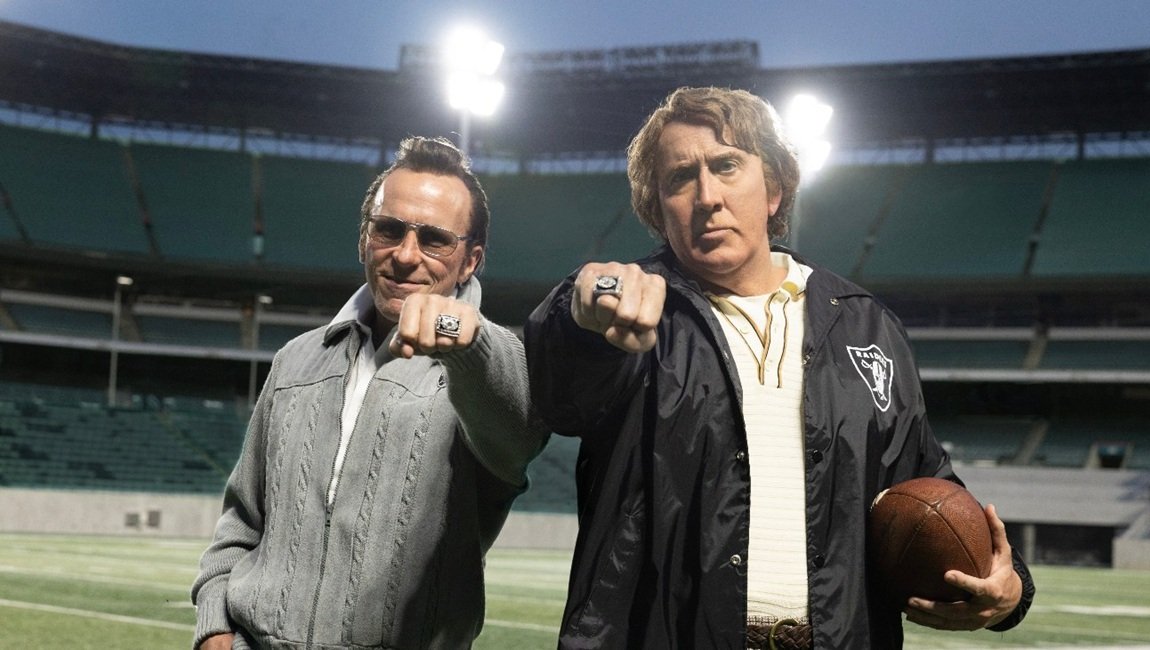
A Turducken — or turkey, duck and chicken, all deboned and served encased in each other, like a Russian nesting doll of meat, or an aviary centipede — is a uniquely American monstrosity that fails in its conception because all three birds of different sizes and fat contents are delicate proteins that have to be perfectly calibrated, prepared, and cooked to exact temperatures so as not to render their breasts inedibly dry. Halfway through Madden, Nicolas Cage — in a fat suit, playing the titular Canton-enshrined coach, commentator, and digital football revolutionary — sticks his bare hand directly into a turducken. You would think this is David O. Russell — once thought of as among the best, most exciting, inventive, and thoughtful young American filmmakers of the ’90s — winking to his audience, letting us know he is in on the metaphorical joke and the turducken we are watching is a fuck-you provacation. But after watching the film he’s made, and spending time afterward thinking about it, that doesn’t seem to be the case.
Madden is a turducken of sorts. It’s a relationship drama about the occasionally rocky 62-year marriage between John and Virginia Madden (Kathryn Hahn, doing her best) and the occasionally rocky four-decade-plus friendship between Madden and Raiders owner Al Davis (Christian Bale, looking like checker cabbie from Brooklyn by way of Mordor); a sports movie about a great football coach who made a mid-career and mid-life transition into broadcasting and eventually became the face of sports video games; and a pomo, absurdist comedy. It’s also none of these films, because it’s clumsily stitched and never settles on a consistent energy or tone.
That said, Madden wants to be a comedy. Hahn, Shane Gillis, John Mulaney, Snoop Dogg, and Nic Cage — in prosthetics doing something like a stammering Jimmy Stewart impression that sounds nothing like his subject — are all assembled presumably to make that film. Russell’s most loyal late-career soldier, Bale, has also proved to be the patron saint of the later years of Adam McKay’s filmography, and that’s the tradition Madden seems to be drawing from. The to-the-camera, wall-breaking asides; the MacFarlane-esque quick cut visual gags; the historical reenactments laden with bad wigs and heightened ’70s and ’80s period fits; the non-sequitur, improv-heavy riffs on pop-culture — Madden draws from a hybrid of McKay’s ribald edutainments like The Big Short and Vice with a dash of his late, great HBO series Winning Time (the film even mounts its own “Catalina Wine Mixer,” a feeble attempt to make “Santa Maria Barbecue” happen). The problem is that it’s not funny, it’s completely arrhythmic, and it’s incredibly difficult to understand why Russell wanted to tackle a John Madden biopic ripping off this style in the first place.
It’s been 32 years since Russell broke into the American indie film scene with the incest comedy Spanking the Monkey, immediately announcing himself as a wunderkind in a cohort with, in all seriousness, Wes Anderson, Noah Baumbach, Steven Soderbergh, and Quentin Tarantino. That’s how we used to talk about him, as one of the great filmmakers of his generation, with a real voice and perspective. Madden is his 11th film, and might be the best argument yet for the wisdom of Tarantino’s mandate that filmmakers have a double digit expiration date.
Whispers and shouts about Russell being a demanding, unprofessional asshole on set have been in the air for nearly as long as he’s been working as a filmmaker, but up until the last decade there was work product that he could point to as justification for bad behavior. The style of “let the camera roll” quirky dramedy he pivoted to, beginning in 2010 with The Fighter, attracted stars who were given a wide berth to play big and vie for trophies, which worked, and proved lucrative at the box office, for a time. Something curdled in 2015 with twin failures Accidental Love and Joy, and Russell arguably hasn’t made more than two consecutive scenes work together since. It’s one of the more baffling examples of an obviously talented filmmaker completely losing their moorings in recent memory.
Which is frustrating because Madden is a glowing Vince McMahon meme proposition for football, video game, and movie nerds of a certain age. Cage and Bale in a David O. Russell biopic farce about a beloved, outsized figure from our childhood is a can’t-miss proposition on paper, depending on what era you’re scribbling it. That it sails so far into the stands demands questions like: “Was there a shooting script?” “What were they seeing in the dailies?” And, perhaps most urgently, “What the fuck happened in the edit bay?”
You can squint at Madden and see several versions of it that work. It’s a story about a strategic genius so devoted to football that he has to get away from it to literally save his life and preserve his family, then remakes himself as personality and impresario in the afterglow of that accomplishment using many of the same tools. There’s a compelling story about codifying one of the great football minds of the 20th century as a playable cartridge, following the ebbs and flows of the snakebitten, then miraculously triumphant, renegade Raiders as they’re shuttled back and forth between Oakland and L.A. There are the incredible lives of Madden and Davis and their tumultuous partnership, Madden’s ascent and modernization of the football telecast. Which is to say, there’s so much story, clearly too much story for Russell, who was working off a 2022 Blacklist screenplay by Cambron Clark.
So what you get is an elastic film-length montage that slogs. Anecdotes pile up with no greater purpose. Narration is exposition and dialogue is also almost all exposition, unless it takes the shape of random, meandering riffing from actors who aren’t expert improvisors and either can’t be bailed out by the edit or simple aren’t. Characters who have no bearing on the story are introduced late and arbitrarily. There are snippets from deleted scenes that should’ve been entirely deleted woven in with no logic or feel for placement. There isn’t a single performance in the film that feels committed or sincere, which is less bad acting than actors who have been completely undercut and sold out by uneven, inert, inept filmmaking that fluctuates wildly from moment to moment.
We are asked to care about Madden’s fear of flying, or whether or not the Maddens will get separated, or why the video game matters, or why Al Davis’s Hall of Fame induction matters, or why anything matters. But the film provides no persuasive arguments to pay attention to any of it. What is remarkable about Madden is how instructive it is. The seams of the film are so apparent that a layperson can half watch this on Amazon between Cowboys snaps, or an oven full of sides, or a game of Sudoku on their phones, as one would image many Americans will in the coming week, and intuitively understand what is missing from this scene, or how that transition was bungled, or what was intended there but not delivered either on the page or on set.
So then we’re left to ask: what happened to David O. Russell? What wilderness did he get lost in, can he be saved, or can we at least get an answer to use as a cautionary tale for future generations? It’s a fascinating and potentially urgent question for a writer/director who made what is still probably the best movie about the American incursion in the Middle East, and adapted a book about meditation into a wacky, funny, moving takedown of American consumerism that contained many styles and ideas and shouldn’t have worked, but delivered them all perfectly cooked. Madden is pure sawdust.
DIRECTOR: David O. Russell; CAST: Nicolas Cage, Christian Bale, Kathryn Hahn, John Mulaney, Sienna Miller, Shane Gillis; DISTRIBUTOR: Amazon MGM Studios/Prime Video; STREAMING: November 18; RUNTIME: 1 hr. 50 min.
Comments are closed.