
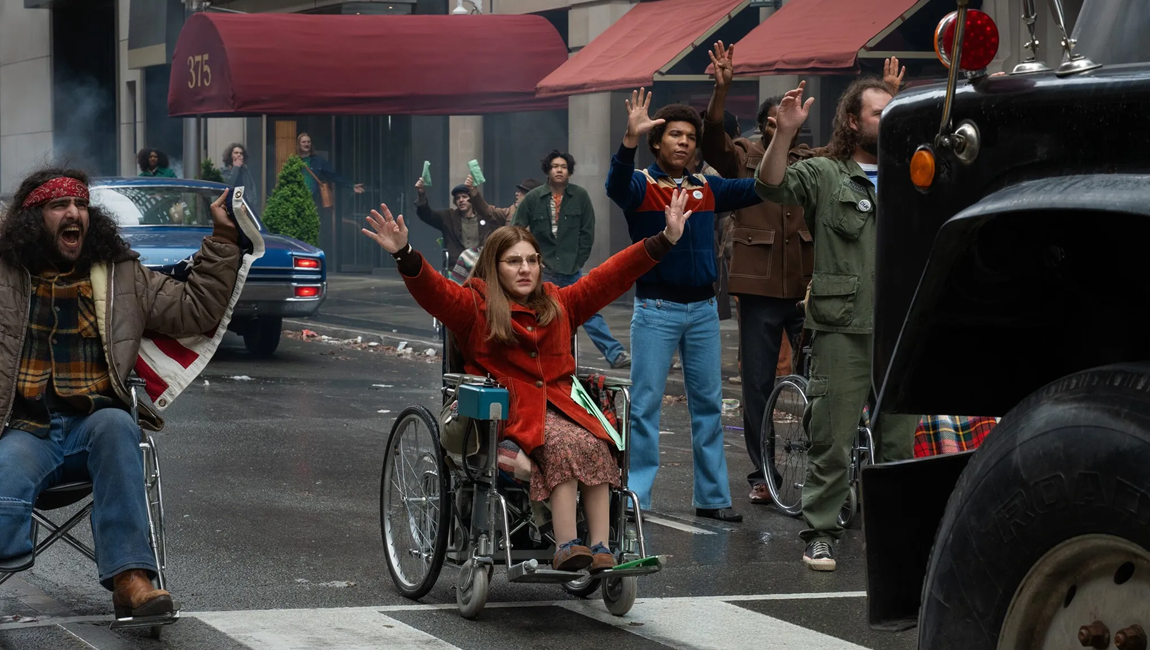
In 1977, Judy Heumann continued a trailblazing fight for disability rights with the 504 Sit-ins. The movement, helmed by Heumann, saw dozens of fellow activists with disabilities occupy federal buildings across the United States in favor of a sweeping piece of legislation protecting rights from housing and transportation to employment discrimination and inclusive education. Heumann herself led the San Francisco sit-in, the movement’s most effective and highly publicized chapter. With nearly 120 activists occupying the building over 25 days, it remains America’s longest nonviolent occupation of a federal building.
Heumann’s efforts, grueling as they may have been, were a success: Section 504 was signed unchanged after nearly a month of hunger strikes, compromised care, and federal abuse. Siân Heder’s Being Heumann distills the sit-ins into a movie as palatable and winking as its title suggests. The film is an inspiration — just don’t tell that to Heumann herself.
Continuing a streak of mission-based dramas after CODA, Heder casts the activists in her biopic exclusively with actors with disabilities. It’s a noble and resoundingly successful choice: Being Heumann’s cast is uniformly excellent and charming. At its center, Ruth Madeley plays Judy Heumann, a frazzled and uncompromising activist with a mouth full of vinegar. Madeley’s Heumann is as cutthroat and hardnosed as the real thing. A proudly self-diagnosed “asshole,” Heumann brazens herself a thorn in the side of a system ambivalent to her wellbeing, with particular ire toward Secretary of Health Joseph Califano (Mark Ruffalo), the pen reluctant to sign Section 504 at the potential expense of his career. That’s of little concern to Heumann, whose cause is holy righteous: she’s committed to the rights of “a minority group that anyone could be a part of at any time.”
But Heumann’s valor is choked down by a suffocating cuteness that pervades every inch of Being Heumann. The movie is stricken with a metastatically benign, pedestrian sense of humor; in its opening minutes, a passerby throws change into a disabled protester’s coffee, a joke recycled from Seinfeld, The Fischer King, Two Weeks Notice, and boundless other properties. Being Heumann’s jokes are cloyingly unidirectional, an impulse that bleeds — with far harsher impact — into its character design. Heumann’s rougher edges are algorithmically manicured; she’s a heel to the bad guys, a cantankerous friend to her fellow protestors, and carries a quiver of plucky punchlines to deescalate infighting on a dime.
Madeley’s castmates are similarly burdened. There’s no one among the protesters who’s not oozing with lovability; anything unwieldy about their personalities is reduced here to a minor peccadillo and often excused with a laugh line. It’s another chapter in a well-intentioned but malignant trend in the depiction of people with disabilities on screen. In an effort to prove the humanity of people whose humanity is routinely denied, the spectrum of their personhood is reduced to a slim window of “good.” The result is more product than person, a commodified reduction that doubles as a pat on the back for the film’s audience. Even Califano, Being Heumann’s de facto villain, falls victim to the film’s overbearing sense of cheeriness. Califano stood as a historic hurdle to American accessibility, but his character seems deliberately bent around Ruffalo’s aw-shucks public persona. It’s a disservice to the character of the protestors, the radical sacrifices the sit-ins demanded of them, and the monumental barriers they faced in the fight for equal rights.
Heumann and company’s crusades are further complicated by the artifice of Being Heumann’s efforts as a period piece. Characters are draped in a pachouli-scented pastiche of love beads, drug rugs, and bellbottoms with the precision of a slapdash SNL sketch. There’s even a moment in which Rob Delaney, who plays sympathetic congressman George Miller (no relation), looks as if he might lose his costumed mustache into a coffee cup. Being Heumann boasts a buzzy soundtrack with equal nuance. Iggy Pop’s “The Passenger” scores a close-up of wheels rolling down a Manhattan street; Funkadelic’s “Give Up the Funk” pops when a protestor produces a bag of pot. By the time Heder sets a defiant Heumann to “Judy is a Punk,” Being Heumann’s good will is so sufficiently buried under a mountain of first-draft ideas that it threatens parody.
It’s difficult to remember, but there was a time when the notion of virtue in public works and media wasn’t leveraged as a bad-faith political slight. Still, a gladhanded manipulation of morality has always been artistically thorny. “If there is any test that can be applied to movies,” wrote critic Pauline Kael, “it’s that the good ones never make you feel virtuous.” Being Heumann’s pervasive goodness — and its limp political and historical cosplay — is a well-meaning abatement of Judy Heumann’s radical commitment to civil progress. There’s a moment in Being Heumann in which a wet-eared reporter, played by Dylan O’Brien, makes his case to Heumann to join and cover their cause. He says that their story would resonate with America, that it could leave the people feeling inspired. Heumann isn’t having it. “Inspired to do something? Or just inspired?” she responds. It’s hard to imagine she wouldn’t sneer at her own biopic, too.
DIRECTOR: Siân Heder; CAST: Ruth Madeley, Mark Ruffalo, Dylan O’Brien, Madeline Delp, Rob Delaney; DISTRIBUTOR: Apple TV; IN THEATERS: November 6; STREAMING: November 13; RUNTIME: 2 hr. 7 min.
Comments are closed.