
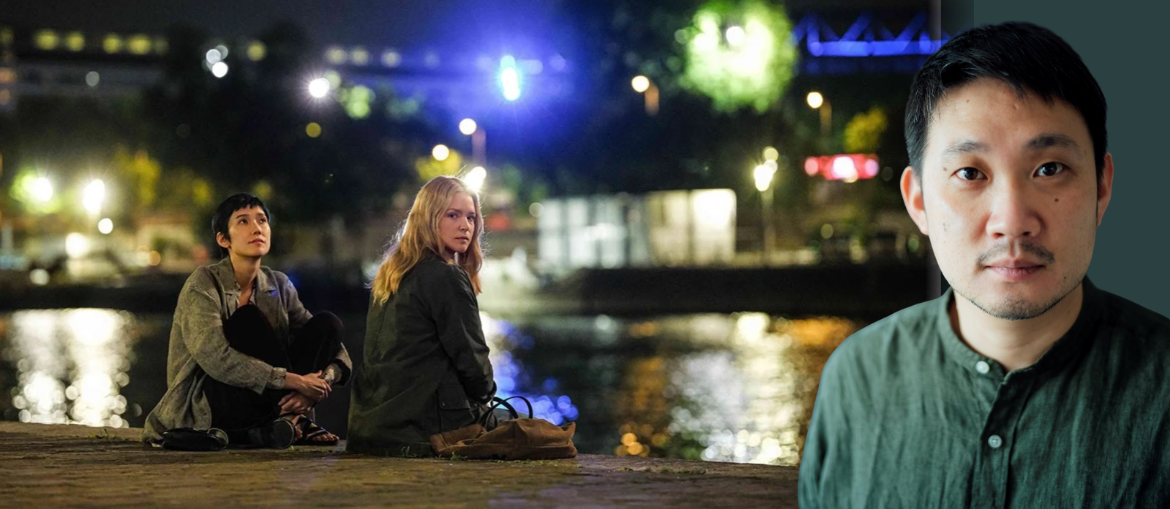
Ryusuke Hamaguchi’s work is so steeped in a yearning for care and understanding that it’s a wonder he only discovered Humanitude a decade ago. The philosophy of care, created by French phys-ed teachers Yves Gineste and Rosette Marescotti, centers on four basic tenets: Look, Talk, Touch, and Stand. Used in care facilities for patients with dementia, the technique aims to treat the patient with as much intimate, focused care as possible — seeing them and their needs above their diagnosis. While basing a film around this philosophy might not seem like a go-to, its core ideas course through Hamaguchi’s filmography. So much so, you’d almost think he’d invented it.
His latest film, All of a Sudden, uses the philosophy to scaffold a tale of love and connection between two women. Marie-Lou (Virginie Efira) directs a Parisian care facility. She and her staff are exhausted and overworked, but as it’s a for-profit institution, if they don’t get results and turn over patients, the money will stop flowing. Facing resistance from longtime staff, she attempts to institute Humanitude, hoping the method will finally produce results. One day, on a break from work, she runs into an autistic child and his grandfather. The grandfather is a famous Japanese actor, Gorô Kiyomiya (Kyōzō Nagatsuka), in France for a play he stars in. Through him, Mari Lou meets its director, Mari (Tao Okamoto), a woman who rewires Marie-Lou’s entire existence.
Over the course of a mammoth yet ever-engrossing three-hour runtime, the women begin a relationship that eschews any traditional labels. Efira, in interviews and Q&As, has cheekily leaned into the romance, and while that’s certainly there, Hamaguchi blurs the lines. Dying of cancer, Mari seeks to further understand the world around her before passing. One night after a performance of her play, which Marie-Lou attends, the two walk through Paris chatting the night away. The latter is forced to return to work for the night shift, and Mari joins her. Their conversations weave through the care home, landing on a stunner of a set piece where the two talk in depth about bodies under capitalism. It’s as enthralling as anything you’ll see this year.
The two become inseparable, and while Hamaguchi never allows them a kiss or even a declaration of outward romantic love, the unsaid is beyond obvious. Marie-Lou invites Mari to stay in the home to live out her final days, allowing her to employ her own methods of touch to the patients. Here, Hamaguchi plays with our expectations of what “care” means, showing that sensuality can mean many things beyond romance. When the staff massages their patients’ feet, there’s a professionalism there because of course there is. When Marie-Lou does it to Mari, or Mari to Marie-Lou, what do we call that? A gorgeous film of longing and real, unlabeled love unfurls. It’s never important what their parameters are. It only matters that the two women found each other at this moment in time.
Ahead of All of a Sudden’s release, I sat down with Ryusuke Hamaguchi to talk Humanitude, what it means to be present, Sho Miyake, and so much more.
Thanks to Monika Uchiyama for translating.
Brandon Streussnig: So much is revealed in your work through dialogue. It often feels so precise in how you construct it. How does that process work when you have to write for another language, specifically a French person speaking Japanese and vice versa?
Ryusuke Hamaguchi: That process is just a patchwork process of trying to come up with solutions little by little. First, of course, I had to learn French myself, although I can’t speak it. Now, I can read and understand quite a bit. Then I worked with a very skilled translator. For this project, I worked with Léa Le Dimna, who’s also worked with directors like Hirokazu Kore-eda. She worked not only as a translator, but also as a co-writer on the script, and she helped me on set.
From there, it was about relying on the French actors to make sure the translation was strong enough that they didn’t feel the lines or dialogue were strange, and that helped me confirm the strength of the script itself. The rest is just allowing the actors to understand and interpret the script as they want, because, of course, they have a better understanding of French culture and how their characters and the people they’re acting across may react to this dialogue. It’s just placing a tremendous amount of trust in the actors because they, by far, have more experience within French culture. That sense of trust is something that I do on all of my sets. It’s a kind of normal thing: trusting the actor’s autonomy and allowing them to express themselves through their interpretation of the script. Because once that’s established, that also means that I’m able to direct them.
BS: When you talk about interpreting your script, it makes me think of your rigorous rehearsal method. You’re well-known for having your actors read the script in a flat tone and cadence, repeatedly, until they get it. When I spoke to Virginie Efira, she spoke very highly of this. What is it you’re looking for in that process? When do you know they’ve got it?
RH: Typically, of course, it’s easy to understand that acting is actually very difficult because the person has to be a different person and say things they wouldn’t ordinarily say. So this practice of flat reading allows them to internalize the lines and dialogue physically, almost like a muscle, so they become easier to say. It’s as if the character’s lines are brought to the very forefront of the mind through that repetitive act of flat reading.
Another difficult aspect is that they don’t have an internalized history of the character, and that’s something that I need to supplement. I think Virginie has also talked about how I gave her the subtext, or the character’s history. That’s something I developed through a questionnaire the character fills out. It’s 17 questions, actually. I first fill it out, considering how the character might answer these questions and what kind of history and experiences they might have. I then give that subtext to the actor. But I give it to them as just one possible way of answering these questions, and I want them to use it as a reference to develop the character further. It makes clear what my thoughts are on the character as the director, and then they can develop the character further on an individual basis. That allows them to imagine the character’s history and, through that, approach the character with a better sense of reality.

BS: How did shooting in a real care home with non-actors affect your process?
RH: We did use an existing care facility as the set, but actually in this film, I didn’t employ any non-actors. So all the background actors, or the actors playing those with dementia, are professional actors. Because we were actually filming in a care facility, there are certain people in the background who are residents of that care facility, but rather than people who have the dementia that are being depicted in the film, these are people that I could communicate with and direct in the sense that we’re about to film a scene like this, and we were just able to communicate that pretty clearly. So in that sense, most of the actors that you see, actually all of the actors that you see, are professionals.
I think what was most important was gaining access to that care facility two months before we began filming. We were able to have our own staff room there and perform rehearsals. We also shared the courtyard with the residents and staff, which allowed us to observe them and incorporate some of those elements into the film itself.
BS: I’d never heard of Humanitude before this film. It’s almost a no-brainer when it comes to your own films. I’m thinking specifically about touch and looking at someone, seeing them for who they are. That’s present through all of your work. When did you discover this philosophy?
RH: I agree, the principles of Humanitude definitely resonated with my own process because it was very similar to directing, and it starts with having an interest in, or care for, a person. What is this kind of care? It’s similar to directing in that it’s about having an interest in and care for a person, then using techniques to draw out a certain response. So in terms of directing, you can’t simply just have an interest in a person, an interest in their experience; it’s not about trying to draw out a certain performance. You also have to consider what they are concerned about and try to alleviate those concerns, as well as remove obstacles so they can move more freely.
But it doesn’t suffice to just have that sense of care; you need techniques in order to understand how those obstacles can be removed or alleviated. You must have techniques to properly convey the kind of care you are showing them. So it really becomes about physically removing certain roadblocks or obstacles in order to allow for that freedom. I encountered Humanitude about 10 years ago, and it has resonated with me ever since.
BS: The film is adapted from letters between two academics, correct?
RH: Yes.
BS: I imagine that reading those, while no doubt surprising and human, might not lend itself to something cinematic. How did you go about finding that?
RH: There was a book published that was an exchange between two women: one is a Japanese philosopher, the other an anthropologist, and they exchange letters with each other. The philosopher, at a certain point, has cancer, and then, about midway through their exchange, falls ill, heading toward a terminal kind of diagnosis. Of course, these conversations are quite abstract, but it’s interesting how they also contain humor and very human elements. They’re also talking about their own private lives. But of course, because they’re two academics interacting with each other, they’re mostly sharing wisdom and knowledge about their own fields. Once the philosopher does fall ill very suddenly, there becomes a gap between their two experiences: one of the person that’s going to continue living and the other who is heading toward dying.
Through their friendship, they try to overcome that gap, and if they can’t, they continue to walk alongside each other. So although the conversation is between these two academics, there is a kind of humanness that’s also framed by their academic intellect. In the sense that they talk about private things with intellectual rigor, and talk about emotions in an unsentimental way, in the sense that neither of them indulges in pitying themselves. So when I read it, I immediately liked the content of the letters; I was very drawn to it, and I was also deeply moved. I knew it would be very hard to translate this into cinema, into the filmic medium, but I thought that if I could somehow convey the emotional resonance of these letters through a film, it would be incredibly powerful. I was also excited by the idea of having more people know about the existence of a book like this. I’d also like to say it will soon be published in translation in English.
BS: I’m very much looking forward to reading that and seeing how it shaped this film. Something I’ve loved across your work is that you use these structures or institutions, be it grief counseling, city council meetings, theater rehearsals, or care homes, and find ways to show how we can really see the person across from us. Tell me about that throughline.
RH: I wasn’t able to get into it in an earlier question, but I wanted to come back to it. When I thought about how I can take what’s emotionally resonant to me and translate it into a film or convey that to an audience, I think that I have to tap into all of my own experiences, my knowledge, et cetera. That includes how I feel or the things that I’ve experienced and felt while working on set. You could say commercial filmmaking is also a rigid system, and that system needs to exist to make these films happen, but within that systematic framework, unfortunately, human experience and human interests are deprioritized. Through my research, I realized that the same kind of deprioritization within the system happens across many different places. For instance, my research into elder care facilities shows that this happens in a very vivid way in those spaces.
Then I’m trying to connect all of these things to my own experiences. Of course, this idea of theater isn’t so distant from my experience as a film director, and it’s a process of patchworking all that knowledge and research together. It’s not a particularly intellectual or rigorous process, but it’s still based on research. For instance, with this script, I consult with French people; if someone says to me, “This isn’t how it happens in France,” then I make adjustments. It’s just a slow process of adjusting and patchworking together.
BS: You recently wrote a beautiful essay about Sho Miyake for the program of his Metrograph series. I’m a huge admirer of his as well and could probably spend hours talking with you about him. You have a film study group with him. His taste is fascinating. Recently, he programmed Tony Scott’s Déjà Vu in Los Angeles and then, here in New York, he’s programmed films like Crystal Voyager. Is there a film or filmmaker that he’s brought into the conversation that might surprise us?
RH: I also love Tony Scott! [Laughs] The study group you’re talking about is Miyake, Miura Tetsuya, and me, and we discuss which directors we’re going to study next. I think that, fundamentally, we just kind of have similar taste. Of course, we each have our kind of specialties in the sense that I’m obsessed with Cassavetes and he might be obsessed with someone else. But as far as a surprising choice that came from him, or a surprising choice we arrived at, we are continuing the study group, and I guess choosing Ernst Lubitsch to study was quite surprising to me, at least. We’re trying to approach his films and trying to understand how he made the directing choices that he did.
Comments are closed.