
Geese, for lack of a better word, is good. Heirs apparent to the art-rock mantle, they reign in the arena less because they deserve the top spot and more because they’ve managed to slice through indie culture’s great splintering and establish a place for themselves in the zeitgeist. Geese owes its success largely to the lighting-in-a-bottle songwriting talent of its frontman, Cameron Winter, who either withheld his true gifts on Geese’s first two albums or at some point toward the end of 2024 stepped into a Brundle-like telepod and accidentally fused with some DNA from a strand of Thom Yorke’s hair. On the heels of wild acclaim for both his debut solo album Heavy Metal and Geese follow-up Getting Killed, his star rose considerably in 2025, culminating in his coronation as New King of Rock at Carnegie Hall on December 11. Anyone who was anyone was there.
For the rest of us (living within a 100-mile-or-so radius of a major metropolitan area, at least), there’s Cameron Winter at Carnegie Hall, Paul Thomas Anderson’s roadshow cooldown project following the gargantuan One Battle After Another. You fall right into Cameron Winter, and it’s easy to forget the form when enveloped in the combination of Winter’s warbling and the warmth of Anderson’s photography. But the hand is there: PTA is in flexible form despite the weight of those 35mm cameras, playing with light, shadow, and sound in ways he hasn’t since the early 2000s.
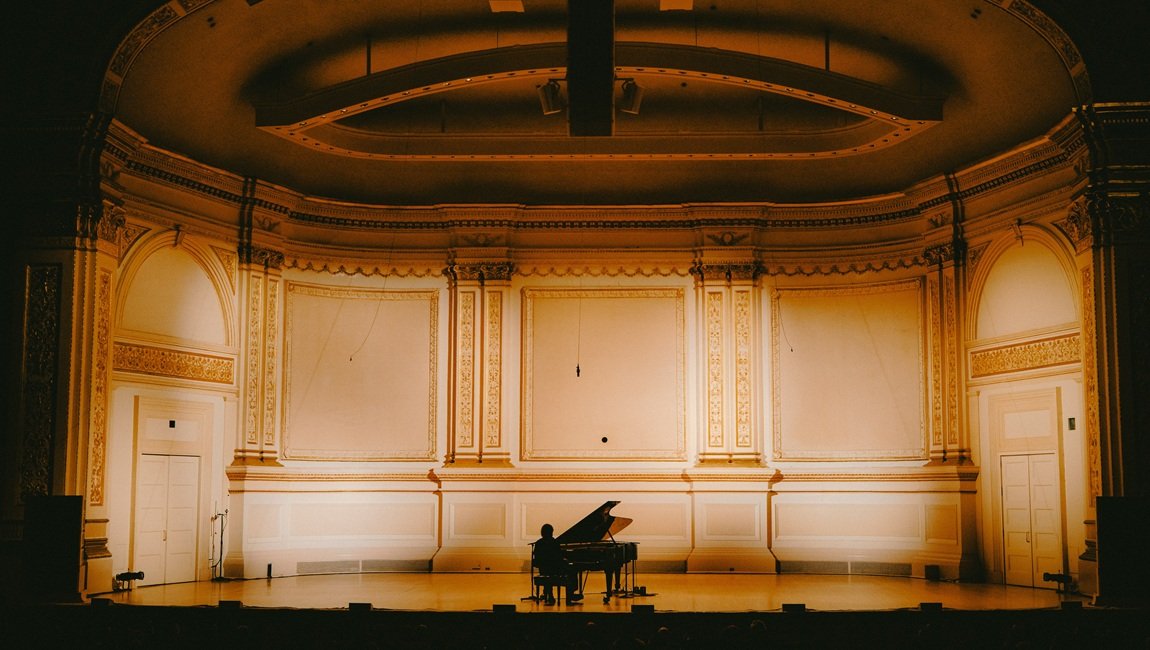
Because of how much capital is bound up in their work, it’s not often filmmakers get to doodle. When they do, the results tend to reveal more about their pleasures and passions than a major work might, and Cameron Winter at Carnegie Hall affords Anderson the same stylistic freedom that can be found in Junun and Anima. There are shades of orange and brown he’s never worked with before, and the film opens on a pointillist montage that resembles Frederick Wiseman’s establishing shots (whether in a deliberate nod to Wiseman, only PTA can say — the film was shot before Wiseman’s death but assembled after it). If there’s connective tissue to be found between Anderson’s fiction work and Cameron Winter, it’s that he’s still trying to find ways out of his White Elephant skin. Certain shots evoke Punch-Drunk Love — when Winter taps the keys at the far end of his piano over and over, Anderson shoots it such that it brings to mind the vulnerability and curiosity of Barry at his harmonium. Largely, though, Anderson dips back into the eternal well of Jonathan Demme’s technique, borrowing zooms and transitions from Stop Making Sense. Cameron Winter at Carnegie Hall doesn’t take any great leaps, but it synthesizes PTA’s fixations — some of them long dormant — in a satisfying way.
Yet the victory really is Winter’s to be had. On stage with Geese, Cameron Winter cuts a figure somewhere between Ziggy Stardust and Labubu-toting Zillenial. Solo, he’s an impish, precocious boy (in one shot, he can be seen with his back curled over the piano like Charlie Brown) who has somehow managed to touch transcendence. The classical patina provided by the Isaac Stern Auditorium and the Steinway (Keith Jarrett’s favorite) he’s perched at helps, no doubt, and tagging Paul Thomas Anderson in to film the affair got this writer to sit up straight and pay attention. Winter’s show could’ve been shot on an iPhone, though, and still feel as textured and dynamic. “God is real,” he bellows, and a halo of light illuminates the hall and all of his audience. For a moment, we believe in the possibility of his proclamation. But that moment is delivered to us courtesy of Winter and his stage manager, not Paul Thomas Anderson.
That said, the film invites a similar introspection, at times of its own place in the moviegoing landscape. Darkness on stage in between songs, auditorium lights that seem to stretch on forever, close-ups that go in and out of focus — it embraces human fallibility and creates a mahogany container into which we can project our hopes and hang-ups. During “Love Takes Miles” (not, surprisingly, a highlight), the camera, handheld, walks down the aisle. Smartphones pop up, and they look out of place; it’s a sly dig at their magnetic disassociating quality. PTA then cuts to a shot of anonymous silhouettes enjoying the show from the balcony. The juxtaposition reminds us that there’s still a place for communal art in our world — and moreover, that cinema is one of those arts. It doesn’t need to litigate its own value—exceptional performances like Winter’s, filmed with care, are evidence enough.
Published as part of NYFF 2026 — Dispatch 8.
Comments are closed.