
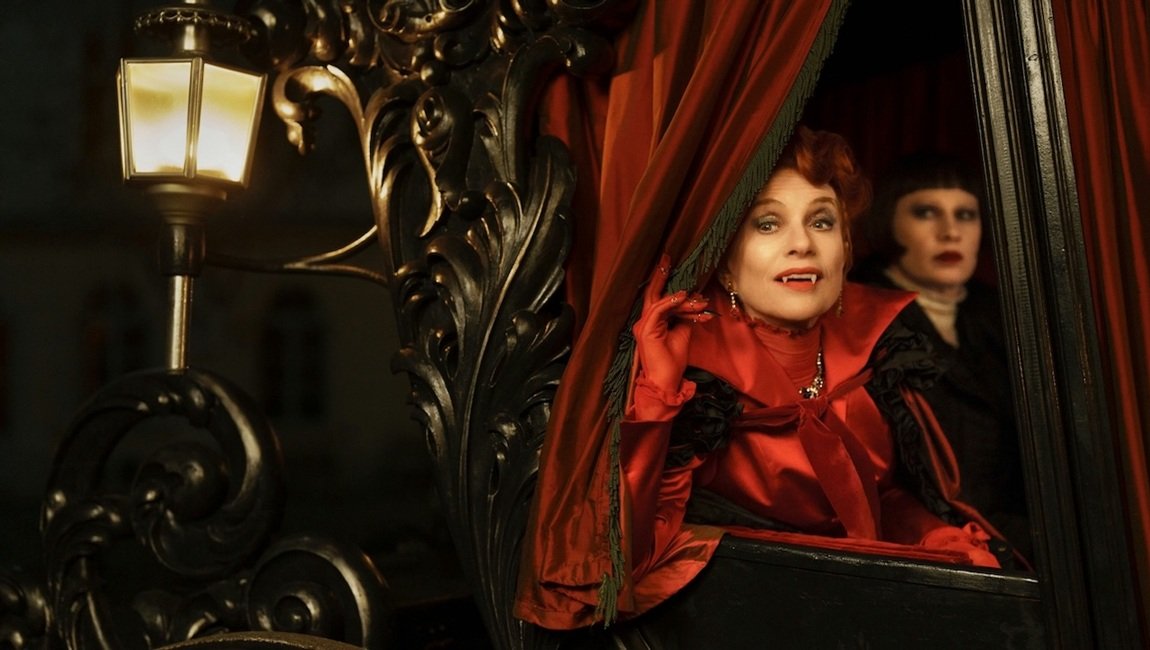
With The Blood Countess, Ulrike Ottinger makes the case that there’s only one suitable way to open a movie where Isabelle Huppert plays a resurrected Báthory Erszébet, the aristocrat and rumored vampire from Habsburg-era Hungary. Strapped to the front of a blood-red barge, its fabric blending into her costume like some gigantic bustle, she floats proudly through the flooded grottos beneath Vienna, her pet bat Pipi riding along with her. Ottinger, now in her fifth decade of filmmaking, once made her name in the arthouses with spectacles of a similar sort. Now, with her first non-documentary feature in over 20 years, she’s back and camper than ever. And what could be camper than Huppert as Báthory on a blood-red barge?
As Báthory takes to the city’s surface, traveling through its ornate, cobbled central streets on a horse-drawn carriage, the gargantuan train of her coat heaved in behind her, tourists stop in amazement. They’ve come to Vienna for the history but, like the audience, they’re seduced by the glamor of this magnificent, idiosyncratic stranger. Throughout The Blood Countess, camp precedes plot and, while it may be to the detriment of flow and cohesion, it’s quite the delight to watch. In the age of drab naturalism and grey-sludge CGI backdrops, both Ottinger and Báthory are a blast from the past, a joyous return to opulence in cinema.
Ottinger makes extensive use of Vienna’s equally extensive array of exquisite historic buildings, positively glimmering in Martin Gschlacht’s characteristically handsome cinematography. Each and every character is decked out in their own personalized couture wardrobe, individually print and color-coded. There’s such generosity in how Ottinger has constructed these characters, but also their actions and their environments. It’s rich and elaborate, even garish in its lack of subtlety. And of course it is: again, this is a movie in which Isabelle Huppert plays one of history’s wealthiest and most notorious (supposed) vampires.
Alas, with every gesture exaggerated and every joke underlined, there’s precious little narrative momentum. Báthory has been revived, it seems, to seek and destroy a book that has the power to make mortal any vampire who sheds a tear upon it. The Blood Countess doesn’t so much concern this search, however, as use it as an excuse to send Huppert, and a few other similarly colorful figures, on some jolly japes (their jolliness diminishes, though, as their number amasses and the movie’s pace grinds ever closer to a total halt). There’s Rudi Bubi von Strudl, Báthory’s vegetarian nephew, Theobastus Bombastus, a vampirologist in town for a conference, and even Conchita Wurst, the Austrian winner of the 2014 Eurovision Song Contest. Her impromptu performance of her winning song, “Rise Like a Phoenix,” to a group of armed police officers in a tomb, may be the movie’s most wearying scene, but it’s entirely in line with the high campery exhibited elsewhere.
Wurst’s presence is jarring in part because Ottinger stages the scene with apparent disinterest, but perhaps more because of its anachronistic quality. The Blood Countess, despite taking place in the present, is a movie firmly rooted in the past: its characters have seen centuries of history, and dress accordingly, and they move through locations that appear unchanged throughout that history. It’s here that Ottinger displays more interest, yet it’s precisely in the modern setting that the history acquires its purpose. The tour group, seen a number of times, witnesses the dead brought back to life, figuratively in their guide’s narration, literally in the resurrected vampire with whom they keep crossing paths. The past is performed for them, just as this cast of eccentrics performs their own identities in their many quirks of personality. Vienna is their stage, and the screen is Ottinger’s.
Perhaps fittingly, The Blood Countess’ finale takes place at a funfair, where the fun sadly fizzles out a bit — Ottinger’s preference for long scenes and long takes saps the slapstick humor of the snappiness it demands. But its charm remains — this may be a vampire comedy without much bite, but the very idea of a vampire comedy lacks bite anyway. It’s a camp idea, and Ottinger plays it as such. To reiterate: Isabelle Huppert plays the vampire Báthory Erszébet on a quest through present-day Vienna to find a magical book. It’s pure, fabulous camp, and a terrific return for one of cinema’s most distinctive auteurs.
Comments are closed.