
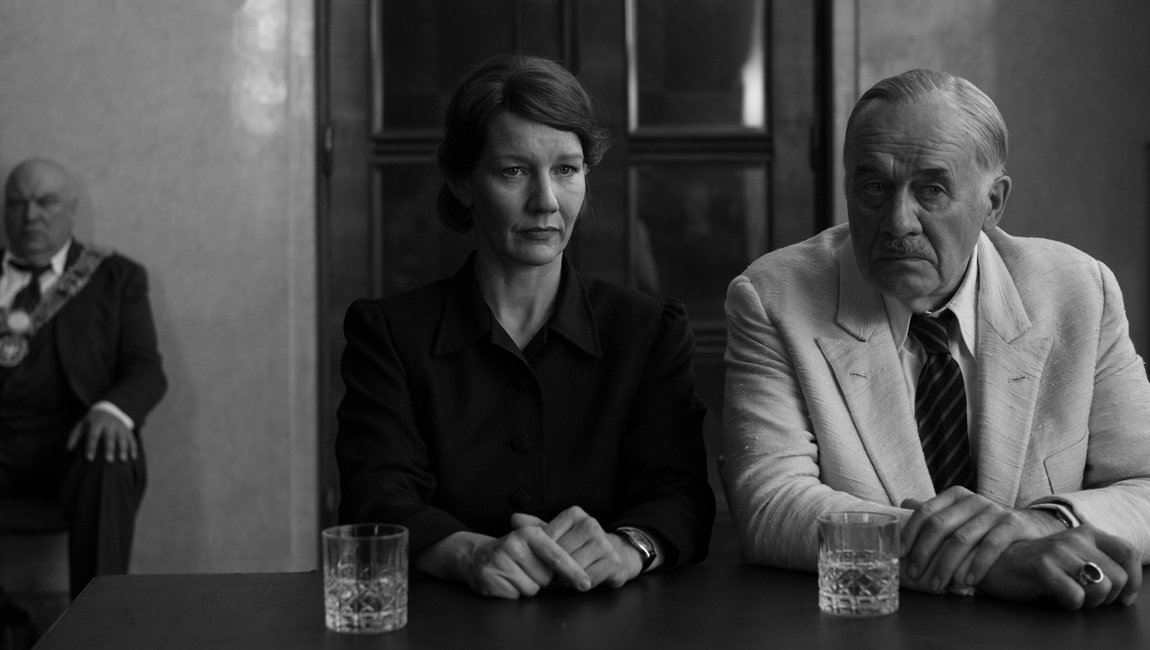
Pawel Pawlikowski, the immaculate king of grim black-and-white Eastern European cinema, has made us wait eight years for a new film. After the exquisite moral excavation of postwar Polish society in Ida and in the now-modern classic Cold War (2018), Fatherland (aka 1949) turns toward the brutal fragmentation of postwar Germany. Yet unlike the mournful romanticism of his earlier work, Pawlikowski adopts an unexpectedly comic tone and narrative compactness, arriving at a moment when his signature reflections feel especially urgent.
At the film’s heart stands the maestro of intellectual prose Thomas Mann (Hanns Zischler), alongside his witty daughter Erika (Sandra Hüller). Together they embark on what gradually resembles a masochistic pilgrimage to their native land. Under the pretext of commemorating the bicentenary of Johann Wolfgang von Goethe, Mann returns to receive an award and in exchange deliver speeches aimed at guiding a fractured nation, intellectually and territorially suspended between “Stalin and Mickey Mouse.” But after all, who else could attempt to articulate what remains of a fatherland burdened with unimaginable guilt if not a Nobel Prize-winning writer invoking Goethe’s faith in art’s ability to transcend politics and restore harmony.
Their first stop is Frankfurt’s Metropol Hotel, where Mann and Erika — the latter functioning equally as assistant and interpreter — are immediately thrust into an international press conference. There, Mann is confronted with questions even his starched white suit cannot shield him from. Having fled Germany in 1933 and spent years in American exile, does he truly grasp the society he now returns to advise? Can exile grant moral authority, or merely distance? And where, ultimately, is home? Mann responds with steely patience, seizing the convenient opportunity to draw self-parallels with Johann Wolfgang von Goethe. The philosopher was born in the West and lived in the East, and much like Mann himself, belonged everywhere and nowhere in between. After all, he would be unlikely to stand before international journalists had he not fled Germany. Once the duo announce their intention to continue the journey into the Soviet-controlled East, the atmosphere shifts into unease. Though this decision would later attach to Mann a reputation as a latent sympathizer with communism, there in Metropol it registers more of an emotional dislocation.
As Mann and Erika drift through a lavish reception, they encounter (former) Nazis now washing away shame with champagne, or simply displaying none at all, like the descendants of Richard Wagner attempting to persuade Mann toward a cultural rehabilitation of the Third Reich’s composer. Pawlikowski stages these awkward encounters with a semi-phantasmagoric absurdity through which the film reveals its most biting register. It is hilarious, were it not so apocalyptically unsettling. When Erika — mentally fractured by a familial tragedy — hears drunken soldiers singing Wehrmacht songs, she breaks down, cursing them as Nazis through tears that seem to emerge from somewhere deep within the soul itself, with such instinctive anguish that one almost feels compelled to join her outrage. Crossing into East Germany roughly halfway through the film, the protagonists encounter a different kind of existential depletion. The people appear poorer, perhaps more sincere, yet exhausted by communist ideology, remaining largely indifferent to lofty philosophical discourse. Many would gladly exchange abstract ideals for real coffee instead of chicory.
As a brilliant orator, Mann maintains composure before demanding audiences, even as frustration, self-doubt, and helplessness steadily corrode him from within. Zischler delivers a stunning performance almost entirely through his gaze, radiating an overwhelming mixture of burdensome intellectualism, self-disappointment, and profound anguish for a fatherland that seems to be no longer a fatherland for him at all. Hüller, meanwhile, continues the beautiful monochrome European period-film era following her Berlinale-winning turn in Rose, yet here revealing a deeper sentimental register of her vast acting spectrum. Together, they create a bittersweet father-daughter dynamic balancing familial tension and emotional dependency while allowing each other the room for independent evolution.
Pawlikowski’s film feels as thoroughly steeped in Goethean rigidity and philosophical complexity as it is relentless in ridiculing the German temperament itself. Co-written with Henk Handloegten, the astute and eloquent script reaches an intellectual congeniality worthy of Mann while maintaining remarkable agility in navigating historical self-reference. What emerges from this is a nauseating familiarity with the deadlocked debates circulating today: how to separate a perpetrator’s immense cultural legacy from bloodshed, whether art and culture can ever truly be detached from politics, or whether the reappropriation of vague philosophical frameworks under the banner of national identity offers a reliable solution.
At only 82 minutes, Fatherland finds its greatest strength in laconism, allowing the film’s hints, parallels, and historical echoes to reverberate without overstatement. Though chamber-like and formally smaller than his previous features, it somehow feels vastly larger in thematic scope — a tale as old as Europe itself, warning once again against the egoistic temptation to remain apolitical during overtly political times. Part of the film’s metatextual weight stems from the work of the director’s longtime collaborator Łukasz Żal. His cinematography evokes the psychotic symmetry and ambient dread of The Zone of Interest while remaining faithful to the stark visual austerity characteristic of Pawlikowski’s cinema. In the way their close-ups of singing faces overcome by existential dread often communicate more than spoken lines, the luminous black-and-white image further enriches the symbolic architecture of the auteur’s filmography, extending the vision of a bipolar world increasingly consumed by darkness itself. Among the many reasons to anticipate Fatherland stands its finale. Pawlikowski reconnects with his Polish cinematic lineage and the legacy of pain that shaped it, punctuating his film with an invocation of Andrzej Wajda, whose cinema sought channels through which fractured postwar souls might still cry out. Perhaps the ugly cry in an ugly church is all that remains — and it is already something.
Comments are closed.