
A Date With Shirley
Back in the ’90s, Ken Jacobs came to the San Francisco Bay Area for a week of programs and seminars. When attending one of the screenings at the Pacific Film Archive, I was accompanied by a Berkeley professor who was curious about Jacobs. It was a program that focused on Jacobs’ work with early cinema, which included a Magic Lantern performance and two of his better-known films from the decade, The Georgetown Loop and Disorient Express. While discussing the program afterward, the professor expressed a general lack of enthusiasm for what Jacobs was doing. They referred to his practice as “pre-theoretical,” meaning that as an artist he seemed more interested in exploring various effects than telling the audience what they meant.
This comment has stuck with me over the years because in some sense it was correct, only not in the way it was intended. One of the other works Jacobs presented during that residency was his Nervous System performance Ontic Antics Starring Laurel and Hardy, and in some respects that title perfectly explicates Jacobs’ art and philosophy. His is an ontic cinema, “pre-theoretical” only in the sense that phenomenology insists on a moment of pause, where we attempt to discern and experience what is actually there in our perception, before situating it into our prefab conceptual categories. It is an art about breaking down our perceptual habits with respect to cinema and the world itself. What are we looking at?
The other part of that title, antics, is what really gives the game away. Having our perceptions toyed with is fun. When you think you know what something is, and upon further inspection it is something else, there are two basic responses. The fascist gets pissed off, since for the fascist, the world is there to serve a function and to confirm prejudices, not to surprise. By contrast, the free mind responds to surprises with wonder and, quite often, laughter. Being surprised entails discovery, and for the unafraid, learning is pleasurable. It means we are not yet finished with the world, and vice versa, that an eternity of ambiguities lays before us.
Ken Jacobs died on October 5 of last year. He was predeceased by his beloved wife and creative partner Flo, who passed in June. There is no question that Jacobs was the maker of several canonical works of the American avant-garde. These include his early collaborations with Jack Smith, Little Stabs at Happiness (1960) and Blonde Cobra (1963); his feature-length deconstruction of a Billy Bitzer one-reeler, Tom, Tom the Piper’s Son (1969); his massive, years-in-the-making attack on American conformism, Star Spangled to Death (2004); and various later works that employed variations of his Nervous System and Eternalism processes, whereby the oscillation between two stereoscopic views, when combined with color manipulation and intra-frame editing, reconfigured the projected image into swirling, vibrating 3D illusion.
This exploration of the conditions under which the human eye would attribute three-dimensionality to a projected image was the project that Jacobs pursued for the final 35 years of his life and career. He never stopped experimenting or trying to apply new technologies to this fundamental goal. Jacobs’ final sets of Eternalisms were adaptations of .gif files, because where most people saw an easy way to excerpt popular films or circulate memes, Jacobs found a tool for turning the forms and spaces of urban life into rectangles of pulsating light, their throbbing energy pitched to the pace of Jacobs’ beloved New York City.
Jacobs was interested in pushing his medium to new limits, but not for the sake of high-modernist purity. His work remained curious and unsure, defiantly “pre-theoretical.” That’s not to say Jacobs was shy about his social and political views, or that he refrained from expressing them in his work. Sometimes his films were anguished affairs, like his 2007 diptych Capitalism: Slavery and Capitalism: Child Labor, or his 2002 threnody on 9/11, Circling Zero, Part One – We See Absence. But even at their most serious and when delving into the various tragedies of modern life, Jacobs’ films never lost sight of the need to surprise both himself and his viewers with the raw datum of vision. His work was about dismantling the categories of understanding that had led to these disasters in the first place, studying the evidence and attempting to renew our relationship to our shared world. After all, theories must follow the facts, and Jacobs never once took the facts of our seeing for granted. Surprise, astonishment, curiosity — these have always been the enemies of power and oppression. Jacobs’ cinema may not have been a machine for killing fascists, but it was absolutely guaranteed to stun the fuckers.
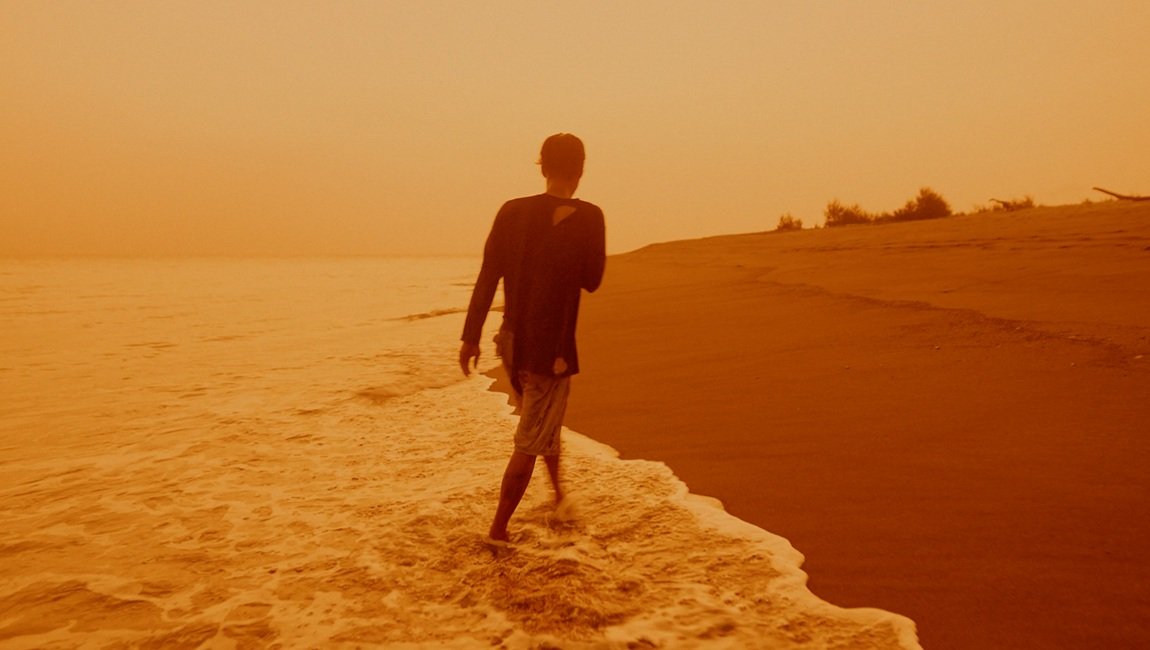
All of which brings us to A Date with Shirley. Shot in 2025 and completed earlier this year, this is Jacobs’ final medium-length project. Over the course of its 48 minutes, Shirley unfolds in something close to real time, which in itself reflects a significant shift in Jacobs’ usual working methods. Most of his films seem to compress or protract time, on the assumption that ordinary temporality rhymes a bit too closely with our habitual ways of navigating everyday life. In A Date with Shirley, Jacobs has paid a visit to his haircutter in Chinatown. (Her telephone number is featured in the opening credits, so in a strange way this could be Jacobs’ first ever filmed commercial, his wry riposte to Peter Kubelka’s Schwechater.) Over the course of the film, Shirley gives Jacobs a haircut, and shampoo, and a blow-dry. At the end, his children, Azazel and Nisi, help him up and walk him outside. The end.
There are certain things that we recognize as viewers, quite apart from Shirley’s formal strategies. Jacobs is an elderly man, quiet and only tentatively mobile. We are witnessing a moment of familial elder care, a man being cared for by his two adult children, not long after the death of their mother and not very long before the man’s own death. There is a tenderness in this scene that anyone can recognize, and it is something most of us have experienced or will, eventually. The salon is a small urban space, bustling with activity, but our focus remains on Jacobs as Shirley plies her trade. As has always been the case for Jacobs, this is a socialist film about the value and dignity of human beings and their labor. But it is also about an ethic of care. An older woman gently grooms an elderly man, helping him maintain his aging body.
A Date with Shirley is also unusual in that, unlike most Jacobs films, it is a three-camera affair and features conventional “coverage.” Jacobs holds a camera in his hands, pointing from the chair into his reflection in the mirror. On the side of the shop, Nisi films her father in profile. And in the far corner, Azazel holds his camera aloft for high angles. The placement of mirrors in the shop redoubles these camera positions, so Jacobs is at the center of a network of interconnected viewpoints. Also, all three camera operators judiciously avoid capturing Shirley’s face until the end, when she agrees somewhat reluctantly to let Ken shoot her straight on.
Upon this familial home-movie canvas, Jacobs engages in his usual forms of play, and a couple of new ones. The image frequently freezes to allow the color-negative flicker and stereoscopic pulse of the Eternalism 3D mode. Some of these moments feature Jacobs prominently as a subject of self-portraiture, while others emphasize details within the shop or the arrangement of bodies positioned around Jacobs in the barber’s chair. These electrified freeze-frames allow us to notice the crowded shop in all its details, replete with bottles and tools, plants and chairs and cluttered shelves. This film also helps one realize Jacobs’ relationship to Ozu, how close formal attention to ordinary spaces can focus the viewer’s attention, renewing those forms perceptually like a Cézanne still life.
But there is something here that hasn’t been seen in Jacobs’ previous films. In his Eternalisms, Jacobs has often magnified certain parts of the frame, or used digital tools to crop or remove portions of the image in order to isolate others. But in A Date with Shirley, Jacobs uses something like the new “stickers” tech from our phones, wherein the camera reads the image as a set of bounded, recognizable objects and then lifts them out of the larger visual field. In various moments, Jacobs’ own image, that of his children, or just isolated pockets of space, become floating forms in a black field. Just as Jacobs détourned the standard use of .gif files, here he applies the visual gimmicks of Big Tech for completely different ends. What is designed to merely categorize and excerpt the image — “this is a thing, and now you can have it anywhere you want it” — becomes an iris, a close-up, a cameo, a way to instigate active part/whole relationships.
Over the years, when writing about Ken Jacobs’ work, I have sometimes compared him to Jean-Luc Godard. Although their projects were very different, both men shared a devotion to unpacking the image, manipulating it, politicizing perception at a fundamental level. In addition to this, both men shared a sense that each individual work, while having its own integrity, is also an entry from a much larger audiovisual encyclopedia — an excerpt from their entire corpus, yes, but also from the cinema as a whole. So as I watched A Date with Shirley, I thought about Godard’s final film, Scenarios.
That film ends with a shot of a tired, half-dressed Godard sitting on a bed, announcing, “I’m ready.” Godard knew full well that this was the last image he would produce, and the final words he would speak on film. Jacobs, though, was in no way making a “last film.” Clearly fatigued and increasingly frail, Jacobs’ body of work concludes with a very different image. He is not isolated like Godard, but instead surrounded and supported by loved ones. Azazel asks his father if he wants him to go bring the car around so they can head home. But Ken says no, he is not ready to end their outing yet and tells Azazel and Nisi that he’d like to go down the street to a bakery. The film ends suddenly, in mid-gesture, implying that it could have continued onto the next location, the next small but vibrant experience. With this abrupt non-conclusion, Jacobs suggests that the film never really ends. Rather than completion, he chose eternity. — MICHAEL SICINSKI

Tropical Park
Hansel Porras Garcia’s sophomore feature Tropical Park accomplishes a remarkable feat in cinema. In any other film, the depiction of a fraught encounter between a long-estranged brother and sister would be, based on their characters’ backstories and experiences, the stuff of exquisite melodrama. Full of love, tragedy, missed opportunities, unfortunate mistakes, and serendipitous reversals, the lives of Frank, a conservative integrated Cuban immigrant (a large Trump flag festoons his front yard), and Franny, a trans woman and an immigrant as of one month ago, are instead conveyed in the most humble of forms.
Garcia conceived of the film without a traditional script. Instead, working with actors Ariel Texido and Lola Bosch, Frank and Franny respectively, they improvised the entire film based on a dozen-page treatment. Further still, the film is done in just one take, the camera fixed to the back seat of the disused car Franny has just inherited from her dead father, and with which Frank is taking her to her first driving lesson at the titular Tropical Park in the suburbs of Miami. It’s a formal conceit reminiscent of James Benning and Bette Gordon’s The United States of America (1975) and David Easteal’s The Plains (2022), but even more extreme.
The camera’s immobility is more than just a clever cost-saving technique. Because we rarely see Frank and Franny’s faces in full, the challenge Texido and Bosch face — and conquer — as actors is to convey the range of human emotion through the backs of their heads. The viewer, in this dynamic, is not a fly on the wall, clandestinely observing some secret drama, but a fellow passenger, albeit a passive one. Only the occasional glimmer of their profile or flash of their eyes in a mirror provide a more traditional entry into Frank and Franny’s psyches. Even when, after an argument about the conditions of Franny’s continued stay in Frank and his wife Erika’s home, they leave the confines of the car and face the camera directly, they’re far enough away that the viewer can’t focus on the details of their faces.
Paradoxically, though, Frank and Franny never feel far away, and it’s a testament to the supremely natural performances by Texido and Bosch that the collapse of emotional distance between performer and audience mirrors that of their characters. Perhaps a nod to the melodramatic elements of the characters’ backstories, Franny asks Frank to let her boyfriend — in Mexico, awaiting his chance to cross the border — stay with them, at almost the same time that Frank lets Franny know her time in his house is coming to an end. The expected bouts of anger and lashing accusations unfold in waves. Frank is at once cold and pragmatic, Franny justifiably upset and a little bratty. Over a 40-minute stretch while the car is at a standstill in the parking lot, we feel their pain double over each other’s.
Garcia’s political commentary is sly. While Frank’s conservatism and Franny’s trans identity are mentioned explicitly, they’re never the textual material of their conflicts. Instead, the film wades into what it means to make calculations around familial allegiance, in Frank’s case weighing a bond of blood that has been neglected against a bond of marriage that saved him. The result is a film without easy — or, really, any — villains, just the complicated, ambivalent foibles of people trying their best under difficult circumstances. — CHRIS CASSINGHAM
Also Playing
The Whole World is a Lie
Charlie Birns, by his own account, set out to direct a documentary that would re-capture his transcendent experience in an acting class taught by self-styled Method guru Tony Greco. His primary filming techniques in this quest were to re-convene the class within a compressed timeline and film it from beginning to end, and to interview an eclectic array of scientific and spiritual experts, counting among them a professor of mathematical cosmology, a Buddhist monk, and a tarot psychic. Birns’ completed project, the meta-cinematic documentary The Whole World Is a Lie, shows with excruciating detail how these techniques — and Birns’ own search for meaning — unraveled completely during the documentary’s chaotic production. The result is both an enthralling depiction of a process that goes completely off-the-rails and an intimate self-reckoning with childhood trauma and existential anxiety.
The brewing conflict behind the scenes of The Whole World Is a Lie is apparent from early phone conversations between Birns and Greco. Greco seems uncertain about Birns bringing cameras into his classroom, and he places an unwieldy condition on his participation: if Birns is to film the class, then he must also participate in the class as an actor. The limits of this approach quickly become clear, as the class is first wary of Birns, then openly hostile toward him.
Greco is portrayed as a domineering character who exercises firm control over his class and inspires devotion from his adult students, some of whom have been taking his class for upwards of 20 years. Birns’ encroachment on Greco’s territory clearly provokes him, and Birns resultantly finds himself the frequent object of Greco’s forceful displays of anger. The students, seeming to pick up on their teacher’s emotional cues, rail against the presence of cameras in the classroom and a perceived lack of directorial clarity from Birns; Greco vigorously joins in this collective tirade, denigrating Birns’ skills as a filmmaker and later subjecting him to humiliating acting exercises and withering, acutely personal feedback. As the soft-spoken Birns struggles to defend himself or to assert power in the room, it quickly becomes apparent that not only will he fail to replicate his supposedly transcendent experience, but that the class’s participation in the project is in jeopardy.
Greco and his students are morbidly fascinating to watch; the manipulative, voluble Greco abuses his unquestioned authority, while his students lash out emotionally with very little prompting. Take, for example, a scene in which Greco specifically requests to have the camera crew film a one-on-one conversation between himself and Birns, only for Greco to spew vitriol at Birns’ working methods and repeatedly demand that he “shut the fuck up.” Or another episode in which a student calmly informs Birns that he wants to “destroy” him for bringing cameras into class. The fundamental irony — remarked upon by members of the production crew, who are depicted as subjects in their own right — is that every person involved has willingly consented to their classwork being filmed and can withdraw their participation at will, yet they take every possible opportunity to ream out Birns on camera for his apparent invasion of privacy.
Interspersed with this slow-motion collapse is Birns’ interviews with experts and mystics, and crucially, with his own parents. These scenes allow the viewer to see Birns outside of the pressure-cooker context of the acting class, and thus to ascertain different facets of his character and the particular nature of the quest he is on. Birns’ father is an especially central character, and while he and Birns have a close relationship at the time of filming, Birns incrementally reveals that his father’s behavior in his childhood was tumultuous, even dangerous. The three strands of the film — the class, the talking-head interviews, and Birns’ conversations with his parents — thread together to reveal the roots of Birns’ relentless search for meaning, and prompt Birns (and thus the viewer) to question whether mediated versions of reality, like acting classes or experimental documentaries, can truly help any one of us to access buried truths about ourselves.
Notably, The Whole World Is a Lie includes a disclaimer that the film is an “edited account in which some events are condensed and re-arranged.” The slipperiness of what is “real” is inherent to Birns’ project, and some sequences see Birns deliberately playing with fiction; for example, he hires actors to re-enact and perform alternate versions of past events from Greco’s acting class. Scenes like this may bring to mind Nathan Fielder’s docu-comedy series The Rehearsal, and Birns’ cinematic techniques and onscreen persona are certainly reminiscent of Fielder’s. Yet whereas The Rehearsal depicts Fielder vainly attempting to create immaculately detailed simulacrums in order to control reality, Birns shows himself attempting to transcend reality and reach a spiritual plane, only to bump up against the artificial constructions that constitute the world as we know it. Whether one can uncover truth from within artifice is a question that cannot be definitively resolved, but in The Whole World is a Lie, Birns succeeds in his formally ingenious and emotionally resonant search for an answer. — ROBERT STINNER
Morte Cucina
There was a time not so very long ago where, hard as it is to believe these days, East Asian cinema was commonplace among the hipper video stores and movie theatres of America. Hong Kong action films, Japanese horror pictures, Korean action and horror movies, and more were the cutting edge among genre film fans, Jet Li and Jackie Chan headlined Hollywood movies, and arthouse audiences thrilled to the colorful spectacles of Zhang Yimou and Chen Kaige, the austere minimalism of Tsai Ming-liang, Hou Hsiao-hsien, and Edward Yang, and the genre experiments of Takashi Miike and Takeshi Kitano. At the heart of that boom was a new flowering of Thai cinema, led in the arthouses by Apichatpiong Weerasethakul, whose 2010 Palme d’Or win marked both the culmination and end of the major distributors interest in East Asian cinema, and in the grindhouses by the elbows and knees of the remarkable Muay Thai star Tony Jaa.
Right alongside them, however, were filmmakers like Wisit Sasanatieng, whose remarkable ode to classic Thai melodrama Tears of the Black Tiger was distributed (and butchered) by Miramax (like most every other East Asian film the Weinsteins got their sleazy paws on), and Pen-Ek Ratanaruang, whose 6ixtynin9 was a stylish exercise for the genre crowd and whose Last Life in the Universe, an off-beat minimalist romance starring Asano Tadanobu as a yakuza-turned-librarian, was one of the very best of the era’s popular arthouse fare. But while Weerasethakul remains a major figure in world cinema, though he’s only directed one feature in the last decade, Sasanatieng and Ratanaruang have seemingly fallen off the radar for all but the most dedicated non-Thai followers of Thai cinema, though they’ve continued to work steadily. Their films show up at a festival here or there, or on a streaming platform among the churning slop, but rarely to the kind of fame and acclaim their earlier films enjoyed. It’s tough to recall anyone talking about a Ratanaruang film in the 15 years since 2011’s lackluster thriller Headshot, but he’s back in 2026 at First Look, with his latest feature Morte Cucina.
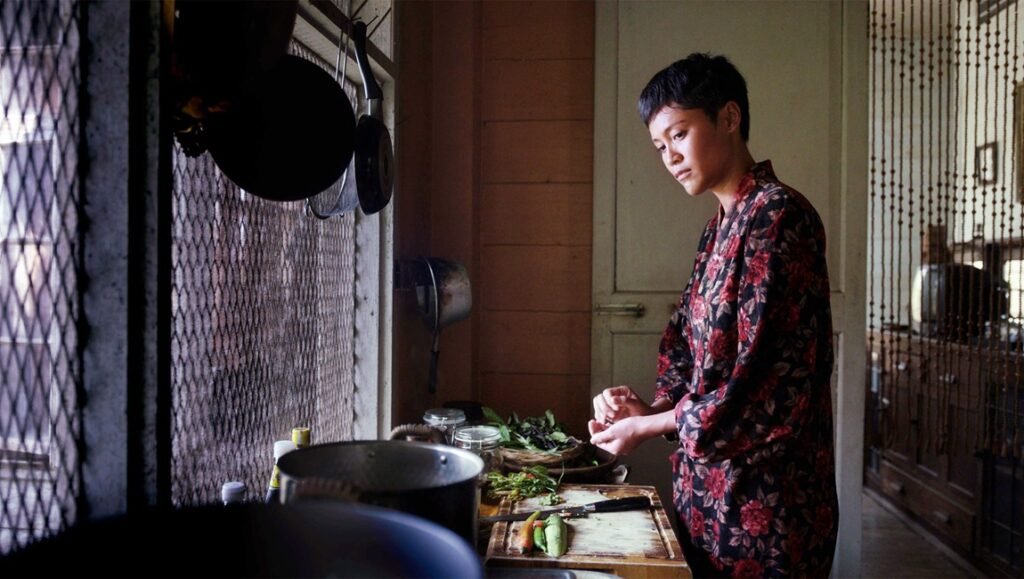
The film is a slow-motion rape-revenge film where a waitress at a nice restaurant (Sao, played by Bella Boonsang) recognizes a customer as the man who assaulted her some years before. Her revenge scheme plays out over several years: she seduces him away from his wife (an annoying dealer hyping the works of a silly artist played in a cameo by Asano), learns to cook, and does so in such a way that he cannot stop eating her food even though it is literally sucking the life out of him. One of his buddies suspects what she’s up to, and any tension in the film, aside from our trying to figure out exactly what she’s doing and how, comes from wondering whether or not he’s going to figure it out and put a stop to it before she gets away with it.
But as is befitting a film more concerned with mystery and allegory than clarity of plot and motivation — there are more scenes of corpse-fucking in Morte Cucina than straight-forward exposition — the atmosphere and mood is sublime. Christopher Doyle, who also shot Last Life in the Universe, serves as cinematographer, and his images of the lush landscapes and dilapidated homes of the Thai countryside are as luscious as his images of Thai cuisine. The early part of the film is confused a bit by a flashback structure that’s reasonably straightforward aside from the fact that the actress playing the young Sao looks nothing like the older version of the character. These scenes are desaturated, and hinge on the character coming from a particularly misogynist Muslim community, which seems a bit prejudicial, if not outright insulting. But the rest of the film is awash in Doyle’s characteristic colors, matched every step of the way by an enveloping soundscape of natural sounds (trees and water and insects) and the sizzles and boils of a first-rate kitchen. But to truly understand the quality of Ratanaruang’s film, all one need do is consider side by side with an American cooking-revenge movie like The Menu, with its thudding literalism and TV aesthetics. It’s depressing to see what we’ve lost in terms of craft and vision when we let Thai cinema disappear from our mainstream screens. — SEAN GILMAN
Humboldt USA
Austrian-born, U.S.-based filmmaker G. Anthony Svatek has an interest in human systems, and how they are put in place to manage forms of chaos that cannot ever be completely controlled. His 2017 film .TV, for example, is about the island nation of Tuvalu, believed by scientists to likely be the first nation destroyed by human-made climate change. As the polar icecaps melt, and the Pacific Ocean continues to rise, Tuvalu is gradually being swallowed. Quite by chance, Tuvalu came to possess one valuable resource that allowed it to garner some income with which to relocate its inhabitants. At the dawn of the World Wide Web, Tuvalu was assigned the Internet country code of .tv, which they were able to sell to advertisers who wanted a catchy domain name. Not even the country’s name, but a mere two letters of it, has proven to be more valuable to the world than Tuvalu itself.
Svatek’s newest documentary essay is considerably more expansive, but the filmmaker has employed his own system for organizing his data into a manageable set. Humboldt USA is in part about the German traveler and ecologist Alexander von Humboldt, whose impact on the mid-18th century was so wide-ranging that he became the namesake for towns, mountains, rivers, and all manner of natural formations. As Svatek tells us in the film’s narration, Humboldt’s importance to intellectual history may have waned, but his name and, by extension, his ideas haunt our world and suggest an alternate path in terms of humanity’s relationship to nature. “Everything is interconnected,” Humboldt professed, but as Svatek notes, Humboldt’s relational thinking quickly gave way to the later theories of Darwin which, much more in line with 19th century attitudes, understood life to be a competition for scarce resources, a battle for survival.
Humboldt USA examines environmentally related activity in three different places — Nevada, Northern California, and Buffalo, New York — that are named after Humboldt. Much in the same vein as James Benning’s Four Corners or Deborah Stratman’s The Illinois Parables, Humboldt USA uses the legal and historical designation of place as a kind of heuristic, affording himself a comparative method that is able to observe relationships that might otherwise go unnoticed. Place names, like borders, are somewhat arbitrary, but not entirely. They represent the traces of history even though, like Humboldt’s own ideas, that history can be forgotten, evolving into its own self-referential signifier. (“This place is Humboldt. It’s just always been that way.”)
What Svatek finds in these three locations differs in the details. In Nevada, we see a team of people from the state wildlife authority releasing bighorn sheep into the Nevada mountains. This was the sheep’s original habitat, but encroachment dwindled their number to virtually nothing. In California, a pair of researchers enter the old growth redwood forests to mount digital cameras that aim to provide a 3D rendering of ecological movement, including animal activity, erosion, lichen growth — things that a human presence would disrupt or that evolve too slowly for the naked eye. Meanwhile in Buffalo, an elderly couple live along the city’s Humboldt Parkway, once a green space but now a four-lane underground highway. They are part of a movement that hopes to force the state of New York to reclaim the highway and reestablish it as green space. But the state has a less ambitious counterproposal, roofing off a large segment of the Parkway for a High Line-inspired urban park.
One clearly sees that these different scenarios have several things in common. In the most basic sense, people are striving to restore parts of the natural environment that have been damaged by human intervention. However, we can see something a bit different on the metanarrative level. In making these plans, many of these activists and environmentalists are subjecting the landscape to different forms of control. For example, the Nevadans who are repopulating the bighorns are dedicated hunters, and the project was mostly paid for by sportsmen who intend to go into the mountains and hunt the same sheep they are depositing there in the first place. Svatek refrains from any commentary, but he lets these folks speak for themselves, and what we witness is a specifically conservative brand of environmentalism. It’s not just good for the sheep; it’s good for the people who want to hunt them. Nature is not its own justification. There must be some human benefit.
In California, the two researchers talk about how their cameras will be able to see the forest from an unbiased, nonhuman perspective. They speak of “seeing like a tree,” or adopting the “point of view of a rock.” But their project will aggregate and analyze all this data using artificial intelligence. The pair are techno-optimists, believing that the less influence human beings have over such a project, the better for the environment. They don’t seem to recognize that they are the ones establishing these parameters and composing the algorithms that will drive their preservation efforts. This is not even to mention the massive ecological toll that AI and data centers cause around the world, depleting water sources and despoiling their immediate environment.
In Buffalo, the activists are a bit more levelheaded, working to mobilize against what they see as a token gesture on the part of the state. As they note, maintaining the Humboldt Parkway but essentially throwing a lid on it will trap and concentrate auto emissions, making a bad situation even worse. Where the Nevada hunters work hand in hand with the state, and the Californians cast their lot with Big Tech, the people of Buffalo rely on old-fashioned grassroots activism. What Svatek indicates through careful juxtaposition and comparison is that, while the actions in Nevada and California will produce change relatively quickly, the folks in Buffalo most likely have a hard road ahead of them. And yet, that dedication is the correct way to meet nature where it is. There are no quick fixes for saving our planet, and perhaps instead of trying to technologize our way out of the crisis, it’s best to work small and plan for a generational timeline. Thinking ecologically entails cultivating an imagination beyond one’s own lifetime, devoting oneself to a future we will most likely never see. — MICHAEL SICINSKI
Also Playing
I Fell in Love With a Z-Grade Director in Brooklyn
“It’s amazing to be able to create something that others don’t understand at all.” So says an elderly woman to the aspiring punk singer-songwriter of Ken’ichi Ugana’s The Gesuidouz, one of the finest films from last year’s Japan Cuts festival. It could just as well be the theme for I Fell in Love with a Z-Grade Director in Brooklyn, one of a remarkable 12 films Ugana has released since 2022. The Gesuidouz is about a punk band making a hit song after weeks of struggle and labor, and, more importantly, the struggle to make another great song after that initial success. I Fell in Love is more conventional in its structure, but no lesser for it. It tells exactly the story its title promises, like all z-grade films must.
Ui Mihara stars as Shina, a young and successful actress in the Japanese pop film industry who has become disillusioned with her work. This is revealed in a remarkable opening sequence where she is being interviewed during a press junket and cannot contain her boredom with and loathing disdain for the empty-headed reporter questioning her, repeatedly looking not at her interrogator, but rather directly into the camera as she delivers hostile and ambivalent answers. Ugana will end the film with another instance of Mihara looking directly at us, but by that time her entire world will have changed.
This happens after she and her boyfriend travel on vacation to New York. They break up on the streets after her incessant complaining, and she loses her phone, her wallet, and her luggage. She ends up in a bar, getting hammered on shots from a sympathetic bartender (she doesn’t speak English, and no one she meets speaks Japanese) and falls in with a crowd of punk filmmakers lead by Jack (Estevan Muñoz), a movie-mad puppy dog about to direct his first feature, but his lead actress drops out the night before shooting starts. One thing leads to another and Mihara is the new leading lady, though none of the crew knows if she has any acting experience.
The rest of I Fell in Love follows the shoot, as Shina — and by extension, the rest of us — is carried away by Jack’s love of film and filmmaking. In turn, the entire crew is blown away by Shina’s acting skill and star power, as she delivers a level of craft and professionalism that far exceeds anything they’re used to seeing. As it must in the movies, work turns into romance between our heroes, but really Ugana’s film is more about discovering the joy in one’s work, and realizing that only at the margins of success, where the work is done not for money or fame or power, can that joy truly be found. I Fell in Love is packed with references to and cameos from the world of no-budget filmmaking, names like Larry Fessenden and Lloyd Kauffman, and the pace and subject matter of Ugana’s career to date seems to be aspiring to their footsteps (the band’s first album in The Gesuidouz was titled Toxic Avengers Infinity War). Muñoz too appears to come from that world, and his earnest performance, like a Fred Armisen character played with a complete lack of irony, reflects the honest enthusiasm and joy of making movies. Mihara’s work is more nuanced, selling both her character’s ennui and her gradual realization of the film’s core principle: Work doesn’t have to be work. It can, if you want, be play as well. — SEAN GILMAN
Little Stabs (Avant-Garde Shorts)
For an artist whose conceptions of cinema constantly evolved with the developing technologies and audiovisual forms, it’s a bit of a shame that Ken Jacobs’ memory is enshrined by his playful, but relatively anodyne time capsule, Little Stabs at Happiness (1963), in a curated series of experimental shorts at the First Look Festival titled “Little Stabs.” Considered an avant-garde landmark at the time, the film is trapped in the specificities of its time, milieu, and the intimate circles of Jacobs’ avant-garde community — one that, in the light of Jacobs’ oeuvre, doesn’t do justice to his radical eclecticism, which relentlessly interrogated the multiplicities immanent to the image while imparting a sense of vibrant urgency and wonder even amidst his incisive polemics. However, to give First Look’s programmers, Genevieve Yue and David Schwartz, their due, the lyrical evocation of the title pays tribute to not just Jacobs, but to all purveyors of an avant-garde, termite cinema, one that expands the possibilities of the medium by nibbling at the boundaries of their subjects. Though many of the selections aren’t entirely successful in this aspect, the best of them reframe their audiovisual materials through their environments and perspectives to peel the layers of polemics, politics, and poetics lurking within.
Alexander Koberidze’s The More I Zoom in on the Image of These Dogs, The Clearer it Becomes That They Are Related to the Stars (2023) is among the more high-profile entries in this cinematic excavation. Filmed in response to Hungarian composer and one of Bela Tarr’s key collaborators, Mihály Vig’s melancholic, slow-tempo piano score undergirded by the subdued, yet eerie movements of a cello at a lower octave, Koberidze slowly zooms toward a low-res photograph of dogs in a balcony. With a title containing both the synopsis and a statement of intent, The More I Zoom in… is a more modest, yet integral entry into Koberidze’s investigations of the poetics of what Hito Steyerl calls “the poor image.” The pixelated imperfections, seen as awkwardly shaped building blocks assembled to form objects when viewed from afar, gradually dissolve into stellar abstractions with each infinitesimal camera movement, but Koberidze connects these pixels to stars not just in the abstract in terms of their shape and glints, but also in the sublime, ending with an upward tilt from a void of darkened pixels in the image to a region of overexposed brightness.
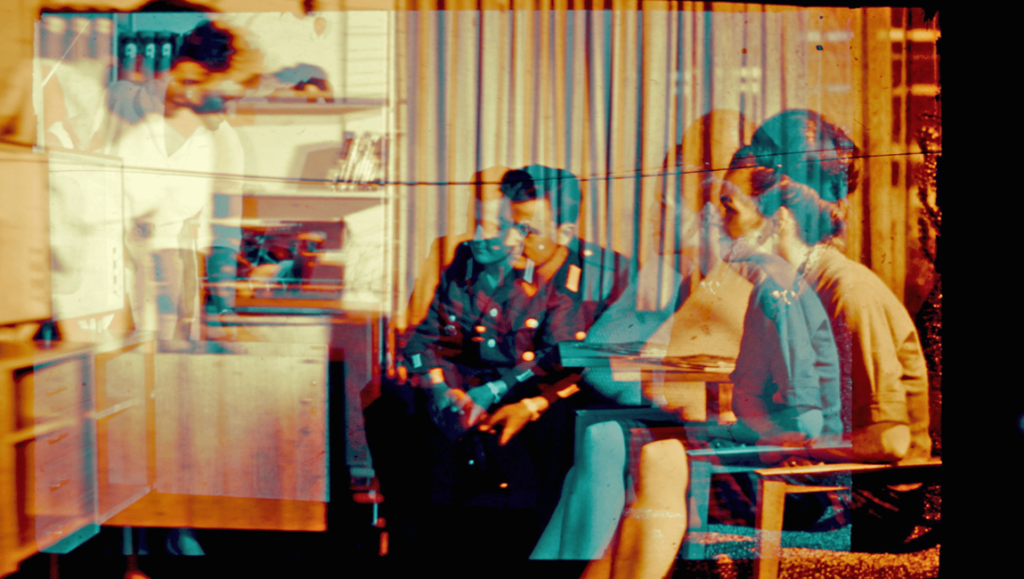
Janie Geiser’s Slideshow (2024) and Peng Zuqiang’s Afternoon Hearsay (2025) also turn their attentions to the materiality of the image, but their focus is geared toward film strips as opposed to Koberidze’s digital image. While the digital container allows Koberidze to leap into the cosmic, the fragility of the film medium and the haziness of their provenance bring the historical into play. Slideshow, another film title which performs the dual role of synopsis and intention, constructs its scenes around found film slides from a Berlin flea market of people unknown to the filmmaker. This unknowability certainly induces a historical vacuum, but it is this very unknowability that stirs Geiser’s imagination, aggressively subjecting the film slides to rapid and slow motions, fragmentations, chemical processes, filters, geometric transformations, and cutting, all to a dense, musique concrete score that combines gentle orchestration with the sounds of sliders, scanners, and projectors modulated to various speeds. The questions of who and what gradually morph into the how, where vacant sites are peopled with creative ideas.
The historical is much more apparent in Peng Zuqiang’s film, which looks at the 8.75 mm film format, one unique to China and for which no camera was made. Afternoon Hearsay therefore foregrounds the film strip itself, reviving a forgotten film format and the scattered histories associated with it. Having no vessel of its own, the 8.75 mm films are printed onto 16 or 35 mm films, and like Slideshow, the images are subjected to filters and patterns of their own. But the complications of projection are directly addressed through juxtaposed footage along with some voiceover narrations surrounding the 8.75 mm and its dissemination. Muddled histories are further muddled through our anachronistic lenses and methods, but, as these two films show, that is no reason to shy away from or dispel the haze.
History, in Basma Al-Sharif’s films, and especially in her homeland of Palestine, aggressively asserts itself, with fascistic narratives and actions increasingly obscuring historical and present injustices. In Old Masters (2025), Al-Sharif thrusts the Palestinian genocide and displacement onto the hallowed halls of art museums, institutions that seemingly offer a blissful retreat from the political. Al-Sharif does a lot more than simply assert that art is political, a point which sadly still needs asserting in public spaces, opening new ways of seeing and engaging with history, art, and politics. Two tracking shots in the museum are superimposed over each other, each following two different people in the museum and their gazes. As their paths gradually diverge, various artworks are displaced from their original settings, expanding the rooms and allowing art reflected through multiple perspectives to converse with each other. She repeats a similar superimposition in an orange orchard in Gaza, with only one person this time instead of two. But between these two scenes, Al-Sharif rewinds the museum-goer’s motions and superimposes it over an overhead shot of Gaza with bombed buildings. The past is dragged into the present tense, both obliquely and directly, where both privileged and bombed spaces reveal methods of engagement that are striking in their similarities and differences.
Jordan Strafer’s Dissonance (2026) opts to wrench the past into the present through an ‘80s style TV show pastiche, where a veteran dressed in military clothes asks his audience to close their eyes. Perhaps Strafer intended his movie to be watched and heard to accentuate the dissonance, but his film is insufferable to the eyes and the ears. (Another film in this program, Lewis Klahr’s Orpheus [2024], also instructs us to close our eyes, as colored lights flicker on our shut eyelids to The Byrds’ “Here Without You.” Orpheus posits a new way of engaging with cinema, while also giving one a better method to get more work done through its instructional intertitle, “Eurydice is depending on you.”) Strafer proves to be an expert at reality TV decoupage, though, with calculated reaction shots of teary audience members and outsized superimpositions of their faces. But with a film that is essentially dimestore Freud brought you by the U.S Army forces, Dissonance offers nothing more than expert reconstructions and psychobabble.
Instead of these smug pastiches, Callum Hill tries to critique the U.S by immersing her film, E Minor (2024), in the conflicting attitudes, ideologies, and contradictions of post-COVID USA, commingling footage shot on film and iPhones with archival footage. She extends her omnivorous approach to the aural as well, like many of the films in this program, overlapping sounds from different sources on the same frame, stopping, replaying, and speeding them up. But despite her relentless activity in the editing room, the images seem strangely anaesthetized, almost as if all these strong ideological passions are meaningless in the face of rampant neoliberalism. For a film that attempts to “journey into the sociocultural unconscious of western identity” (from the film description), the dominant feeling is that of enervation.
Among others, our time is characterized by both a heightened acceleration of climate change and a heightened awareness of our influence on the climate. Artists have always homed in on the tensions — productive and destructive — between human and “natural” landscapes, and Kyath Battie’s wonderfully titled Super, Natural (2025) can count itself among the bearers of this tradition. When “pristine” natural environments are being rebranded as retreats for the rich and zones are designated in forests for our consumptive, viewing pleasure, the already porous boundaries between nature and urban spaces are now marked by intrusion and transformation. Battie underscores these intrusions through the blatant artifice of his images, where rocks projected in the foreground are complimented by rear projections of light shows. Crickets chirping provide the background score for light shows in the city, while electronic scores are heard on the islands. This blending isn’t seamless, with Battie accentuating the distinctiveness of each of his elements, rendering all our distinctions as nothing more than our “artificial” constructions. Perhaps the horror of this prompted Marco Godoy to start anew in The System (2014), eliminating sound in the first two scenes by only showing a triangulated light source beaming across the ocean. But resistance and reimagining emerge from the tools we have, so he erects a large speaker on an island, with a voice reading Eduardo Galeno’s The System that asks us to suppress the past and colonize consciousness.
Kate Solar’s (for once I dreamed of you) (2025), where both visual and aural forms are deliberately obscured, isn’t exactly the start of something afresh, but is a film that retreats from our material reality. Scratches are both seen and heard in the narrative, with Solar accentuating the grains in her images. Slow motions enhance the vagueness of forms rather than clarifying them as the narrator and camera appear to roam across a field with water streams. Recalling Godard’s famous capsule on Becker’s Montparnasse 19 (1958), Solar’s film is a beautiful leap into the void, an oneiric construction that flagrantly violates all institutionalized cinematic norms. For a program that wishes to “reconsider our relationship to the images onscreen,” there can be no better end than a film which wishes to do away with the image altogether. — ANAND SUDHA
Comments are closed.