
Two things can be true at once — a simple fact of life many folks still struggle to accept. Even with his reputation perpetually tarnished by sexual abuse allegations, Michael Jackson remains one of the greatest pop musicians of all time. So fittingly, while Antoine Fuqua’s feature film about the rise of the “King of Pop” is as close to generically evil musical biopic trash as you can get, the moments where MJ is at peak performance are still capable of leaving one levitating in their seat. How can you not feel the vibration in the room when The Jacksons are in full force to perform a legendary rendition of “Human Nature” during the farewell show of their 1984 Victory Tour? To hear one of the most emotionally loaded performances of arguably the brightest pop song ever written and recorded — MJ often described it as one of his own favorites — with the actual audio of the concert sourced from the Jackson estate and polished for the film, is a goosebump-inducing gift for any admirer of the pop icon’s oeuvre.
As far as gifts go, only song and dance deliver in Michael, a film that otherwise banks on its audience’s cultural amnesia and eagerness to eat from the trough of slob that is called the musical biopic. Brought to you by Graham King, the man who produced Bohemian Rhapsody (2018), Michael picks up the baton in a relay of artistically questionable, yet commercially viable biographical films that valorize multi-platinum-winning recording artists by cinematically placing them in the pantheon of pop cultural nostalgia currently dominating the entertainment industry. Within the framework of Marvel’s decline as mainstream multiplex behemoth, you could argue pop singers like Freddie Mercury, Elton John, David Bowie, Bruce Springsteen, Bob Dylan, and Michael Jackson are our superheroes now, all of them lionized in frictionless and schematic biopics that have been rendered superfluous by the prophetic satire of Walk Hard: The Dewey Cox Story (2007).
Michael‘s frictionlessness especially sits uneasily, as the film conveniently glosses over the myriad controversies the pop icon was embroiled in for about a quarter century of his life and career. Quite naturally, though, you wouldn’t expect a script greenlit by the Jackson estate to dissect the pedophilic accusations surrounding Mike, but still… what John Logan’s script offers in return is an exploration of MJ’s own childhood demons, with an attempt to squeeze drama out of his conflict-averse relationship to his domineering father Joe (Colman Domingo). Cosplaying as a drill sergeant with a belt always within reach, the factory worker from the steel mill capital of Gary, Indiana, forcefully sculpted his young boys into the Jackson 5. Opening in medias res, behind the scenes of The Jacksons’ final joint performance where MJ announced his permanent departure from the band he fronted alongside his brothers, Michael jumps back to the childhood years that portray its titular star as a highly gifted kid who was quite possibly whooped into a permanent state of boyhood.
What follows is a by-the-numbers, linear trajectory of the Jackson 5’s rise to fame, offset by Michael’s desire to ascend to an even higher level of artistic freedom and stardom in his own right, which required him to finally stand up against his abusive father, who remained The Jacksons’ manager well into their adulthood. This tension serves to illustrate Michael’s social isolation and his resulting attraction to exotic animals and hospitalized children as his only friends. With the luxury of hindsight, the scenes in which a grown-up Michael spends hours at the bedsides of bedridden children are baffling in their (un)intentional effect. Is Michael trying to whitewash MJ’s affection for young boys or is the film very discreetly exploring his awkward obsession with childhood as a way to at least acknowledge the allegations he faced as he aged into later adulthood? It mostly raises the notion that Michael is not a film for people who want to remember, but rather a film for people who prefer to forget the thornier aspects of loving the art of “monstrous” people. You could call it the cinematic equivalent of the “Let People Enjoy Things” meme projected on the big screen.
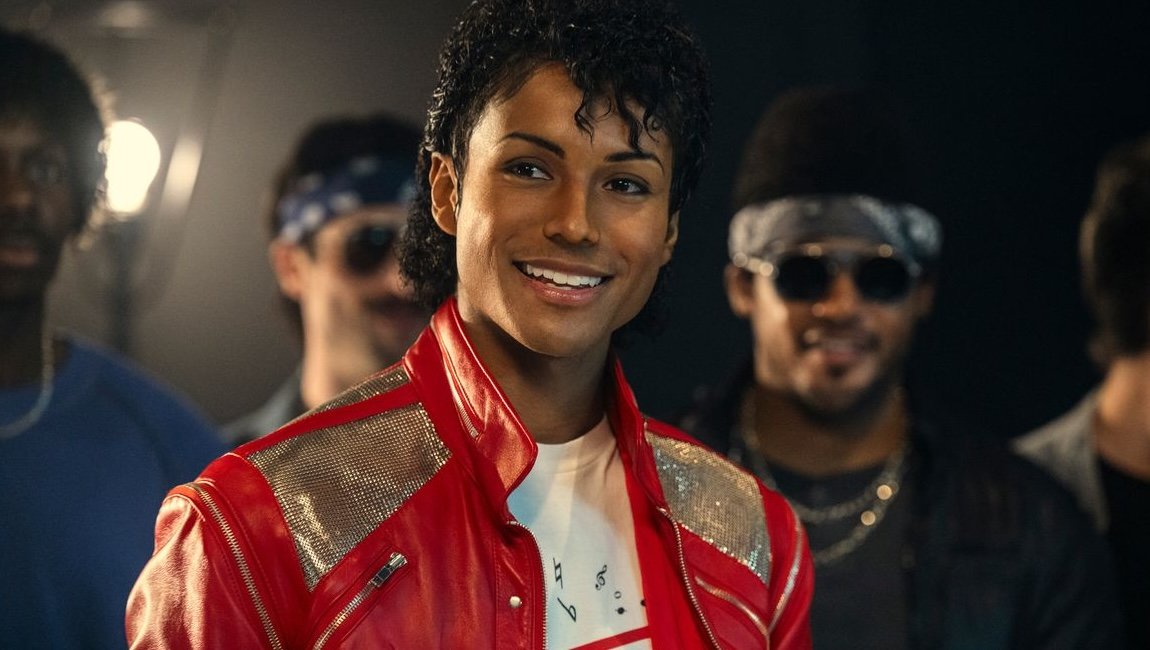
In terms of enjoyment, the film occasionally manages to elevate its formulaic source material when we’re finally back in the era of young adulthood and Jaafar Jackson inhabits Michael Jackson’s skin, taking over the role from the admittedly cute and gifted child actor Juliano Krue Valdi. As Jermaine Jackson’s son — thus MJ’s nephew — there is an initial uncanny quality to the establishing shot of Michael gazing over Hollywood while discussing his first strides into a solo career. However, once Jaafar steps out of that uncanny valley, he proves to be a tremendous actor, delivering a poignant depiction of a sensitive young man who often acts small, but actually dreams big. Perfectly capturing MJ’s demeanor, Jaafar Jackson never overplays MJ’s often parodied mannerisms, instead embodying how the musician had a unique gift to fill every pocket of his songs with highly pleasing rhythmic ad-libs and melodic touches that buried personal flourishes deeply into his pristinely engineered music.
If we judge Michael on its own intentions and leave all controversies aside, here the film sadly also falters, as the biopic never satisfyingly explores how this timid man managed to make pop music with such gusto and grit. How did a boyish Michael Jackson even manage to put so much sex and shades of violence in his countless bangers? A cringe-inducing scene sees MJ gazing at a TV screen witnessing the erupting gang violence of Los Angeles in the early ’80s, prompting him to employ feuding street soldiers of the Crips and Bloods in his music video for “Beat It.” At the helm of Training Day (2001), Brooklyn’s Finest (2009), and the Denzel Washington action vehicles of The Equalizer series, director Antoine Fuqua seems sensitive to fraught race relations in America. Regrettably, his attempts to instill that sense of political consciousness here feel undercooked to the point that the effort serves as yet another example of how Michael lacks the willpower to actually evoke the artistic genius that sat within MJ well into the latest stages of his career.
Compared to the stylistic abomination that is Bohemian Rhapsody, Fuqua fortunately is smart enough to let his actors do the heavy lifting. A telling scene shows MJ on the set of the John Landis-directed music video for “Thriller,” in which the singer interrupts a take, demanding the choreography to be captured in a wider shot that also includes the footwork of the dancers, a lesson MJ learned from countless childhood rewatches of Charlie Chaplin classics and Singin’ in the Rain. Fuqua emulates that strategy with decent coverage of mostly wide shots and medium close-ups, resulting in a much smoother visual language allowing you to simply gaze at the spectacular bodily movements of MJ.
Inevitably, all the contrived drama between MJ and Joe runs out of gas, allowing Michael to simply abandon the notion that it’s even a narrative film to begin with. Rumors of behind-the-scenes conflicts, rewrites, and reshoots are highly discernible in the structure of the film, which in its final act segues into extended musical performances that override any dramatic arc and merely play out as pleasant simulacra of Michael Jackson concerts. The greatest irony emerges here: these are the most enjoyable scenes of the film, while also the most pointless, as the incredible behind-the-scenes concert film This Is It (2009) still exists as a fascinating and underappreciated study of the icon at arguably his very best, made just before his eventual passing.
The shorthand way Michael wraps up all of its inherent dramatic and ethical dilemmas comes at the very end, with titles just before the closing credits declaring: “The Story Continues…” This load-bearing floating signifier simultaneously means everything and nothing at all. Because what will continue exactly? Is this the announcement of the Michael Jackson cinematic universe? A hint at Jackson’s tarnished reputation to come? Or simply an acknowledgement that Michael’s faux-narrative was only a cynical pretext for people to abandon any sense of guilt and fork over their money to enjoy the music of their beloved pop icon on the big screen without any notion of MJ’s wrongdoings? Let’s just say it’s the human nature of present-day Hollywood to go for the easy way out, which explains why they can proudly deliver an inherently broken film about one of the most contested and celebrated public figures to have ever graced the stage.
DIRECTOR: Antoine Fuqua; CAST: Jafaar Jackson; DISTRIBUTOR: Lionsgate; IN THEATERS: April 24; RUNTIME: 2 hr. 7 min.
Comments are closed.