
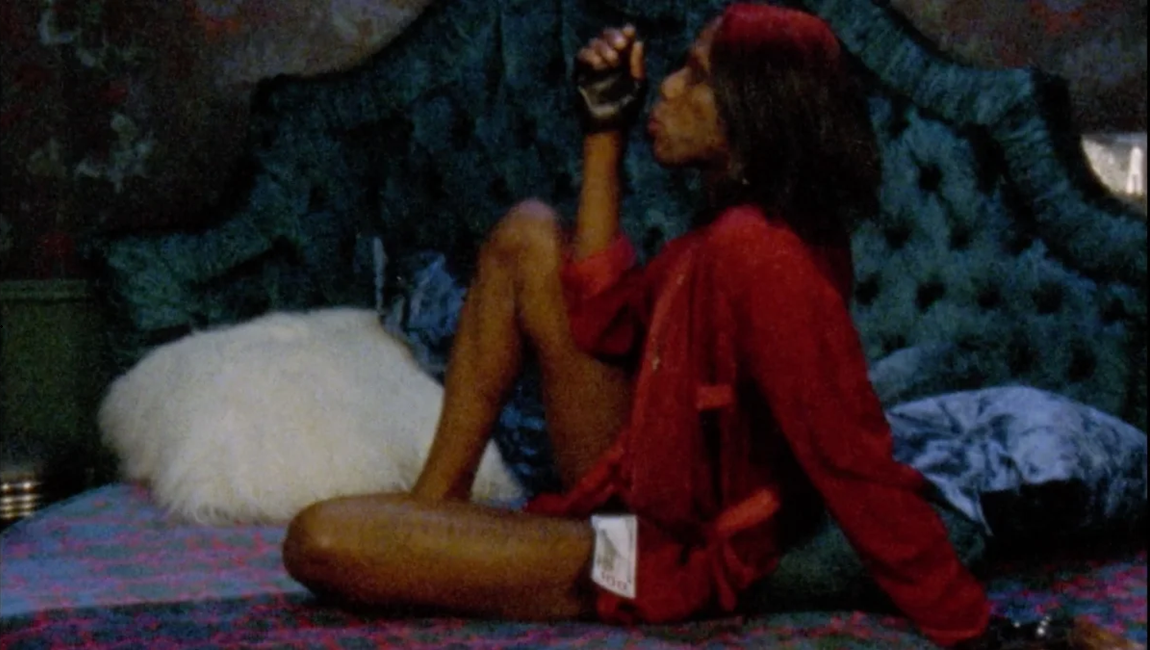
It’s perhaps too easy to dismiss a film as heavily aestheticized and intentionally non-narrative as Jonathan Rosado’s Matador Bolero for prioritizing style over substance. The filmmaker could, very justifiably, make a case against this complaint, arguing that style is his film’s substance. Its lo-fi, grunge aesthetics — Rosado shot the film, like his previous two feature films, with Super 8 cameras — combine with The Suede Hello’s synth-heavy electronic score to create an eclectically paranoid atmosphere, overwhelmed by the specter of (gendered) violence. Narrative haziness — call it surrealism, if you want to be more charitable — further knocks against the notion of clarity; timely signifiers like organized sex-cults, seemingly straight out of Alejandro Jodorowsky’s The Holy Mountain (1973), violently clash against timeless signifiers like crystal balls doubling as dictatorial supercomputers, to plunge us into the film’s darkly uncertain world in which violence (especially, against women) perpetuates itself as violently in the future as it did in the past.
But unlike, say, David Lynch, who uses narrative fragmentation (borderline incomprehensibility, too, in a film like Inland Empire) and operatic formal flourishes to substitute narrative cohesion for potent emotionality, Rosado does next to nothing to substitute for the deadening incoherence of Matador Bolero. The film has a generic, Zodiac-like narrative on paper — a high-profile murder of an actress at a New York nightclub, called The Matador, becomes the locus of attraction for three very different people: a detective (Kansas Bowling), a news reporter (Jack Irv), and, as per the film’s official plot description, “an elusive being living outside the realms of time and space” (the screen debut of queer musician, Yves Tumor). But, for reasons never made clear to us, it’s overcomplicated by another futurist plot element: all these characters seem to be under the influence of a new-age cult governed by a superintelligent computer, named Bolero. Rosado disregards cohesive movement between these disparate strands — the (intentionally?) horrendously dramatized generic bits with the detective and the reporter (replete with poor sound mixing that barely makes their audio comprehensible) clumsily interrupt the otherwise stream-of-consciousness music video-like bits with the cult and Tumor’s “entity,” entirely dominated by the Suede Hello’s hypnotic music. And this is before we even break into segments featuring abstract animation that could be a dying person’s point of view, or the cult’s programmatic visions, or, really, whatever else you want it to be. Rosado’s intent here, it seems, is to capture what one of the unseen characters says they consider “not a good memory: [something] that comes in as a flood, [something they] try to push away but somehow it remains dead center.”
But there is no emotional, let alone narrative, “center” in Rosado’s film. Its flashy — and, at times, admittedly accomplished — style taunts us to come running toward it like a broken and battered bull is forced to do toward a flamboyant Matador. But why should we take the bait when, just looking from afar, we see nothing but an orgy of style that can’t even communicate its ideas of gendered violence convincingly? If anything, Matador Bolero’s ill-disciplined approach to storytelling (and form) indulges as much in perpetrating misogyny by making the women in its film little more than cattle; their bodies are bruised and battered for the sake of showmanship here, and nothing else.
DIRECTOR: Jonathan Rosado; CAST: Yves Tumor, Kansas Bowling, Jack Irv; DISTRIBUTOR: Lucky American Films; IN THEATERS: May 22; RUNTIME: 1 hr. 37 min.
Comments are closed.