
It’s a fair response for one to give less importance to mainstream directors when they downplay their themes or politics in interviews, for if the stark responses by Hollywood directors in America and France are anything to go by (Ford is a notorious example), production economics and the political atmospheres of places might prompt a cautionary approach — not to mention that a film or any other artwork can always be more than the intentions of its creator. But with Imtiaz Ali, one begins to think that his insistence on the “apoliticality” of his films and the universality of emotions, in the sense that he follows the desires of his characters, is an earnest statement of intent, one that is almost perfectly realized in his films. His latest, Main Vaapas Aunga (translated as “I Will Return”), is a patchwork of clichéd universalisms, beginning with a shallow-focus medium shot of a patriarch (Naseeruddin Shah) quivering in his chair as he switches on the TV. Of course, the channels he surfs are related to the loves of his youth, be it directly in the form of a cricket match, or indirectly in the form of a Bollywood love song or images of lives lost and properties destroyed by an earthquake in Myanmar, followed by his mutterings on the tragedy of the homes lost by the living. He then changes the channel to see the alarming pollution levels in Delhi, only to switch it off in frustration. That these two tragic incidents in two disparate locations and cultures, tethered only by the callousness of human violence and the undue burdens it imposes on the living, triggers the patriarch’s dementia and reinvigorates his determination to exorcise past demons wrought by a cruel separation — or even partition, if you will — is a key indicator of Ali’s dramaturgy and framework of universal humanism, one which espouses that humans are bound by shared feelings of displacement, home, and loss despite the differences in societal norms and cultures. While all this sounds very liberal and noble, does universality automatically imply the smothering of specificity?
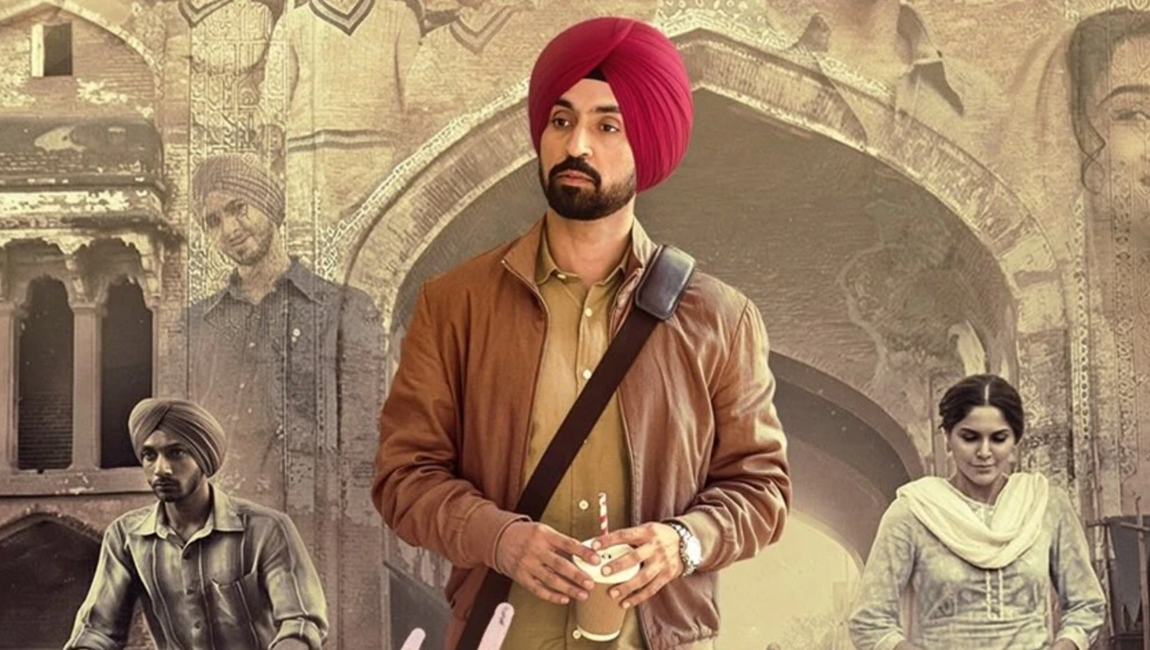
Regardless of the earnest, but rather pat, simplicity of the beginning, Main Vaapas Aunga does hint at some interesting ideas buoyed by Ali’s ambition. A common narrative strategy across different Indian films from the north and south is to weave a love story into fraught political backdrops, mapping the anguished passion of lovers onto the instability of their surrounding environment. Ali is no different in this regard, but he attempts to complicate it by fracturing the past through the patriarch’s demented mind, almost becoming a metaphor for the haziness of history itself. The love story is between a Sikh, Keenu (the old man, played by Vedang Raina in his youth), and a Muslim, Afsana (Sharvari), in Pakistani Punjab, just before the partition. To grossly oversimplify, the partition involved the careless division of India and Pakistan by both colonial and communal forces that led to the displacement and massacres of multiple communities. Keenu’s family members are unaware of his life pre-partition, and this aspect is particularly intriguing for Nirvair (Diljit Dosanjh), Keenu’s grandson, whose non-committal flightiness is in stark contrast to his grandfather’s obstinacy. Ali sets up this intergenerational conflict/connection in order to piece together details from the jumbled ramblings of the demented old man, where a lost love, the Partition, cricket, and fantastical stories involving Martians compete for his attention. His family might have inherited his trauma, but they are adrift in a sea of shape-shifting signifiers of events which they have heard in snatches of conversations, but remain ultimately vague. History is riddled with cracks, frustrations, and inconsistencies, and as interpreters of an unlived past which undoubtedly has influenced their actions and sociopolitical situations, Keenu’s family attempts to inhabit these cracks to understand him and themselves better, while also hoping to get some closure.
Ali’s narrative ambitions are also reflected in his audiovisual choices, employing a clear schema that signals his ambition through the extensive use of cross-cutting, (largely) shallow-focus compositions in the past, showy soft-focus superimpositions of the past and present through Keenu’s lens, and manipulations of color within the same frame, intermingling the personal with the political. However, like many filmmakers of his stripe, Ali confuses ambition for depth, where the mere mention of lofty themes constitutes sufficient exploration. Main Vaapas Aunga is a clean film made from a very messy (and horrifying) history, where Ali’s attempts to scramble timelines and tones are met with all-encompassing psychological explanations for Keenu’s actions. Whatever productive tensions Ali developed through the dialogue between grandfather and grandson are immediately dispelled through scenes that provide the entire context for Keenu’s incoherence. Nirvair (and Ali) ties his lack of purpose to the lack of closure in Keenu’s life, and as he engages more with him, he slowly begins to recognize his traits and tendencies, making efforts to correct them and, predictably, becoming better at whatever he does. His part-time stand-up comedy becomes a success, mainly because he researched a bit on partition after listening to Keenu’s past, allowing Ali to introduce yet another truism on art developing from personal incidents, though the insipid stand-up bit involved consists of nothing more than throwaway lines picked up from a basic Google search. Nirvair merely becomes a conduit for Ali’s malformed ideas on art, politics, and history, allowing him to insert “current” topics like exploitation and stubble burning of crops in India while giving us a superficial history lesson along with it.
If one were to be more charitable, it could be argued that Main Vaapas Aunga tries to be an era-defining romance, a heartbreaking fable on the trauma wrought by partition, and an exploration of how we relate to history and how it influences us — but the film ends up being inadequate on all three counts. To his credit, Ali does attempt to blend these conflicting tonalities, as evinced in a love song that alternates between Keenu’s past and present, while also interspersing it with archival footage of political speeches and riots. But all these feel like half-hearted stabs, for Ali subordinates all his specificities — character, community, history, and politics — to an overreaching narrative arc on the universality of displacement. One detail which this writer dwelled less on in this article is Keenu’s community. The partition is often framed as an internecine conflict between two key players: the Hindus and Muslims. Main Vaapas Aunga purports to remind us of another community, the Sikhs, whose losses are often forgotten, only to then consider their lifestyle as an incidental detail. Even A.R. Rahman’s rather acclaimed music doesn’t let their traditions linger, abruptly switching to jazz or blues midway through the song. Through archival footage and newsreel filtering of his “fictional footage” of Keenu fleeing from his homeland, Ali continues a similar approach from his previous Amar Singh Chamkila (2024), where the archival footage merely imparts historical validity that elides over all communitarian specificities. The Sikhs are among the humans affected, and this is a result of human violence. Throwaway lines on the British are given, but if the final credits scene is anything to go by — Ali’s and Rahman’s music video pitch to Universal Music Group — displacements across the world, including the Palestinian genocide and the refugee crises, are wrought by human violence, while the people are rehabilitated to society through human compassion. While it would be wrong to argue that these events aren’t indeed connected and that collective empathy is necessary, such a video is merely a signpost for progressivism, and a rather empty one at that, with the music, in particular, disregarding the cultural traditions of the ones displaced in its awkward incorporation of gospel and Arabic choruses willy-nilly. These broad-strokes appeals to universalism don’t just lead to facile thinking, but they also weaken the very thing which Ali considers the most important in his “apolitical approach” — the emotions and desires of his characters.
DIRECTOR: Imtiaz Ali; CAST: Naseeruddin Shah, Vedang Raina, Sharvari, Diljit Dosanjh, Anjana Sukhani; DISTRIBUTOR: Netflix; STREAMING: August 7; RUNTIME: 2 hr. 47 min.
Comments are closed.