
For the past decade or so, Nathan Fielder and Lance Oppenheim have been dancing on either edge of the same cultural black hole. In 2018, Fielder officially wrapped Nathan for You, a 4-season Comedy Central show that pierced a needle through pie-eyed business scams and the retrograde egomania of reality TV. Oppenheim was busy filming Some Kind of Heaven, a lens into the snow-globe psychedelia of an otherwise forgotten Floridian retirement community. A new vanguard was under construction for the North American documentary: a deadpan interventionist at one post, a cutthroat traditionalist at the other.
That same year, Theranos founder Elizabeth Holmes was drifting into Fielder and Oppenheim’s orbit. Holmes’ 2018 fraud indictment was one of the most highly publicized incidents of Trump’s first term. After a trial that would extend through 2022, Holmes was sentenced to over 11 years in prison and $450 million in restitution to investors; perhaps even more catastrophically, the ordeal also wrested Holmes’ control of her meticulously manicured public image. So why, then, would she turn to the creator of Dumb Starbucks to document her final days as a free woman?
“Radical transparency,” answers Billy Evans, Holmes’ partner and the father of her two children. Evans and Holmes invited Fielder and Oppenheim into their rented Del Mar beach house as they count the days until Holmes’ sentence. The resulting, three-hour documentary, You Can See Everything, is perhaps the greatest and most titanically thorny deconstruction of image and identity of the century.
It seems that Holmes knows what she’s getting into. “We wanted to tell a more human story,” she tells Fielder, who’s also a bit perplexed at his presence in her home. She’s abandoned the searing red lipstick and Jobsian uniform of her rise and fall in favor of earthy sweaters and a sea-salt frizz; her house is a curated litter of children’s toys and consumer tech. On the surface, it’s a baldly doctored picture of reinvention, but Holmes has only doubled down on her innocence — and with enough conviction to knock Fielder on his back foot. Fielder’s reputation is one of a splinter in constant search of a paw, but he wavers in the face of Holmes’ board-friendly blue eyes. “You’re being real right now?” he asks. “I’m always being real,” she answers without a blink. Her charm is as off-kilter as it is abundant; somehow, comedy’s most notorious manipulator begins to coil around her finger.
Meanwhile, Evans flitters through the house like a media manager, twitching with enough relentless agita to step from You Can See Everything’s margins to the center stage. The hotel heir met Holmes shortly after Theranos’ collapse; as they raise their two children, they’re also working on their next venture, trading calls with investors and plotting an organizational arc around Holmes’ impending sentence. Evans practices a corporate commitment to his alleged transparency — evidenced by a full-frontal shot in the shower he almost certainly insisted upon — but he proves an easier egg for Fielder to crack. “Weren’t you worried that she was scamming you?” Fielder presses Evans on their front porch. Evans responds with platitudes on love and trust; he will eventually end the interview by literally running off the shot, muttering something about meeting his cousin.
The idea of the “real” Elizabeth Holmes is a flag that Evans and Fielder, warring totems of professed trust and inherent skepticism, fight desperately to capture. It’s a concept of which Holmes herself is fiercely protective. She takes particular concern with a 2023 New York Times profile that, in response to Hulu’s The Dropout and a potential new biopic, quotes Holmes as saying, “They’re not playing me. They’re playing a character I created.” Holmes insists that the quote was a fabrication, that she and Evans recorded every conversation with the Times and can prove she never said it. Both the quote and its subsequent denial could well be You Can See Everything’s thesis: Elizabeth Holmes has been rendered — both publicly and internally — an infinitely layered construction of identity, a living dialogue of performance and interpretation that’s dizzied the notion of truth into ephemera.
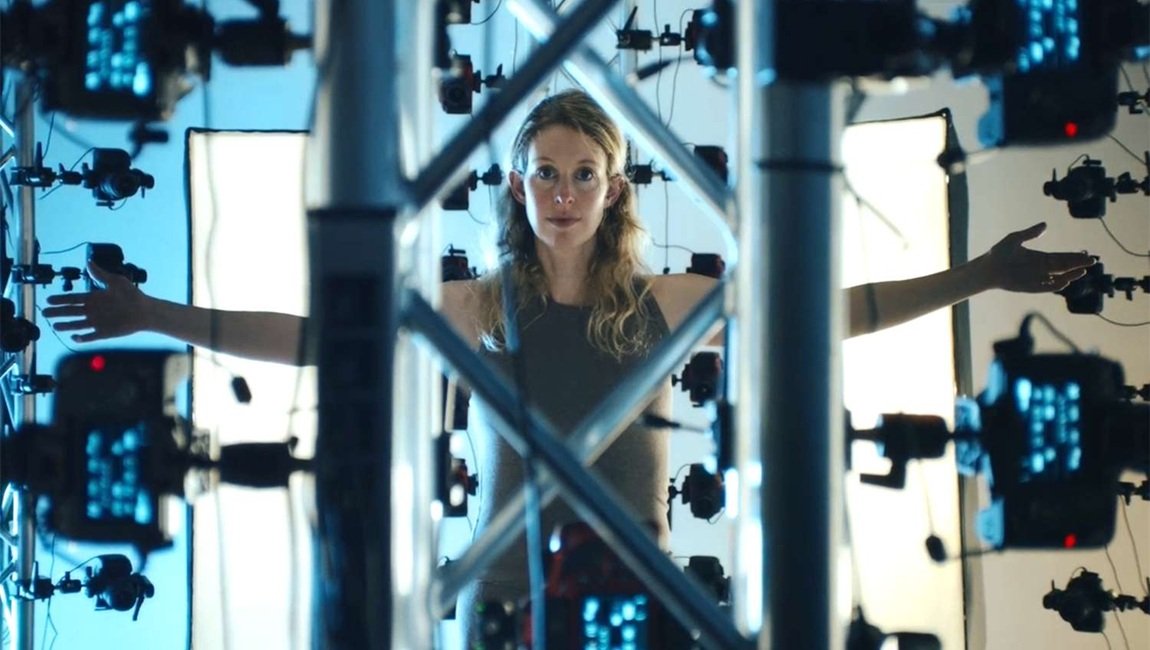
Holmes begins her sentence halfway through You Can See Everything’s epic runtime, leaving Fielder and Oppenheim only with Holmes’ sprawling, breathing legacy as its subject. And, of course, Evans. Before Holmes serves her time, she takes 360° photos of herself in service of an AI avatar that can continue communications while she’s incarcerated, the control of which lies exclusively with Evans. It’s a ghoulishly suspect interpretation — especially after reviewing Evans’ contributions to Holmes’s Twitter account — but one with a clear enough motive. Holmes was starting to believe her reputation and identity had spiraled beyond any means of salvation; earlier in the film, she paints Amanda Seyfried’s turn in The Dropout as cheap fiction that has metastasized into a public gospel.
Seyfried’s presence looms large (and literal) in You Can See Everything. The film’s first half is the closest thing Fielder has produced to a traditional documentary, and while he offers his trademark presence as emcee-cum-subject in himself, it’s shot and cut with Oppenheim at the helm. But Holmes’ exit — and Seyfried’s entrance — from and into the picture dig an uncanny valley that hits The Rehearsal creator like catnip. Absent the burden of his subject’s beguiling construction of character (and his beguiling, increasing affection for that character), Fielder breaks You Can See Everything into a study of the construction of character itself. It proves to be his opus. Fielder’s toolbox and hunger for metatext are familiar — there are notes of every bit of his work, from Jon Benjamin Has a Van through The Curse — though its assemblage here is singular. The details of You Can See Everything’s denouement are too rich to spoil on the page, but its footprint is seismic: Fielder peels back the layers of his film with the bloodthirst of a cenobite, the flesh of everyone from Evans and Seyfried to himself and his production company (a suspiciously game A24) left at the altar.
Even as Fielder cinches a deconstructionist masterpiece, he’s never quite able to get to the bottom of whether Holmes is being real with him. Before Holmes begins her time at a federal prison camp in Bryan, Texas, Fielder tries another path to illustrate why he just can’t buy her innocence. She maintains that she told the truth and that her words were misinterpreted; Fielder responds by showing her a clip of Abbott and Costello performing “Who’s on First?”
Holmes can’t seem to understand the joke. “She just thinks differently,” offers Evans. It’s a condescending mea culpa by proxy, but one that doubles as a sly reinforcement of Holmes’ character, performed or otherwise. It’s easy to imagine Evans repeating the phrase — a marketing touchstone from Holmes’ idol — throughout Holmes’ conviction and indictment, a defiant double-down on the Silicon Valley ethos that landed Holmes in this predicament to begin with. Holmes has lost her freedom, her fortune, and her reputation; somehow, even before modern media’s most effective puppeteer, her image and identity have floated back into her own palm.
DIRECTOR: Nathan Fielder & Lance Oppenheim; CAST: Elizabeth Holmes, Nathan Fielder, Billy Evans; DISTRIBUTOR: A24; IN THEATERS: October 16; RUNTIME: 2 hr. 54 min.
Comments are closed.