
The Hollywood biopic has a storied history, and a rather nasty reputation. The term itself seems to best communicate a lowest common denominator framework: a scrap of paint-by-numbers paper to trap lesser writers and directors on the one hand, and an invitation for formula-busting directors to transcend boundaries on the other. It’s why films like Oppenheimer or The Social Network, which by defintion might fit the genre, feel an entirely different species when sitting next to atrocious entries like Bohemian Rhapsody or 2026’s Michael. And it might be: there’s a fair argument to be made that the pop culture biopic of celebrity is a genre all to itself, one usually built on a foundation of hagiography and an innate forgiveness and/or admiration for a subject’s shortcomings. More than their auteur-driven cousins, then, these films are cursed (or blessed, depending on your perspective) to go the way of their performances. If your boomer dad is allowed to give input, Taron Egerton sells Rocketman pretty well, and while you might know it’s empty spectacle playing to the cheap seats, your dad isn’t exactly wrong.
But another factor in this biopic puzzle is the level of celebrity of the real-life figure being portrayed. It’s easy to critique Rami Malek’s performances as Freddie Mercury in the aforementioned Bohemian Rhapsody, in no small part because countless videos exist of the Queen frontman with which to compare Malek. So for a film like Elsinore, which details the story of Scottish actor Ian Charleson (Andrew Scott), there’s a bit of a built-in advantage. Charleson was certainly famous in his own right: the screen and stage actor performed at the National Theatre, where he was nominated for an Olivier Award for his performance in Fool for Love, and starred in the Best Picture-winning Chariots of Fire, but from the vantage of 2026, he’s far from a household name or recognizable face. But amidst his life’s work, perhaps his defining role was that of Hamlet, a character he played several times throughout his career, including his last run of performances at the National Theatre.
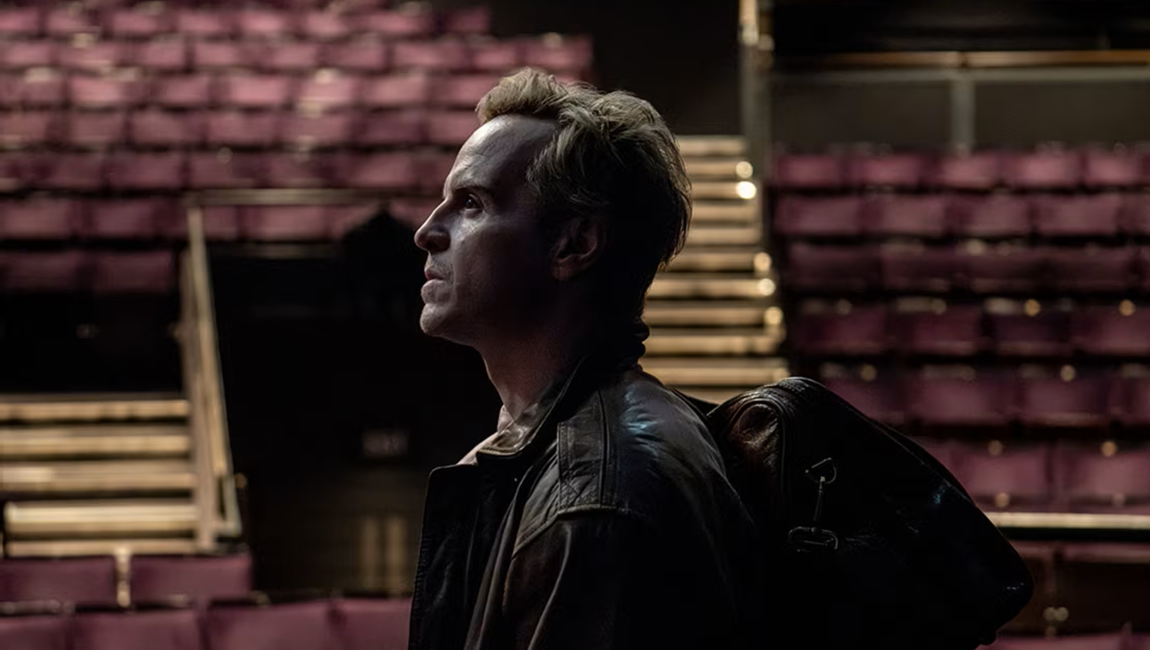
Given the absence of pop culture cachet that accompanies its portrait of Charleson, Elsinore takes on a distinctly different flavor of celebrity biopic, and allows the the scales to tip more toward genuine performance than mimicry for Andrew Scott (known for his own Shakespeare performances), who delivers a suitably stellar performance as Charleson. Elsinore begins in the late 1980s, a few years after Charleson was diagnosed with HIV. He’s auditioning for crummy roles to get by when he is chosen to play Hamlet in the National Theatre’s production of the play (a replacement for Daniel Day-Lewis, who abandoned the production in the middle of a performance). Around the same time, Charleson’s virus progressed into AIDS, and his ability to continue with his dream job came into question. One can see Scott’s personal experience with Hamlet working overtime here to bring his version of the Scottish actor to life, his intimacy with the role translating movingly to Charleson’s pained and deeply interior performance. In rehearsals for the play, fellow cast members are in awe of Charleson’s method, and the collapsed boundaries director Simon Stone illuminates, the extra- and meta-textual forces at play in the soliloquies and monologues delivered by Scott as Charleson, add an extra charge to these sequences. But Scott is equally impactful off the stage: during the endless medical appointments and hospital stays required by treatment, he affectingly reflects the turmoil of Charleson’s experiences. At one point, Charleson must reveal his sexuality and imminent demise to his parents, and Scott poignantly moves through the scene with vulnerability and tenderness, achieving an entire range of emotions in a brief few minutes.
Outside of Scott’s genuinely touching work, however, Elsinore — like many a biopic before it — finds little else to chew on. Few of the film’s supporting actors are given much to do: that’s especially true of Olivia Colman, whose Dr. Margaret Johnson is one-note and dull. Billie Piper, playing casting director and Charleson’s friend Patsy Pollock, is given the most to work with, but there still isn’t enough meat here to help the character transcend beyond the supportive friend archetype. The film’s structure is also left wanting: endless montages do little to engage on their own, functioning mostly as connective tissue that moves the narrative from point to point. And while the theatre scenes are richly rendered, lackluster set design and camerawork plague the film any time we leave the playhouse, disrupting any aesthetic coherence and staunching what momentum builds during these scenes. Scott is almost certain to be nominated for an Academy Award for his work in Elsinore, and considered in a vaccum it’s perhaps a fair laurel to bestow. But it’s disappointing that his strong work wasn’t given a more artful film to flourish within, and that by and large Elsinore is just another tickmark in the ledger of great performances in biopics unworthy of them.
DIRECTOR: Simon Stone; CAST: Andrew Scott, Olivia Colman, Billie Piper, Johnny Flynn, Luke Thompson; DISTRIBUTOR: Focus Features; IN THEATERS: November 20; RUNTIME: 1 hr. 51 min.
Comments are closed.