
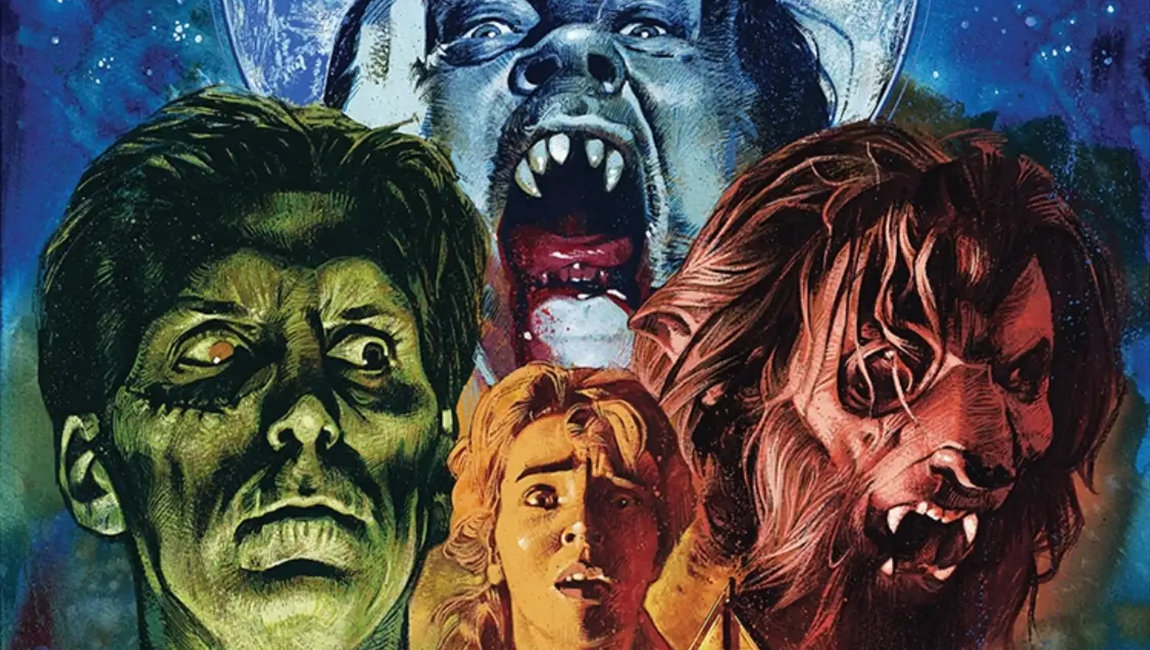
Larry Fessenden has been delicately orchestrating his ersatz Universal Monsters vision for almost 20 years now. His self-starring Gen-X Dracula fable Habit premiered in 1996, introducing audiences to his talky, often pervertedly comic vision of the horror film, both as cultural object and self-intervention. His project continued with Depraved, a moody Frankenstein melodrama and definitely the most personal film Fessenden does not star in, and Blackout, an upstate New York wolf-man pastiche. Where the studios have failed to resuscitate Carl Laemmle’s foundational cycle of the American gothic, the indies have succeeded, at least nominally.
And so comes the series’ head: Trauma or, Monsters All. If you’ve kept up with Fessenden’s work — and more broadly, the “mumble-gore” genre — the prospect of a creature feature monster-mash is about as exciting as it is befuddling. Mumblecore, in any genre, presents itself as a marriage of economic necessity and cinema verite observations. It’s a normal movie with the air left in. With horror, such as in Adam Wingard’s You’re Next or the long-running V/H/S series, it elaborates a kind of bait-and-switch: on the one hand, takes are long, drawn-out, and talky, often comic and awkward, hypothetically distancing the audience. But that distance from the cinematic results in a proximity to the “real.” So when the gore does arrive, it is less than drama to the audience, and aligned with lived experience. It works well for Wingard, whose villains are mostly serial killers and rapists, those figures entrenched firmly in the realm of everyday abomination, but Fessenden does not seek to dampen the mythological aspects of his creatures. “My movies have this weird quality…” he reflected after the film’s Fantasia screening. “They’re fairly contemplative, so I don’t get that fun jolt of everybody cheering when someone’s head is cut off. No one is sad when their characters die.”
At first, this seems an admission of failure. What’s horror when all the stakes are gone? It’s difficult to picture a Fantasia audience, still reeling from the newest Blumhouse shockfest, walking into Trauma and coming out with any opinion other than “those hicks upstate really do like to talk.” But Fessenden’s slow conversational trudging-along is in fact where much of his genre literacy shines through. If you’ve seen House of Dracula, Frankenstein Meets the Wolfman, or any of the later installments in the Universal Horror catalog, you will know that much of their runtime is comprised of medium shots of two men spouting nonsense-philosophy at each other over a table of bubbling beakers and chintzy med-school skeletons. The “meets” in Frankenstein Meets the Wolfman is a mostly unfulfilled promise, up until the final 30 seconds, when the awaited battle is thwarted before it begins by a chemical explosion in a cardboard castle.
The real pleasure, then, in both Fessenden’s films and Universal’s, lies in the ordinary. Cassandra (Laetitia Holland) arrives in “Talbot Falls,” a backwater town where rumors of werewolves, Frankensteins, and more flit in and out of public gossip in guarded scrutiny. Though heavily involved in completing a new biography of George Washington Carver, Cassandra finds the barely-hidden drama outside her window, where Charly the wolf-man (Alex Hunt) and Adam the prometheus (Alex Breaux) attempt to manage their respective conditions in homosocial seclusion. She writes an ill-timed article for the local paper about the tragedies haunting the town’s past and present, and earns herself a pariahhood equal to that of the monsters.
The film’s drama unfolds sleepily, in a kind of rural haze of time folding in on itself. Fessenden tries to build a dialogue around the nature of the “outsider” figure, from Mary Shelley to George Washington Carver, and the forces that compel one to choose an identity for themselves. Characteristically, much of these conversations occur in dimly lit, sparsely populated drawing rooms where faux-gothic tchotchkes are thrown around like remnants of an ill-fated Halloween party. Also characteristically, these questions are never very interesting. Fessenden is an ex-hippie and, likewise, treats his major subjects as a metaphysical headache from which art can be a kind of salve, but never an answer. He looms above the politics of his work much like his own character Sam the Vampire does his mortal counterparts’ petty problems. Those looking for incisive critiques of “the times” best look elsewhere.
But Trauma is not less successful for its iniquities in the philosophical realm. In fact, they bring Fessenden closer to his source texts than ever. The later Universal Monsters dripped with Curt Siodmak’s boisterous nonsense prose, often flitting about among topics of death, slavery, decadence, and class disparity, but as a hummingbird might manically speed about a flower for a fraction of a second. What is entrancing in these films, then, is the incantatory nature of their delivery. Siodmak, and other writers in his cohort, writes dialogue that melts into scenery; bereft of their narrative purpose, they become a fleshy pulp of hypnotic sound, delivered in strange, sleepy voices, at the edge of a trembling crypt. Fessenden realizes how little separates these films from the average mumblecore comedy, and though Trauma’s dialogue is less concerned with gothic mysticism than House of Dracula’s, the effect is largely the same: massive blocks of considered text inundate the viewer, all while a deep sadness prevails just underneath, one all the more affecting as experienced through the haze of a trance. No wonder audiences don’t “cheer” at Fessenden’s movies! They are all trapped in the same melancholic stupor, like a fly in the spider’s web.
DIRECTOR: Larry Fessenden; CAST: Laetitia Hollard, Aitana Doyle, Addison Timlin, Alex Hurt, Larry Fessenden, Barbara Crampton; IN THEATERS: November 4; DISTRIBUTOR: Dark Sky Films; RUNTIME: ddd
Comments are closed.