
It was only in January 2026, a whole decade after Michał Marczak’s All These Sleepless Nights had premiered at Sundance, that I learned that a not insignificant number of people have taken Marczak’s ambient cult movie about a bunch of self-absorbed twentysomethings and their nocturnal roamings through Warsaw for a documentary. In fact, many do to this day. In that same instant, I also learned that the film — despite the filmmaker’s dismissal of the documentary label for his own films — had won Marczak the festival’s Best Director award in the “World Cinema Documentary” section. Just like a book becomes a novel by virtue of the editorial attribution on the book’s cover — or, often, beneath its title — a commercial film, whether through festival programming or marketing, sooner or later is sorted into the clusters of fiction or non-fiction — which, in the latter’s case, is to say “documentary.” Given the term’s centenary, it is worth remembering that it — though first as the attribute “documentary value” — was coined by the Scottish filmmaker and theorist John Grierson in his review of Robert Flaherty’s Moana (1926), a meticulously staged work of salvage ethnography. The term “documentary,” meanwhile, has stuck and causes problems to this day.
Years later, in a 1933 essay in Cinema Quarterly, Grierson added the still widely quoted and nearly all-encompassing definition according to which the documentary is the “creative treatment of actuality.” While this definition opens up audiences’ imagination of what a documentary might comprise, its lack of criteria — How “creative” may its treatment be? What is one to make of the elusive notion of “actuality”? — begs for ontological clarification. However, rather than getting lost in the description of the object, let us turn to an understanding of documentary as a mode of reception. Analogous to Jaimie Baron’s notion of the “archive effect” — the idea that a spectator encountering found images, shot at a different time or for a different purpose, recognizes their temporal and intentional disparity — one may speak of a “documentary effect,” which, before the first shot, sets in with the label itself. The viewer of a documentary, accordingly, would expect places and persons appearing on screen to have “authentic” off-screen counterparts, with the latter’s roles not fundamentally diverging from those assumed within the mise-en-scène.
It’s with this preface in mind that the following discussion of Michał Marczak’s Closure shall be understood, a film which emerged from a chance encounter between Marczak and his subject Daniel during location scouting for a feature film he had co-written with his wife Karolina. Whereas Marczak, at the time, sailed along the Vistula River with his wife and child, Daniel had already spent months alongside, on, and inside the water, in search of his son Krzysztof (“Chris”), who had disappeared one day without notice. There is CCTV footage of the final moments when the then-sixteen-year-old Chris was seen, standing by the edge of the bridge overlooking the northward currents of Poland’s longest river. As the camera rotated, it lost sight of its unintentional subject — seemingly forever. It is the same bridge onto which Daniel strides in the opening scene, a life-size dummy thrown over his shoulder. The audience, while not explicitly in on it, understands Daniel’s methodology soon enough — at the latest when the dummy splashes into the water and the attached camera momentarily submerges with it before trailing along, just like a real body might do. The reenactment in the present is to reveal the ways of the past.
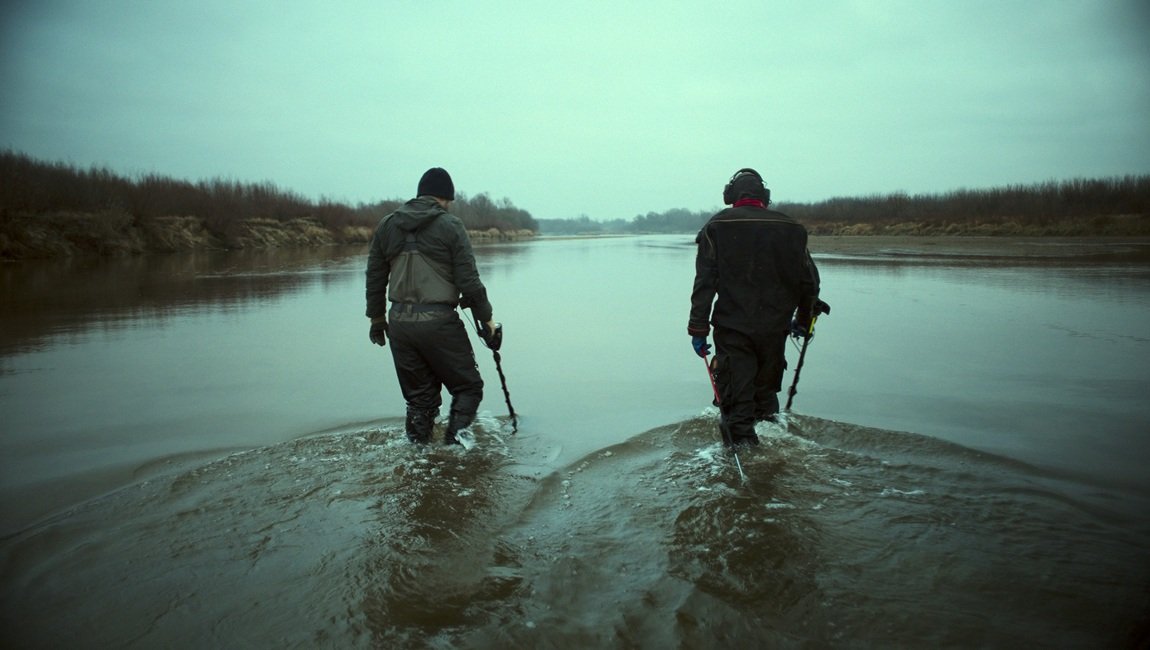
By the time the film begins, we are to understand, Daniel is already an expert in open-nature scouring. Equipped with tracking devices and detection systems, Daniel and a companion before long arrive in shallow waters out of which a body emerges. It is not Chris, but the corpse of an old man. It will not be the last time that Daniel’s search turns up another of the numerous bodies that disappear into the Vistula every year. If there is a hint of agitation to Daniel’s otherwise composed demeanor, it stems from the fact that the police boat that has just traversed these waters did not notice the dead man. “I hope the family finds out soon. So they can find closure,” Daniel says as he stares into the distance. As Marczak cuts away, a drone takes command of the scene, tilting from the bird’s eye perspective into a high-angle shot that surveys the river, its scattered islands, the surrounding woods, and a cityscape in the far distance. “Closure,” the emerging title card reads. This is where the “problems” begin.
These opening minutes suffice to acquaint us with the register of Marczak’s style, which, throughout, remains masterful yet clinical; an airtight aesthetics that in a work of fiction may go unnoticed but that, in a documentary, enmeshes those spectators who experience the “documentary effect” in an incessant inquiry into the director’s every choice. On this premise, even the most commonplace filmmaking decisions such as a reaction shot may impel the viewer to increased scrutiny. Does it imply that the subject — Daniel, in most cases — was shot with two cameras? Or were the two perspectives captured one after the other? And which preparations were necessary to record “plot-progressing” phone calls in such crisp quality? It may seem crude to consider this picture centered on personal loss and grief in such technical terms, but then again, there is an undeniable packaged quality to Marczak’s composition, built on pensive strings, camera-induced dialogue, and a persistent avoidance of stillness. This last aspect in particular suspends any sense of time, which seems all the more remarkable considering that by the end of the film, Daniel will have spent about two years on his quest for closure, often in solitude.
In the director’s note, Marczak states that “[t]he film begins by borrowing the tones of true crime, inviting the audience to wonder what happened. Then that expectation dissolves.” But given that no crime is suggested, why speak of it? Be that as it may, the “tones of true crime,” unfortunately, do not so easily dissolve. At one point, we, as the camera, lurk behind a column inside the house as we behold Daniel in a seemingly intimate conversation with his wife Agnieszka. Later, when another father learns about the fate of his child and, struck by a surge of grief, turns away from the camera, Marczak’s camera, bafflingly, follows him for a while before finally panning away. And then, not least, the staging commits the textbook Haneke violation by wringing suspense out of a resolution of a real-life death.
Customarily, hybrid films such as Closure are lauded simply for their hybridity, as if that were a quality in itself. Yet more often than not, Marczak’s formal flourishes prove limiting rather than expansive, strangely drawing attention to the film’s status as a film while neglecting the implications of its filmmaking for those involved. All the more precious are the few instances in which we see Daniel and Marczak himself interact, moments that hint at a much rawer and less varnished film than Closure has set out to be.
DIRECTOR: Michał Marczak; DISTRIBUTOR: 1-2 Special; IN THEATERS: October 28; RUNTIME: 1 hr. 46 min.
Comments are closed.