
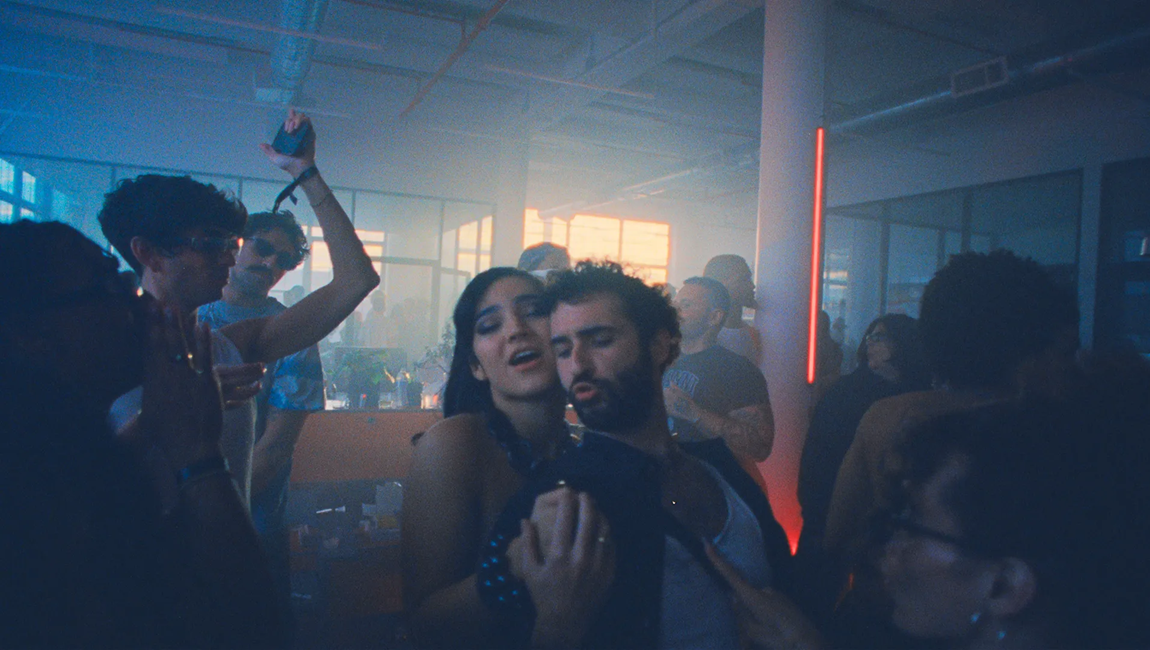
What’s the biggest mistake you’ve ever made on a night out? Those of us who’ve partaken in the odd intoxicating substance here or there might have a range of answers: accidental injury, getting into scraps, loss of ID, or the good old-fashioned loss of dignity. In Jordan Firstman’s Club Kid, Peter Green (Firstman himself) has an answer to trump the lot: a kid.
In the mid-2010s, Peter is a young gay man in Manhattan, planning and running club nights while also making the most of them as a clubber himself. On one otherwise usual night out with friends, a hookup takes him to the club’s dark room, and encourages him to do something he’s never done before — have sex with a woman. For Peter, high on MDMA and eager to please, the request represents less a risk than an adventure, and he obliges, before getting on with the rest of his long night of drugs and dancing. 10 years later, both the risk and the adventure catch up with him. A woman appears in his apartment with a child, Arlo (Reggie Absolom), explaining to the bewildered Peter that the kid is not only his but also his responsibility, as his mother, the dark room woman from a decade ago, has just died. Promptly, she absconds, leaving Peter with the unwanted fruits of a barely remembered labor, and an unforeseen obligation to fulfil.
Firstman works through a litany of familiar tropes with his late coming-of-age story here — there’s no shortage of movies about overgrown kids forced by some sudden imposition to mature, nor about adults learning how to be better people through the unexpected wisdom of their children. It’s the same old heartwarming tale he tells, albeit in less heartwarming terms. Club Kid is a movie of crass sexual humor and copious amounts of hard drug use, a portrait of gleeful, even problematic, irresponsibility that doesn’t soften any of the rough edges of the party life it depicts. As identifiable as many of its details may be to those who indulge in this life, though, it’s firmly a movie made for those who do not. Its use of drug lingo and references to gender identity have an educational quality, with proxy characters like the kid, or one partier’s straight cousin, employed as an excuse for providing contextual information about sex and drugs that seems to exist solely to make this world more understandable, if not more palatable, to those not already au fait with it.
As such, though Firstman portrays Peter’s lifestyle with admirable accuracy — he nails the vibe of dancing alone and high in a near-empty club late into the morning, and that of the wasted day of streaming and Grindr hookups following a big night — the comprehensive stream of detail illuminating it quickly starts to feel performative. All the standard signifiers of debauchery are present and correct, and even if he’s gently lambasting those who engage in it, he can’t seem to resist advertising that he’s one of them. Which is to say, Club Kid has a slight air of smugness about it, with Firstman’s urge to announce himself as one of the cool kids — hot, funny, friends with all the most vibrant personalities on the party scene, and unapologetic about his reckless behaviors — peeking through at times.
But this endorsement of the party lifestyle is also one of the movie’s most interesting aspects, since it innately chafes against the conservative direction of the staple narrative. Peter does learn from Arlo, does grow, and does change, and the changes made to him usher him toward a more conventional existence. Firstman doesn’t rework the clichés of the plot, and the wilder, more adult qualities of his approach to it don’t offset them. But he refuses to condemn Peter’s behavior, no matter how irresponsible it gets. Indeed, he infuses his depiction of this lifestyle with joy, and, toward the movie’s end, suggests that swapping this for a more conventional lifestyle of stability and maturity might just be a necessary step for survival rather than a positive step for self-improvement.
Peter is forced into taking this step through his interactions with Arlo; the self-improvement he experiences stems from the power of love and human connection, though Firstman’s focus on the father neglects reflection on what the son may also gain from this. Arlo is the perfect kid for Peter: infinitely open-minded, remarkably cultured, and seemingly untroubled by the traumas he’s apparently endured thus far in his short life. As a character, he works excellently for comedic and emotional effect, but less so for dramatic effect and believability. The viewer is encouraged to care less about him as a person than about the bond between him and his father.
But while this blind spot is one of several fundamental conceptual flaws in Club Kid, they sum of them is ultimately of curiously little importance. Firstman has terrific comic timing as a writer, director, and actor (both he and Absolom give fantastic performances), and his familiarity with his milieu lends itself to expressive, immersive detail. The film, as a result, is charming and convincing despite its weaknesses in design, and finally quite moving, even if you can clearly see the shortcuts it’s taken to achieve its effects. Like Peter and Arlo’s relationship, it’s not perfect, but it works, and that’s the most important thing.
DIRECTOR: Jordan Firstman; CAST: Jordan Firstman, Reggie Absolom, Cara Delevingne, Diego Calva, Kirby Howell-Baptiste; DISTRIBUTOR: A24; IN THEATERS: November 6; RUNTIME: 2 hr. 6 min.
Comments are closed.