
Let’s start with a bit of a digression. A couple of years after the movie came out in 2019, Quentin Tarantino wrote and published a “novelization” of his film Once Upon a Time… in Hollywood. It wasn’t a traditional novelization, however, in that it largely relegated the film’s narrative to stray paragraphs and mostly dispensed with its memorable finale. Instead, it focused mainly on the Cliff Booth character, sketching in huge chunks of his backstory as well as shedding light on his eclectic taste in movies. It also definitively answered a question left ambiguous in the movie: namely, “Did Cliff kill his wife?” As it happens, we learn the answer to that question is yes, along with more than a couple other folks (not counting his wartime experiences). Indeed, he nearly cut her in half with a speargun. The authorities believed it to be an accident, however, and her cause of death was listed as “mis-adventure.”
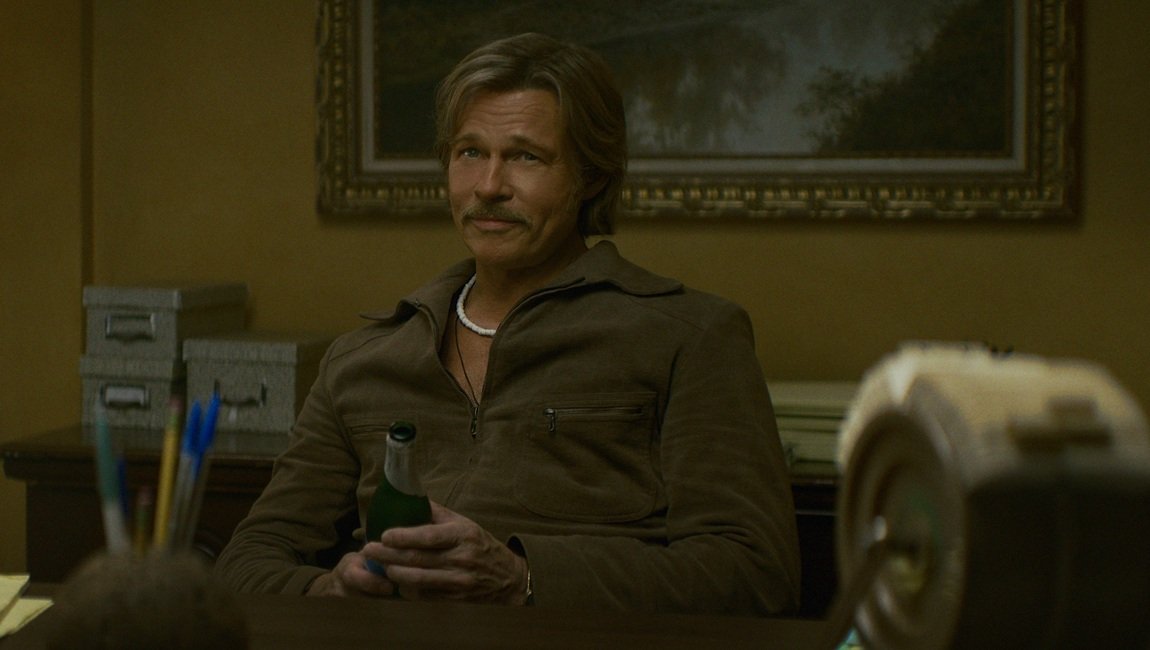
Which brings us to the matter at hand, The Further Mis-Adventures of Cliff Booth. This new film was written by Tarantino, but — presumably to avoid finally having to make good on his self-imposed pact to retire after his tenth movie — he handed the directing reins to David Fincher (whom he has claimed is his only true peer as a filmmaker). Set in 1977, the title is self-explanatory. Cliff (a returning Brad Pitt) mostly doesn’t work as a stuntman anymore, and Rick Dalton is nowhere to be found (we learn he has a successful western TV series in Australia). Instead, he lives with his crotchety dad Gus (Peter Weller) and has multiple other jobs: film projectionist (a Tyler Durden reference, perhaps?) at the New Bev, bartender in what appears to be several different establishments, demolition derby driver, and — most importantly — a fixer for wealthy clients. He’s also still perfectly happy to pull a trigger, something we learn in the film’s pretty delightful opening sequence.
Amidst all this, there’s a larger story that Mis-Adventures settles around. It involves Cliff helping out vain, boastful TV star Charlie Peters (Scott Caan), who famously does his own stunts. Cliff is recruited by Charlie’s business manager Karen Crosby (Elizabeth Debicki), with whom he is immediately smitten. Whatever Charlie’s into, it probably involves the Verdusco brothers (Matt Groove and JB Tadena), a pair of vicious Filipino gangsters introduced graphically murdering an entire family.
Mis-Adventures sets itself apart from Hollywood in a couple key ways. First, it’s somehow an even breezier hangout movie than its predecessor. Hollywood was organized around the idea that we were always heading to that fateful night on Cielo Drive, and Tarantino leveraged that sense of fate to give momentum and purpose to a story that might otherwise have felt shaggy. Mis-Adventures has no such fulcrum point, and so large — and extremely pleasurable — stretches go by in which you may forget that there are a pair of murderers lurking around up to no good. It’s inevitable that they will cross paths with Cliff, but in the interim we spend a great deal of time watching Cliff bartend or play tennis with Charlie. Thankfully, much of that side of the story involves Cliff’s burgeoning, strange romance with Karen (with another possible reference to Fight Club, which should remain unspoiled). Debicki is absolutely radiant and funny in the role, and watching her slowly become more and more charmed by Cliff is a genuine highlight in a film rich with them; it’s not a stretch to observe that she and Pitt have Burt Reynolds/Sally Field-level chemistry. For his part, Pitt knows this guy pretty well and lends charge to even the smallest of moments — there’s a reason he won an Oscar playing Cliff.
The other difference between the Tarantino and Fincher films is, surprisingly, the violence, which is particularly nasty here. Tarantino has always traded in shocking moments of grue, but they’ve become somewhat more cartoonish as his career has progressed. Compare the notorious ear-cutting in Reservoir Dogs to the bucket-sized squibs in The Hateful Eight and you’ll observe the general shift in his violence toward the frequently comedic. Fincher, however, has always had a penchant for relatively more grounded, sharp jabs. The aforementioned introduction of the villains is genuinely shocking, and subsequent incidents across the film’s runtime keep upping the ante. It’s worth remembering, too, that Cliff is essentially a monster — as Tarantino might say, a natural born killer. What sets him apart is merely that he has principles. The closest character analogue to him here might be John D. Macdonald’s Travis McGee, only if he’d also been a thrill-seeking maniac.
Perhaps most surprising in Mis-Adventures, however, is how successfully Fincher has molded his style to Tarantino’s script. He allows ample space for Q’s long-winded monologues — there’s a particularly great one here, in a fictional film called Soul Brothers Die Hard — and perfectly times the many digressive gags and flashbacks. The film also takes on a pretty rambunctious quality for a guy who’s become increasingly known as an icy formalist. Several montages — particularly one involving mud wrestling and another featuring Karen appearing in photos of a movie premiere — even recall Fincher’s early music video work. What’s mostly missing from him is Tarantino’s nostalgia. This isn’t a love letter to his youth and it’s not wistful about a different era of filmmaking. Rather, The Further Mis-Adventures of Cliff Booth is a lightning bolt, a seedy thriller-comedy without a thought in its head but to thrill.
DIRECTOR: David Fincher; CAST: Brad Pitt, Elizabeth Debicki, Scott Caan, Yahya Abdul-Mateen II, Carla Gugino, Peter Weller; DISTRIBUTOR: Netflix; IN THEATERS: November 25; STREAMING: December 23; RUNTIME: fff
Comments are closed.