
The first entry of Rainer Werner Fassbinder’s BRD Trilogy and one of the last titles he made in the 1970s, the decade he’d defined with over 30 films, The Marriage of Maria Braun (1979) did not begin auspiciously. It was one of the director’s most disastrously cocaine-fueled productions, as he struggled to balance shooting it and his Berlin Alexanderplatz miniseries simultaneously while fighting with his producers — who were paying for the cocaine out of the budget — over how it had been financed, all while he was personally reeling from the then-poor reception to the formalist swings of Chinese Roulette and Despair. The first and last scenes of Marriage, the two most expensive, were shot after Fassbinder had obtained an injunction against his producers and fired most of the crew, then returned to Berlin to shoot them and complete the editing. Always an artist capable of overcoming his personal demons through the quality of the work, Fassbinder’s private screening of an answer print of the film pleased his producers so much that they paid off all the debts he’d incurred and began treating it as a potential commercial success to be pushed. The gamble paid off: despite Fassbinder having to settle for Best Actress and an artistic achievement award rather than the Golden Bear at that year’s Berlin Film Festival, The Marriage of Maria Braun was a critical and commercial smash in West Germany, and broke records as the highest-grossing German film in the United States. It’s as cynical as any other Fassbinder, but some films have so much clarity about the way things are that they never stop having appeal.
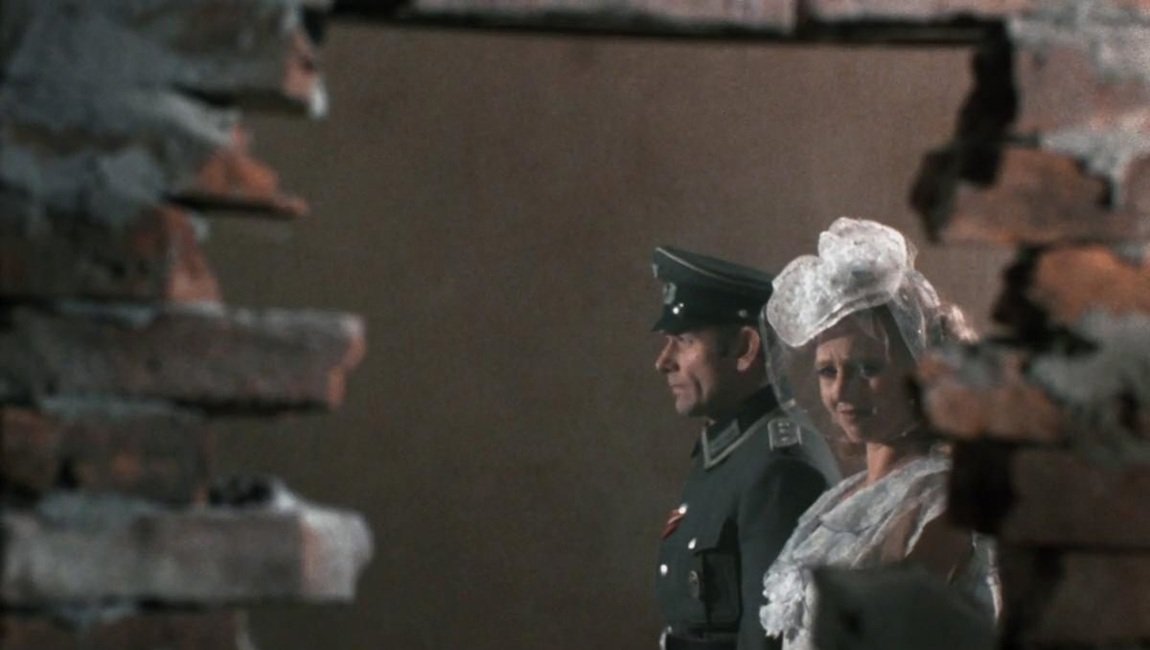
No discussion of The Marriage of Maria Braun is complete without discussing Hanna Schygulla in the titular role, a performance clearly meant to recall Marlene Dietrich’s work for Josef von Sternberg but with the sexual energy warped into a desire for money somewhere between lust and desperation. (Previously one of his regulars, she had taken several years away from working for Fassbinder after numerous fights on the set of Effi Briest, several of which were about the underpaying of the cast and crew.) Germany’s postwar economic miracle and what it took to survive its cruelties, forever the defining theme of the Fassbinder corpus, finds itself forever hanging above the head of Maria Braun thanks to the explosive marriage that kicks things off. Fassbinder’s fight for the money to film this opening was the result of setting it in an Allied bombing raid, featuring Hitler’s portrait blasted to smithereens. Maria Berger marries Hermann Braun under fire and takes his surname, but the marriage only lasts “half a day and a long night” when he heads off to the front and is presumably killed. She begs, barters, and steals to get through the war days, but she tries to avoid sex work despite her dependent mother’s hints that she approves of Maria going even further to keep them financially afloat — she’s poor, but she’s emancipated. Her subsequent relationship with an African-American G.I. named Bill is initially rooted in getting financial support for the Berger side of her family, but a genuine feeling pokes through her grieving, and Hermann dramatically returns from a Soviet POW camp in the middle of the two having sex.
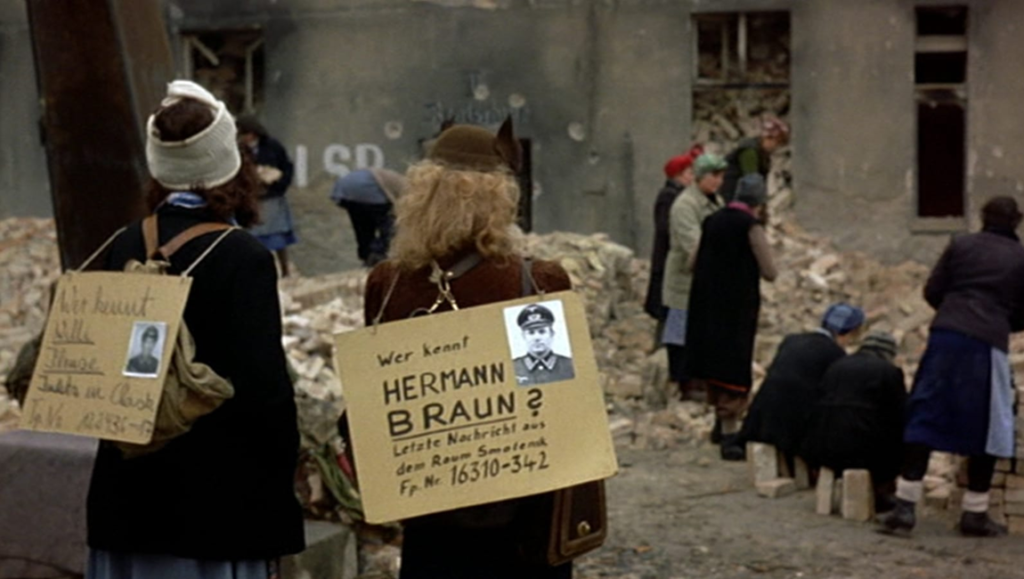 The ugly aftermath, a fight between the two men that Maria stops with a fatal bottle to Bill’s head, leads to Hermann re-imprisoned when he takes the fall for Maria and serves as the first sign of just how unflinching a character Maria has become in her navigation of the new rules. Fassbinder may have actively aimed to make something closer to something like his beloved Douglas Sirk’s Hollywood melodramas in Germany with Marriage, but his love for Robert Bresson and particularly the soundscape of The Devil, Probably’s capitalist hell forever peeked through the sound design of his later works. One of the key sounds of Maria Braun’s collage of radio broadcasts, pop songs, and construction noises against dialogue is a report from Konrad Adenauer citing that there are 160 women for every 100 men in Germany — an abundance of brides and prostitutes, not enough providers. Maria Braun plays the former role to become the latter, serving as the personal advisor to carpetbagging textile industrialist Karl Oswald via careful seduction and planning to build a house and a life for herself and Hermann when he gets out of prison. One sacrifice will beget another.
If Maria were a mother (Fassbinder near-literally aborts that possibility alongside Bill), her ruthlessness and willingness to use her sexual wiles to get to the top of the business world might skew more admirable or toward more conventional melodrama, but she’s closer to a femme fatale with genuine passions, and she knows it. “Reality lags behind my consciousness,” as she puts it, and her perpetual eyes-on-the-prize attitude toward her potential life with Hermann shoots her to the top of Oswald’s business as she conducts a particularly mercenary affair with him. Still, her consciousness didn’t factor in the reality that the affair would result in an increasingly distant Hermann departing for Canada after his release from prison, promising to reunite with her eventually. West Germany has now been rebuilt and rearmed, the men are back in control, and the women are now expected to go back to their old roles. Hermann’s departure results in an increasingly hostile Maria lashing out at everyone in her path — the hired help and coworkers whom she sees herself as above, the family that’s been leeching off her since the war years, and Oswald, forever being above her even when he’s dying. When Oswald’s will subsequently reveals that he’d left half his estate to Hermann as a deal for letting him spend his last years with Maria before Hermann could return, it’s the final signal that she’s lost all control, and she takes the action needed to promptly regain it. (She’s hardly alone in making a critical grab for victory — the climax is accompanied by Germany winning the 1954 World Cup on the radio and being declared world champion.) One more house explosion, one last look at the blown-up portraits of the German leaders: The Marriage of Maria Braun has come to an end, finally with both its parties on equal terms.
Comments are closed.