

Sometimes all you want out of a movie is a really, really huge guy tearing smaller guys apart with his bare hands. Alan Ritchson has been giving us these base pleasures for three, going on four seasons in Amazon’s wonderful Reacher series. There, a giant of a man who just wants to be left alone finds himself in increasingly violent situations where the only way out is to pummel hordes of nameless, faceless goons. It’s a tried-and-true formula and one that Motor City transposes into cinema, albeit with one wrinkle: they’ve stripped out all of that pesky dialogue.
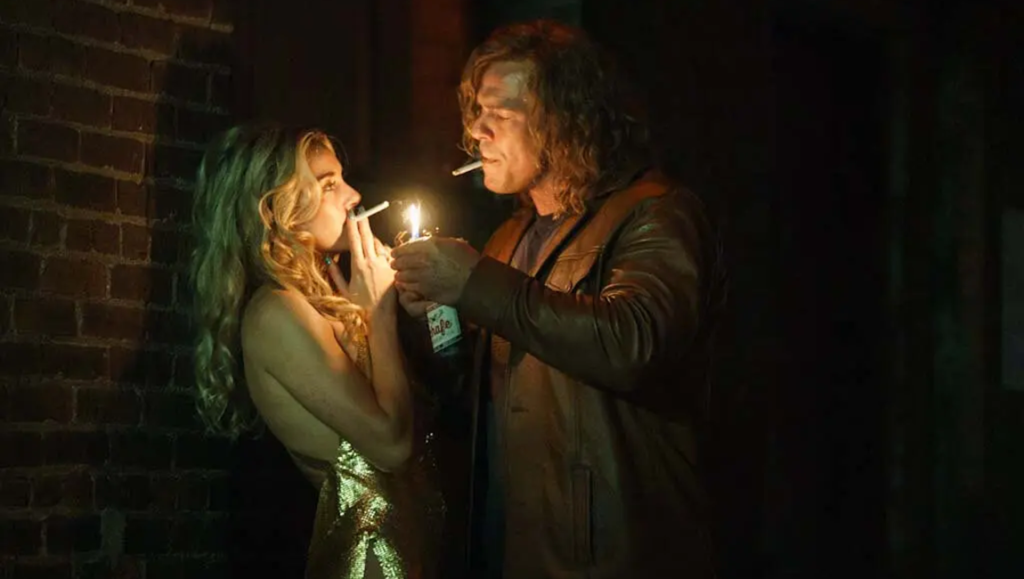
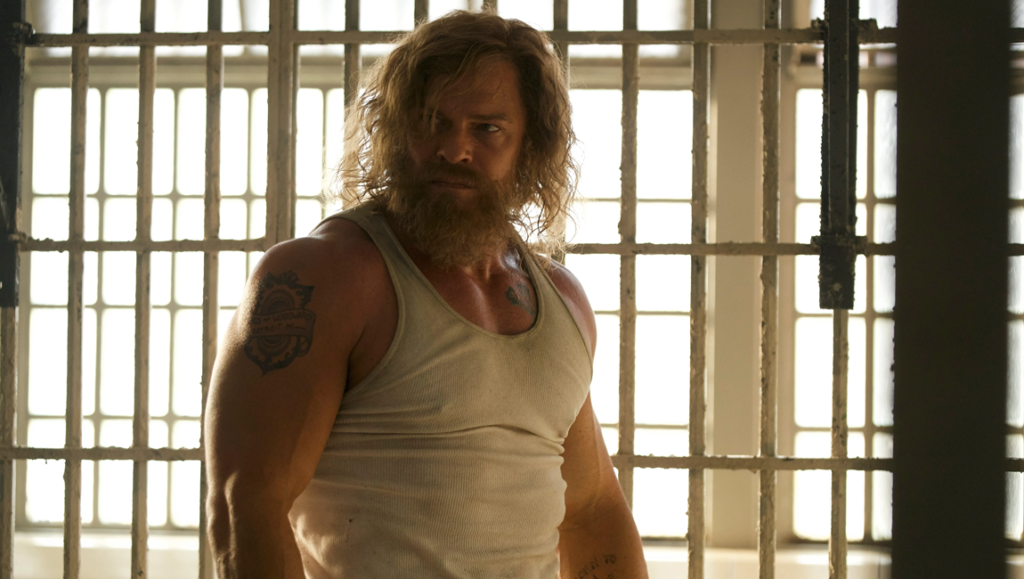
From a script by Chad St. John that’s been floating around the fabled Black List for almost two decades, Motor City follows John Miller (Ritchson), who is framed for a crime he didn’t commit right after proposing to the love of his life, Sophia (Shailene Woodley). Orchestrated by her previous boyfriend, Reynolds (a skeevy Ben Foster), the plan sends the man to prison while his new fiancée leaves him in disgust, returning to her ex. From there, you know the drill: John breaks out of prison intent on righting the wrongs laid against him.
There’s not much here that screams “originality,” but it’s the silent conceit of the film that landed it on the Black List all of those years ago. Motor City, having gone through many previous directors and stars, finally settled on Ritchson and director Potsy Ponciroli (Old Henry). Set to the sounds of the ‘70s, Ponciroli lets the songs guide you through the violence, one fist at a time. It’s a fun jaunt with an absolute barn burner of a climactic elevator fight between Ritchson and the ever-reliable Pablo Schreiber. Again, nothing better than two hosses knocking each other around.
As Motor City hits theaters, I sat down with Ponciroli to discuss the film, stripping away dialogue, and the challenges of a “silent” film.
Brandon Streussnig: Motor City went through many permutations on its way to you. I know many different names have been attached to this script over the years. Was its conceit to always be dialogue-free?
Potsy Ponciroli: Yes. This script was written by Chad St. John, I want to say back in ‘08. It made the Black List and had a billion people attached to it at different periods. Chad wrote the most amazing 86-page script. It’s so detailed. The way he built the world and explored the city and the characters from day one was wordless. It’s not a silent movie; it’s a movie with no dialogue. He wrote that into the core of this thing, and the first time you read it, you can’t put it down. You’re just brought into this universe, and it’s amazing.
BS: What are the challenges of being wordless? I imagine it might, in some ways, relieve the stress of having the actors perform their lines again and again.
PP: I mean, look, this is how movies started back in the day. Silent movies. Before that, we had plays without dialogue. Since then, I’ve gone through every script I’ve read and erased half the dialogue because there’s so much exposition, so much restating the plot, and so much getting people there. I don’t want to say it dumbs it down, but in a way, it does so that people can watch quickly and grab the pieces. This was written so well, and it explores a familiar story in a new way.
When I first read it, I thought there were two scenes that really stood out as potentially difficult. I was like, “Ah, these might be a problem.” Every other scene had a way around it so we could film it in a way that would work, but there were two scenes we really had to pay attention to. One was the proposal, and one was the scene with Shailene and Ben McKenzie in the cafe. The cafe really bumped me. We started exploring location scouting and found this place. That’s where the idea of the piano player came from, and seeing it from his side, that sort of evolved and made that scene work. Then the proposal was basically: how do you find that moment when you have to say, “Will you marry me?” The idea of, okay, in this moment, there’s so much pressure and excitement, and could you be speechless? How do you sell that in a subtle way? So it was tons of conversations with the actors. It was having amazing actors on set and really just having the time to play and explore these moments.
BB: I want to get to the actors, but you mentioned the piano player. How did that cameo come about?
PP: We talked to Jack White early on. He’s from Detroit; his music is from there. He knows that music culture; he knows the progression of music throughout the decades, and getting his input and collaboration on all things Detroit was important. How do we really hold true to Detroit and make something a Detroiter would be proud of? We had talked to him about that in general. Does he want to write something for the movie? Does he want to just collaborate on ideas for songs and things like that? So we threw out the idea, “Do you want to be in it? Do you want a cameo?” He jumped at it. Went through hair and makeup, found an amazing tux with these frilly edges. He was great. He actually played in the restaurant that day.
BS: Going back to the cast, I know Alan Ritchson was on board before you, but how did the rest of the cast come about?
PP: Yeah, when I came on, Alan was already part of it. Going down the list, the first person I called was Shailene Woodley. I was actually developing another project with her. So I called her at 8:00 PM on a Saturday and said, “I have this movie. It’s ’70s Detroit. There’s no dialogue.” She’s like, “I’ll read it right away.” I think she called me back at 10:30. She’s like, “Please let me do this movie.” What we found was that the actors were just up for it. It’s such a challenge to do a movie with no words. I mean, actors were jumping at it. I met with Ben Foster. He read it. We met for lunch. He spent half the lunch standing up on the other side of the table, acting out scenes because he was so excited about it. We got it to Pablo Schreiber. He jumped on it. Amazing human. The best karaoke person I’ve ever met in my life.
We filmed in New Jersey, but we were all prepping out of New York. Pablo organized a karaoke night, and he stands there with the karaoke machine in his hand, the iPad, picking songs as we go, and he’ll sing with you on every song. I never met a person more excited about karaoke than Pablo. It was just such a great cast and great crew, and everyone really bonded and went through this thing together. It was great. It was a lot of fun.
BS: I want to stick with Pablo because Den of Thieves is one of my favorite movies and he’s incredible in it. I think action fans will go into this, see him and Alan, and rightfully expect a brutal fight between the two. You deliver on that and then some. Tell me about putting that elevator fight together.
PP: Alan and Ryan Tarran, our stunt choreographer, have such a shorthand because they’ve done this for years. So they came with so many ideas, and so much thought about the type of action they wanted to do. We had a lot of conversations. One of them was “How do we shoot it?” Because I think they’re used to smaller cameras and putting it up inside the fight, and it didn’t fit the language of our film. So we got our camera operator to take his rig, and we put him into the fight choreography and had him learn the movements. It was such a great collaboration, and so much fun to get in there, learn the language of it together, and really build this thing out.
I learned a ton from Alan and Ryan because those guys live and breathe these stunts and this fighting style. For the elevator fight, I think we were going to have three days to shoot it, but we ended up with one. We built two elevators with removable walls, and we would literally leapfrog from one to the next all day long. Pablo is a massive man, and Alan is even bigger, but the two of them together in this confined space, it’s really fun. I think everyone went home just exhausted and beat up, not as much as they were, but it was a great day of shooting.
BS: There are certainly elements of action to your film Old Henry, but having learned so much more about action on this one, what excites you about it?
PP: Those are the days you really get excited about because it’s fun. We had car stunts and rooftop stunts. Sometimes our second unit would have to go shoot some stuff, and we joked that their stuff was way more fun. They get to do the cool stuff. A lot of this we kept on our unit, though, like the elevator fight. It was just because we had time on the schedule, and we really wanted to be there, be a part of it, and work through it.
BS: The soundtrack is full of ‘70s classics. You have a ton of standards, songs that people will definitely recognize, but you also throw in some deep cuts. What was the process of picking the right songs?
PP: Joe Galdo is my editor, and he was relentless in just trying a million songs. There were a couple of songs we had picked up before we started shooting, like “Nights in White Satin” for the prison break. That was one that was in there from the beginning, and I kept playing it in my office. I actually did a paper cut of it and edited it on paper from 18 seconds through 26 seconds so we could see the entire progression of the escape. It would end in the crescendo, and it hit perfectly. That was one that was there from the beginning. I had to have that song. The rest of them were really just trial and error in the edit. I’d go home for the day, and Joe would spend four hours that night trying 30 songs, 40 songs, and then I’d get in the next day and be like, “Check this out.”
“The Chain” was one of those where we’d already edited the scene with Alan getting arrested, and we plugged it in, and it hit just magically in moments; it would pause, or it would take a break. When his head hits the ground, we actually added a little pause in there on the edit, but it hit right on that beat. Sometimes you get those happy accidents where it’s like, “Oh, it has to be this song now.” Then the process of clearing it becomes a bigger issue because you might not be able to afford something. We got really lucky with this. We had great producers who fought for that. My business partner worked as our music supervisor and helped clear some of the songs. So it was just such a great team to get us these memorable, big songs in there, and also some others that were a little more obscure but fit the world and the time.
BS: Back toward the start of our conversation, you mentioned that you’ve been cutting out dialogue from every script you’re sent now. Is your next move going fully dialogue-free?
PP: There’s a couple of lines in here, but they weren’t anything to move the plot forward. I think it’s “I love you. I loved her, and I still do.” Then the rest of them, I think somebody says, “What the fuck, man?” So nothing pushes the plot forward. We joked that if this is successful, we’re doing an ’80s version five years later with Ben and Alan in Miami with even fewer words. All new songs from the ‘80s, too.
Comments are closed.